
 English
 Arabic
Key Takeaways
- Any fill material lighter than water will experience buoyancy uplift — without exception: Archimedes’ Principle applies to construction materials just as it does to any submerged object. A fill with density below 1,000 kg/m³ will generate uplift forces when submerged, regardless of how it is anchored or loaded above.
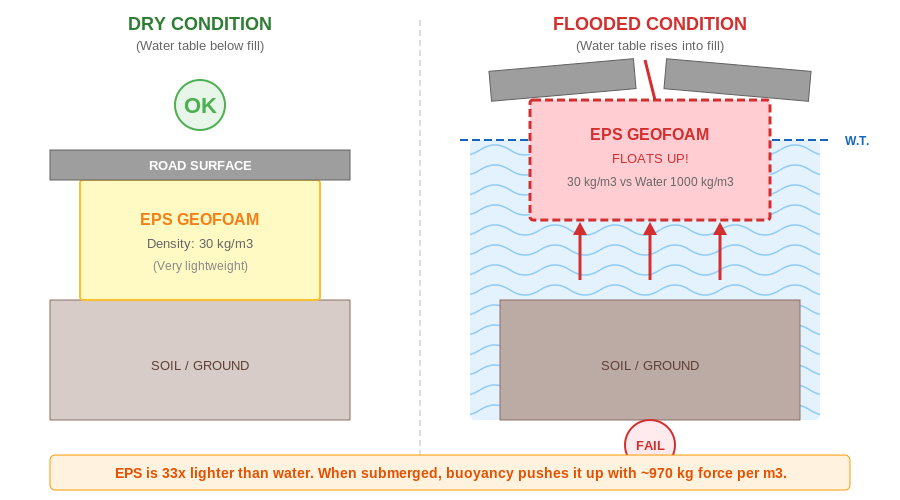
- EPS geofoam at 15–30 kg/m³ generates catastrophic uplift forces: One cubic metre of EPS submerged in water generates approximately 970 kg of uplift force against only 30 kg of self-weight — a ratio of 32 times. This risk has caused documented infrastructure failures in Norway and the United States.
- LIGHTHERM Drymix 250 at 250 kg/m³ is also unsuitable for water-contact applications: At less than one quarter of water density, LIGHTHERM Drymix 250 will float if submerged. It is not the correct product for pool decks, basement slabs, or any zone that may encounter groundwater.
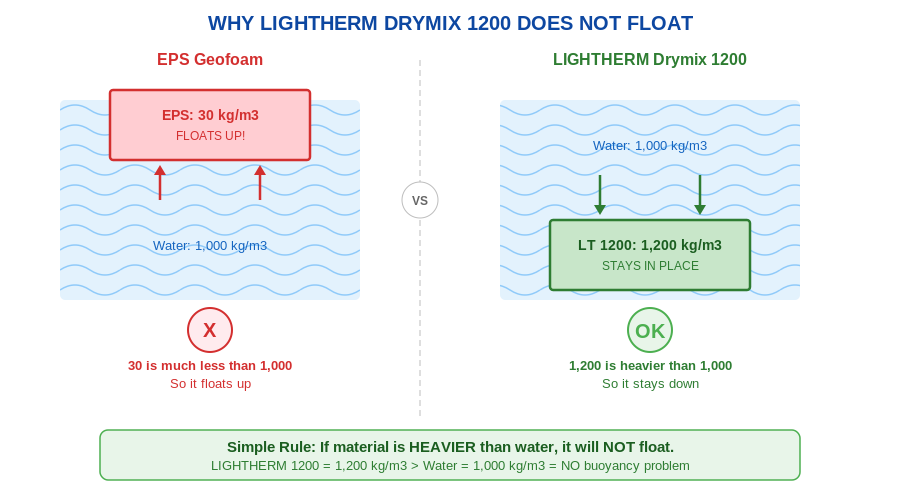
- LIGHTHERM Drymix 1200 at 1,200 kg/m³ exceeds water density — inherent FOS 1.20: With a cast density of 1,200 kg/m³, LIGHTHERM Drymix 1200 is denser than water and will not float under any submersion condition. No mechanical anchorage is required. The factor of safety against uplift is 1.20.
- Validated at Robertson Blue Condominium SPA pool, Singapore: LIGHTHERM Drymix 1200 was cast in-situ around embedded pipes, junction boxes, and mechanical services in a live water retaining structure — delivering 50% dead load reduction compared to normal concrete while remaining inherently buoyancy-safe.
Introduction
Lightweight fill materials have become a standard tool for reducing dead load in construction — particularly in renovation and retrofit projects where the existing structure has limited residual capacity. The benefits are real: lower self-weight means smaller beams, fewer strengthening works, and a more efficient structural design overall.
However, one critical engineering risk is frequently overlooked in the specification process: what happens when that lightweight fill comes into contact with water? In pool decks, basement slabs, water features, and any structure near Singapore’s high water table, the answer can be catastrophic. The physics of buoyancy do not make exceptions for construction materials.
The Physics of Buoyancy in Construction Fill
Archimedes’ Principle establishes that any object submerged in a fluid experiences an upward force equal to the weight of fluid it displaces. For construction fill materials, this translates to a straightforward rule: if the fill density is lower than the surrounding water density (1,000 kg/m³), the fill will push upward against the structure above it.
The net uplift force on any submerged fill is calculated as:
F(uplift) = [ρ(water) − ρ(fill)] × V × g
Net uplift occurs when ρ(fill) < ρ(water) = 1,000 kg/m³
To understand the scale of the problem, consider one cubic metre of EPS geofoam at a typical density of 30 kg/m³, fully submerged in water:
- Buoyancy uplift force: (1,000 − 30) × 1 × 9.81 = 9,515 N = approximately 970 kg of upward force
- Self-weight of the EPS: 30 × 1 × 9.81 = 294 N = 30 kg downward
- Net uplift ratio: 970 ÷ 30 = 32 times its own weight pushing upward
Every cubic metre of submerged EPS geofoam generates close to one tonne of uplift force. In a large floor slab or pool deck where many cubic metres are used, the total uplift load can easily exceed the combined weight of the structure above — with potentially catastrophic consequences.
Documented Failures: The Risk Is Not Theoretical
Buoyancy-related failure in EPS geofoam is not a hypothetical design concern. Multiple infrastructure projects have experienced significant failures as a direct consequence of EPS encountering water.
Norway E6 Highway, Vestby (2016)
During construction of a road embankment on the E6 highway near Vestby, Norway, non-flame-retardant EPS geofoam blocks ignited during the works. The fire consumed the entire geofoam fill section, resulting in total loss of the embankment material and major programme delays. This incident, documented by the Norwegian Public Roads Administration (Statens vegvesen), highlighted both the combustibility risk and the buoyancy vulnerability inherent in low-density EPS fill.
Buffalo Road Bridge, USA (2002)
In February 2002, EPS geofoam fill placed behind the abutment of the Buffalo Road Bridge in the United States became fully submerged during a flooding event. The buoyancy forces generated by the low-density EPS blocks caused differential movement in the bridge approach, requiring emergency structural remediation. This case is documented in the academic paper “Lessons Learned from Failures Involving Geofoam in Roads and Embankments”, published on ResearchGate.
Singapore Context
Singapore’s combination of high water table, intensive rainfall, and extensive basement construction makes buoyancy a particularly relevant design consideration locally. Basement structures, pool decks, water features, and underground utility zones routinely encounter saturated soil conditions. EPS geofoam at densities of 15–30 kg/m³ is fundamentally unsuitable for any of these applications without extensive mechanical anchorage systems — which add cost, complexity, and long-term maintenance risk.
LIGHTHERM Drymix 1200: Inherently Buoyancy-Safe
LIGHTHERM Drymix 1200 has a cast density of 1,200 kg/m³ — exceeding the density of water at 1,000 kg/m³. This single material property eliminates the buoyancy risk entirely. A material denser than the fluid it is submerged in will not float, regardless of the volume used or the duration of submersion.
The anti-buoyancy verification is straightforward:
- Material density: 1,200 kg/m³
- Water density: 1,000 kg/m³
- Factor of Safety against uplift: 1,200 ÷ 1,000 = 1.20 — confirms the material will not experience buoyancy uplift under any submersion condition
An important clarification: LIGHTHERM Drymix 250 at 250 kg/m³ is not suitable for water-contact applications. At less than one quarter of water density, Drymix 250 will float if submerged. Engineers and specifiers must select LIGHTHERM Drymix 1200 specifically for any application where water contact is possible.
Density Comparison
| Material | Density (kg/m3) | Buoyancy Risk |
| EPS Geofoam | 15 – 30 | EXTREME – 33x uplift |
| LIGHTHERM Drymix 250 | 250 | HIGH – floats if submerged |
| Water | 1,000 | Baseline reference |
| LIGHTHERM Drymix 1200 | 1,200 | SAFE – FOS 1.20 |
| Normal Concrete | 2,400 | SAFE – FOS 2.40 |
Case Study: Robertson Blue Condominium SPA Pool, Singapore
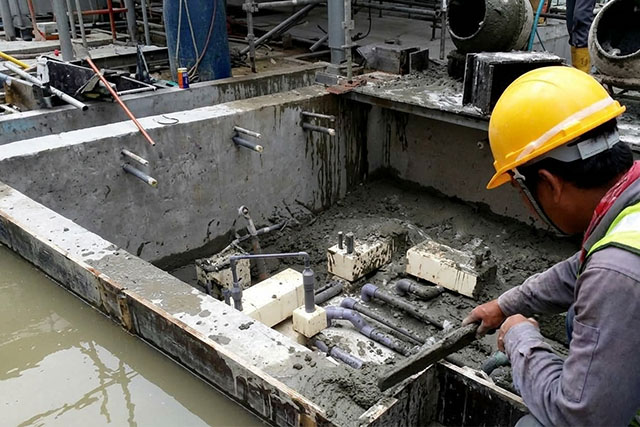
LIGHTHERM Drymix 1200 was specified as the lightweight fill for the SPA pool area at Robertson Blue Condominium in Singapore — a water retaining structure with embedded piping, junction boxes, and mechanical services throughout the floor buildup.
Project Requirements
- Lightweight fill for a pool deck with embedded pipes and junction boxes: the fill had to flow around and encapsulate existing services without requiring specialist formwork.
- Zero buoyancy risk: as a water retaining structure, the fill material had to remain stable under permanent or intermittent submersion conditions.
- Reduced dead load compared to normal concrete: the structural slab had limited residual capacity, requiring a fill at least 50% lighter than conventional concrete at 2,400 kg/m³.
- Adequate compressive strength: sufficient to support pool operations, maintenance foot traffic, and any imposed loads from pool equipment.
LIGHTHERM Drymix 1200 Performance
| Property | Value |
| Cast Density | 1,200 kg/m3 |
| Compressive Strength | Minimum 10 MPa |
| Thermal Conductivity | 0.3 W/m.K |
| Anti-Buoyancy FOS | 1.20 (exceeds 1.0 requirement) |
| Dead Load Reduction | 50% lighter than normal concrete |
| Application Method | On-site casting with mixer, pumpable |
On-Site Application
LIGHTHERM Drymix 1200 was mixed on-site using a concrete mixer and cast directly into the SPA pool structure. The material’s flowable consistency allowed it to encapsulate embedded pipes, junction boxes, and mechanical services completely without voids or air pockets — and without any special formwork or mechanical anchoring systems.
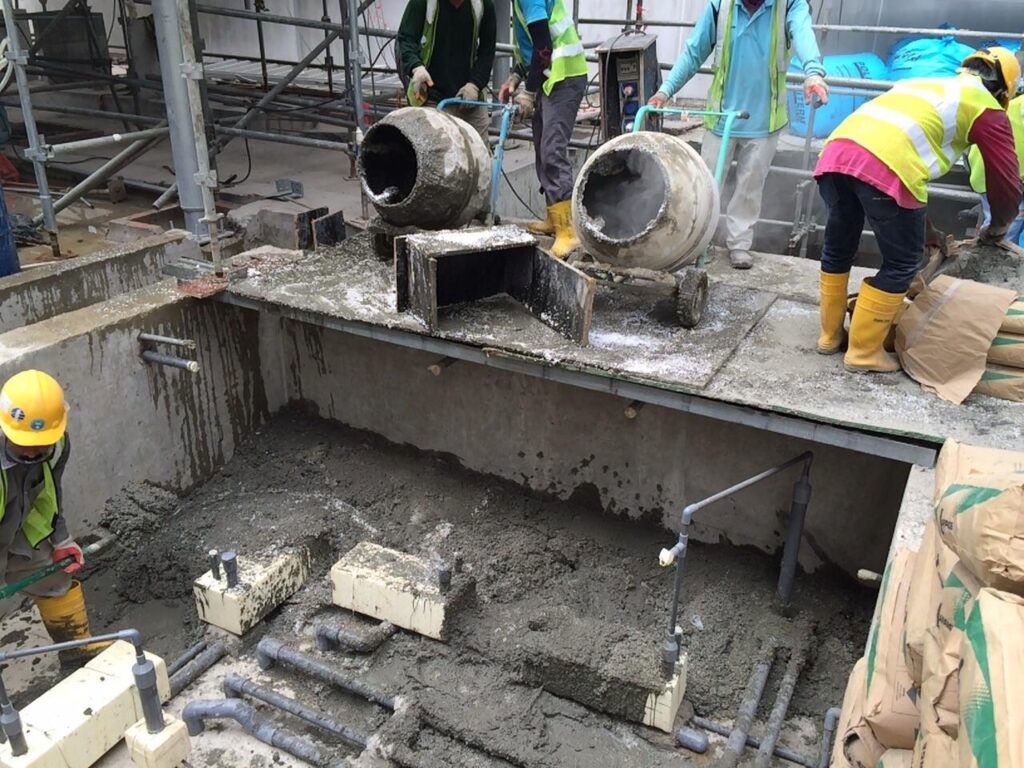
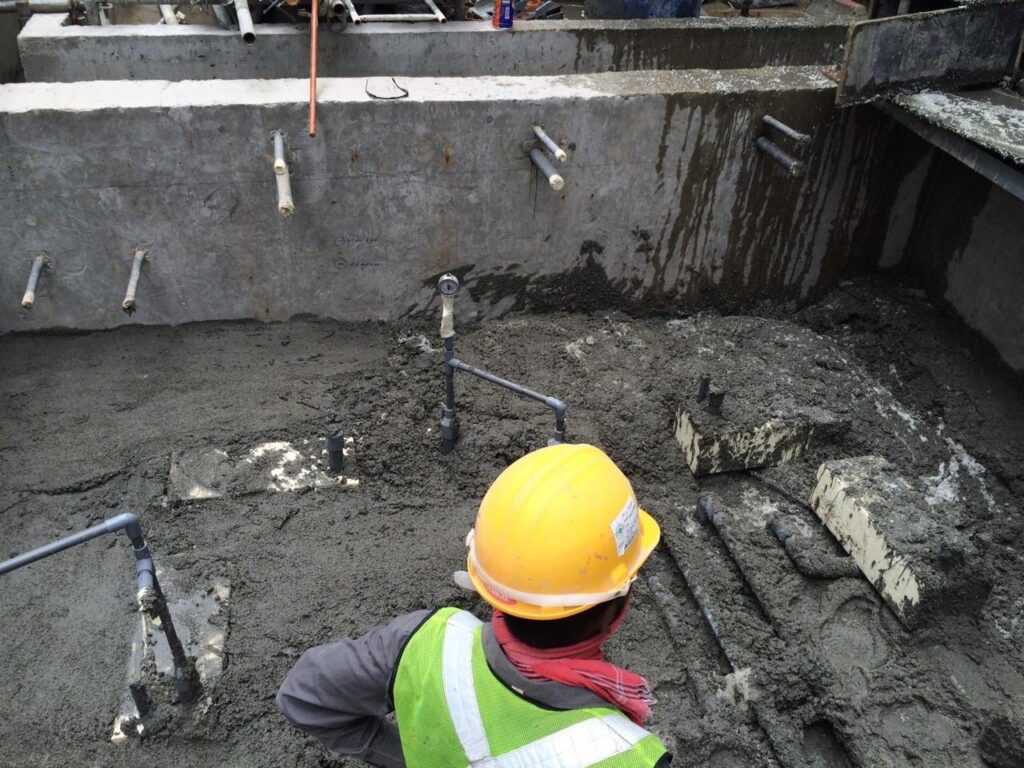
This contrasts directly with what an EPS geofoam solution would require in the same application: mechanical anchoring systems to resist uplift, careful detailing around embedded services to prevent flotation of individual blocks, and ongoing inspection to verify anchor integrity over the pool’s service life. LIGHTHERM Drymix 1200 required none of this — its density handles the buoyancy risk inherently.
Conclusion
Material density is a non-negotiable safety parameter in any construction application where lightweight fill may encounter water. The engineering principle is absolute: if the fill is lighter than water, it will generate uplift forces. The only question is whether the structure above can resist them — and in many cases, it cannot.
EPS geofoam at 15–30 kg/m³ presents an extreme buoyancy risk that has caused documented infrastructure failures. LIGHTHERM Drymix 250 at 250 kg/m³, while suitable for dry applications, is equally unsuitable for water-contact zones. The correct specification for any pool deck, basement slab, water feature, or high water table application is LIGHTHERM Drymix 1200 — the only lightweight fill that delivers 50% dead load reduction compared to normal concrete while remaining inherently buoyancy-safe at an FOS of 1.20, without requiring any mechanical anchorage.
For technical enquiries:
Vodapruf Pte Ltd
Specialists in Lightweight Concrete & Advanced Wall Panel Systems
📞 Malaysia: +60 16 217 7155
📞 Singapore: +65 9796 5910
🌐 vodapruf.com
Frequently Asked Questions (FAQ)
Why does lightweight fill pose a buoyancy risk in water retaining structures?
Any fill material with a density below 1,000 kg/m³ — the density of water — will experience upward uplift forces when submerged, per Archimedes’ Principle. The lighter the material, the greater the uplift force. In large floor slabs or pool decks, total uplift can exceed the weight of the structure above.
How much uplift force does EPS geofoam generate when submerged?
One cubic metre of EPS geofoam at 30 kg/m³ generates approximately 970 kg of upward buoyancy force against only 30 kg of self-weight — an uplift ratio of 32 times. This means every cubic metre of submerged EPS pushes upward with close to one tonne of force.
Has EPS geofoam buoyancy caused real structural failures?
Yes. In February 2002, EPS fill behind the Buffalo Road Bridge in the USA became submerged during flooding, causing differential movement in the bridge approach and requiring emergency remediation. Separately, EPS geofoam on Norway’s E6 highway near Vestby caught fire in 2016, destroying the entire embankment fill section.
Is LIGHTHERM Drymix 250 suitable for pool decks or water retaining structures?
No. LIGHTHERM Drymix 250 has a density of 250 kg/m³ — well below water density at 1,000 kg/m³ — and will float if submerged. It is classified as high buoyancy risk and must not be used in pool decks, basement slabs, or any application where water contact is possible.
What makes LIGHTHERM Drymix 1200 buoyancy-safe?
LIGHTHERM Drymix 1200 has a cast density of 1,200 kg/m³, which exceeds the density of water at 1,000 kg/m³. This gives an inherent Factor of Safety against uplift of 1.20 — confirming the material will not float under any submersion condition, with no mechanical anchorage required.
What were the project requirements at Robertson Blue Condominium SPA pool?
The SPA pool required a lightweight fill that could encapsulate embedded pipes and junction boxes, carry zero buoyancy risk in a water retaining structure, reduce dead load by at least 50% compared to normal concrete, and achieve sufficient compressive strength for pool operations and foot traffic. LIGHTHERM Drymix 1200 met all four requirements.
What compressive strength does LIGHTHERM Drymix 1200 achieve, and how was it applied at Robertson Blue?
LIGHTHERM Drymix 1200 achieves a minimum compressive strength of 10 MPa. At Robertson Blue Condominium, it was mixed on-site using a concrete mixer and cast directly into the SPA pool structure, flowing around embedded pipes and junction boxes without voids, special formwork, or mechanical anchorage systems.