
 English
 Arabic
Key Takeaways
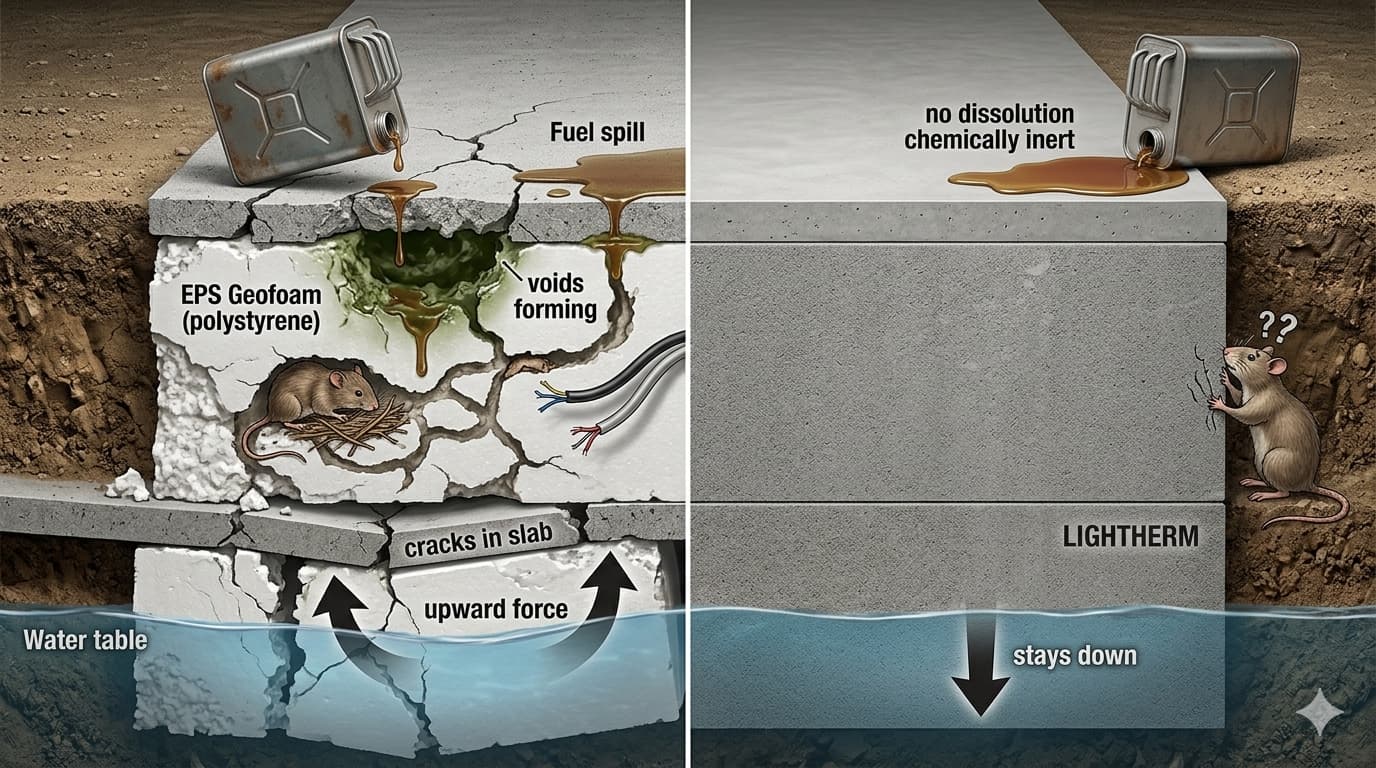
- EPS geofoam dissolves on contact with common construction solvents: Petrol, diesel, acetone, toluene, and many solvent-based adhesives and coatings cause polystyrene to depolymerise entirely — collapsing the foam structure and leaving a void beneath the slab, invisible until structural distress appears above.
- EPS is highly vulnerable to rodent burrowing in tropical climates: Rats and mice readily gnaw through polystyrene and establish nesting colonies within the fill. In Singapore and Malaysia, where rodent populations are active year-round, this risk is particularly acute — and the damage is concealed beneath floor slabs.
- EPS at 15–30 kg/m³ generates extreme buoyancy forces when submerged: One cubic metre of EPS at 30 kg/m³ produces approximately 970 kg of uplift force — 32 times its own weight. This has caused documented structural failures in Norway and the United States.
- LIGHTHERM Drymix is an inorganic cementitious material — immune to all three failure modes: Cured LIGHTHERM cannot be dissolved by solvents, cannot be burrowed into by rodents, and is available in Drymix 1200 at 1,200 kg/m³ — denser than water — for applications where submersion is possible.
- Density is adjustable in LIGHTHERM — it is fixed and problematic in EPS: Drymix 250 at 250 kg/m³ maximises weight reduction for dry applications. Drymix 1200 at 1,200 kg/m³ eliminates buoyancy risk for water-contact applications. EPS has no equivalent density-selection capability.
Introduction
EPS geofoam has a well-established track record as a lightweight fill material in civil and structural engineering. Its extremely low density — typically 15 to 30 kg/m³ — makes it effective for reducing dead loads, and it has been widely used in road embankments, floor fills, and bridge abutment backfill applications globally.
However, the same material properties that make EPS attractive as a lightweight fill also introduce three inherent failure modes that cannot be resolved through detailing or specification: chemical dissolution by common solvents, rodent infiltration in built environments, and catastrophic buoyancy uplift when submerged. These are not edge cases. They are documented failure mechanisms with real project consequences.
LIGHTHERM Drymix is a cementitious lightweight fill available in two primary density grades — 250 kg/m³ and 1,200 kg/m³. As an inorganic, mineral-based material, it eliminates all three of these vulnerabilities by design.
Failure Mode 1 — Solvent Dissolution
Why EPS dissolves
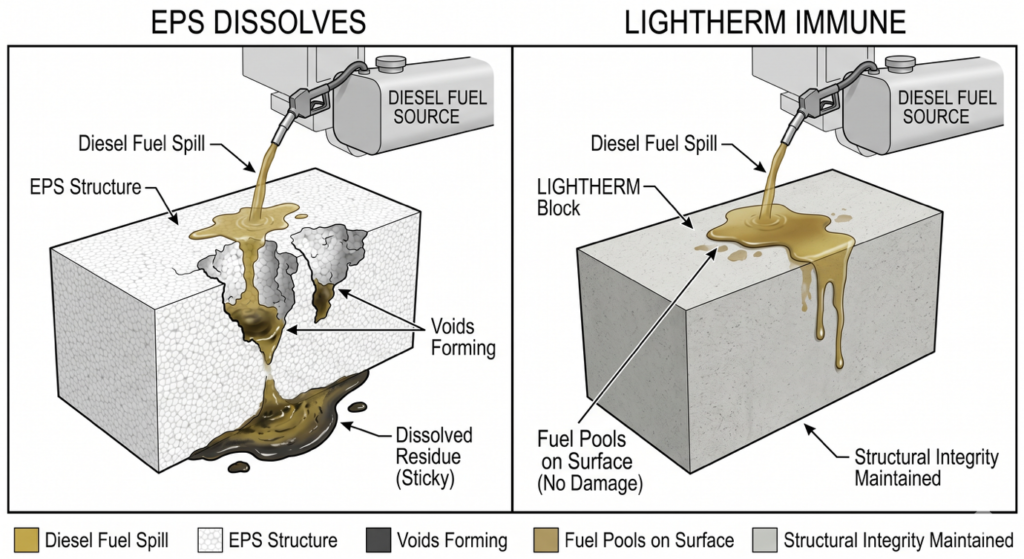
EPS is a thermoplastic polymer. When it contacts certain organic solvents, the polystyrene chains undergo depolymerisation — the foam structure collapses, leaving a sticky residue and a void where structural fill once existed. The dissolution is rapid and complete. There is no partial degradation or recoverable state.
Solvents commonly present on construction sites that will destroy EPS geofoam include:
- Petroleum-based products: petrol (gasoline), diesel fuel, kerosene, mineral spirits
- Industrial solvents: acetone, toluene, xylene, MEK (methyl ethyl ketone)
- Paints and coatings: solvent-based paints, lacquer thinner, polyester resin
- Adhesives: contact cement and certain epoxy hardener formulations
The engineering consequence is significant. A fuel spill from plant machinery, a solvent-based waterproofing application, or even a cleaning product used during construction can silently destroy EPS fill beneath a slab. The void created is invisible from above until structural movement or cracking appears — at which point remediation typically requires breaking out and replacing the floor.
Why LIGHTHERM is immune
LIGHTHERM Drymix is composed of Portland cement, lightweight mineral aggregate, and water. As an inorganic compound, it has no polymer chains to attack and no organic matrix to depolymerise. Cured LIGHTHERM is chemically inert to all petroleum products, industrial solvents, and solvent-based construction chemicals. Petrol, diesel, acetone, and toluene have no effect on cured cementitious material — the same applies to LIGHTHERM as it does to any conventional concrete.
Failure Mode 2 — Rodent Infiltration
Why EPS attracts rodents
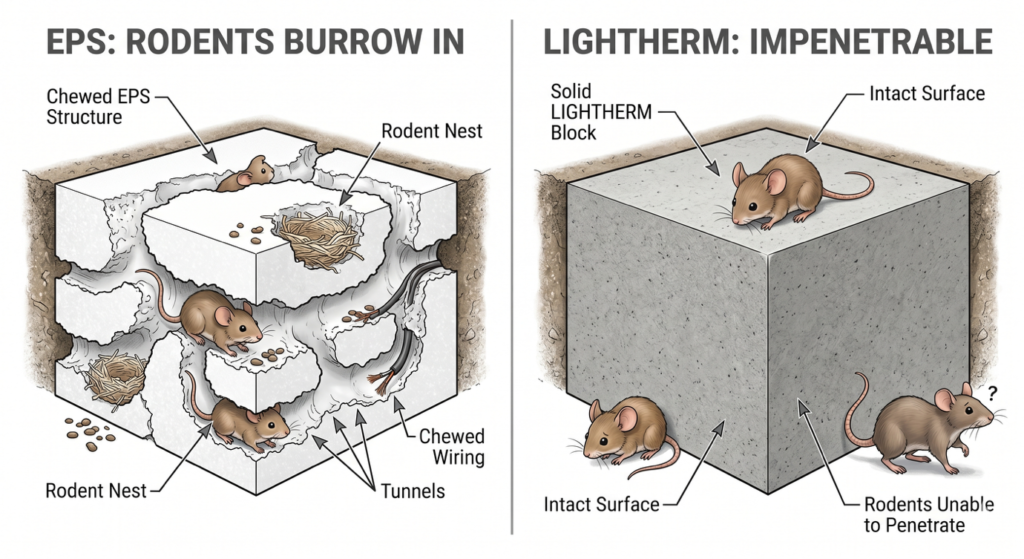
Polystyrene foam is structurally ideal for rodent nesting: it is thermally insulating, easy to excavate, mechanically weak enough to gnaw through, and concealed from predators once within a floor or wall buildup. Rats and mice actively seek out EPS fill as a nesting substrate, particularly in buildings where food sources are nearby.
The consequences extend well beyond structural void creation:
- Tunnel networks: Rodents create interconnected burrow systems through the fill, progressively reducing the supported area and creating differential settlement risk above.
- Expanding colonies: Nesting populations grow over time, meaning the void volume increases continuously rather than remaining static after initial infestation.
- Contamination: Rodent droppings, urine, and parasites migrate into the building above through gaps, floor penetrations, and service runs.
- Secondary damage: Gnawing activity damages adjacent waterproofing membranes, insulation layers, and electrical conduits — creating fire risk where cables are exposed.
This problem is not hypothetical in Singapore and Malaysia. Tropical climates support year-round rodent populations, and the warm, sheltered environment within a floor buildup is precisely the habitat these animals seek during building occupation. EPS fill in occupied buildings is an ongoing vulnerability, not a one-time construction risk.
Why LIGHTHERM is impervious
LIGHTHERM Drymix cures to a solid cementitious mass with compressive strength ranging from a minimum of 0.5 MPa (Drymix 250) to a minimum of 10 MPa (Drymix 1200). No rodent species can burrow into, excavate, or nest within a hardened cementitious material. The pest impermeability of LIGHTHERM is equivalent to that of conventional concrete — rats cannot nest in concrete, and they cannot nest in LIGHTHERM.
Failure Mode 3 — Buoyancy Uplift
The scale of the EPS buoyancy problem
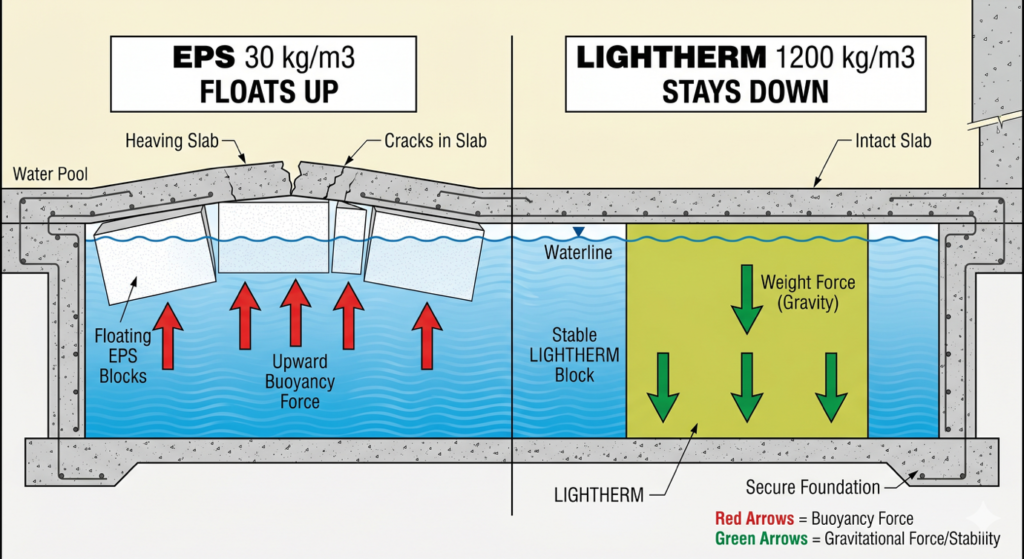
At densities of 15 to 30 kg/m³, EPS geofoam is approximately 33 to 67 times lighter than water. When submerged, the uplift force generated is enormous. For one cubic metre of EPS at 30 kg/m³:
- Buoyancy uplift force: (1,000 − 30) × 1 × 9.81 = 9,515 N ≈ 970 kg of upward force
- Self-weight of the EPS: 30 × 1 × 9.81 = 294 N ≈ 30 kg downward
- Net uplift ratio: 970 ÷ 30 = 32 times its own weight pushing upward
Documented geofoam buoyancy failures include:
- Norway E6 Highway, Vestby: Complete loss of EPS embankment fill due to fire during construction. The lightweight material was totally destroyed, requiring full replacement with conventional fill.
- Buffalo Road Bridge, USA (2002): Geofoam behind bridge abutment became submerged during flooding, generating uplift forces that caused differential settlement in the bridge approach.
- Multiple road embankments: The academic paper “Lessons Learned from Failures Involving Geofoam in Roads and Embankments” (ResearchGate) documents numerous cases of EPS fill failure in transportation infrastructure.
LIGHTHERM’s density-tuneable advantage
LIGHTHERM Drymix addresses the buoyancy problem through density selection — a capability that EPS geofoam does not possess. EPS density is fixed at the point of manufacture. LIGHTHERM density is selected to match the engineering requirement of each application.
| Grade | Density | Best For | Key Property |
| LIGHTHERM Drymix 250 | 250 kg/m³ | Above-water applications — maximum weight reduction and thermal insulation | Thermal conductivity: 0.056 W/m·K |
| LIGHTHERM Drymix 1200 | 1,200 kg/m³ | Water retaining structures, pool decks, basements, any zone with possible submersion | FOS 1.20 against buoyancy — density exceeds water |
This density tunability is unique to cementitious fills. No equivalent product-level solution exists for EPS — the only way to manage EPS buoyancy is through external mechanical anchorage systems, which add cost, coordination, and long-term maintenance requirements. LIGHTHERM Drymix 1200 resolves the buoyancy question through material selection alone.
Comprehensive Comparison
The table below summarises all key performance differences between EPS geofoam and LIGHTHERM Drymix across the properties most relevant to construction specification.
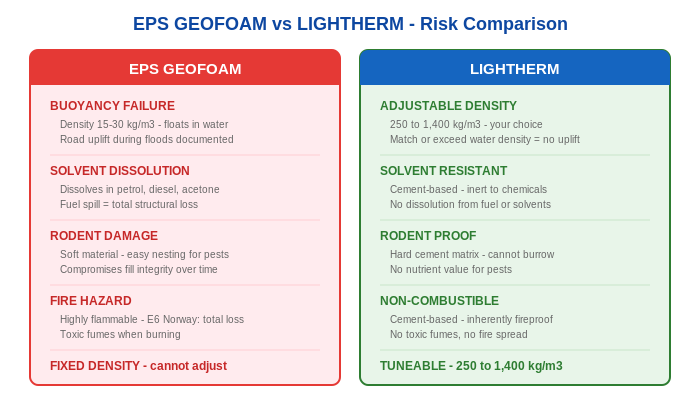
| Property | EPS Geofoam | LIGHTHERM Drymix |
| Density Range | 15–30 kg/m³ (fixed) | 250–1,200 kg/m³ (adjustable) |
| Solvent Exposure | DISSOLVES on contact with petrol, acetone, toluene | Completely immune — inorganic cementitious material |
| Rodent Resistance | VULNERABLE — easy to burrow and nest | Impervious — solid cementitious matrix |
| Buoyancy Risk | EXTREME — 32× uplift when submerged | ELIMINATED with Drymix 1200 (FOS 1.20) |
| Fire Performance | Combustible — toxic fumes, total loss in fire | Non-combustible — cementitious material |
| Compressive Strength | 0.05–0.3 MPa | Minimum 0.5 MPa (250) to 10 MPa (1200) |
| Thermal Insulation | 0.035 W/m·K | 0.056 W/m·K (Drymix 250) |
| Application Method | Pre-cut blocks, crane placement | On-site casting, pumpable, flows around services |
| Waterproofing Needed | Must be sealed from all water contact | Cementitious — inherently water-compatible |
Conclusion
EPS geofoam’s three fundamental failure modes — solvent dissolution, rodent infiltration, and buoyancy uplift — are inherent to the polystyrene material itself. They cannot be designed around through detailing or addressed through specification clauses. They are permanent material limitations that must be evaluated against the conditions of every project where EPS is under consideration.
LIGHTHERM Drymix eliminates all three through its inorganic cementitious composition and adjustable density range. For projects where chemical exposure, pest vulnerability, or water contact are realistic conditions — which describes the majority of built environments in Singapore and Malaysia — LIGHTHERM Drymix is the engineered alternative that removes these risks from the specification entirely.
Vodapruf Pte Ltd
Specialists in Lightweight Concrete & Advanced Wall Panel Systems
📞 Malaysia: +60 16 217 7155
📞 Singapore: +65 9796 5910
🌐 vodapruf.com
Frequently Asked Questions (FAQ)
What are the three main failure modes of EPS geofoam in construction?
EPS geofoam has three inherent failure modes: solvent dissolution when exposed to petrol, acetone, or toluene; rodent infiltration as rats and mice readily burrow and nest in polystyrene foam; and extreme buoyancy uplift when submerged, generating up to 32 times the material’s own weight in upward force.
Which common construction chemicals will dissolve EPS geofoam?
EPS geofoam dissolves on contact with petroleum-based products (petrol, diesel, kerosene, mineral spirits), industrial solvents (acetone, toluene, xylene, MEK), solvent-based paints and lacquer thinners, polyester resin, contact cement, and certain epoxy hardener formulations — all of which are routinely present on construction sites.
Why is rodent damage to EPS geofoam particularly serious in Singapore and Malaysia?
Tropical climates support year-round rodent populations that actively seek sheltered, thermally insulating nesting environments. EPS foam beneath floor slabs provides exactly this — and the damage is invisible until structural distress appears above. Rodent colonies expand over time, progressively increasing void volume and contamination risk.
Is LIGHTHERM Drymix affected by petrol, diesel, or solvent spills on site?
No. LIGHTHERM Drymix is an inorganic cementitious material composed of Portland cement, lightweight mineral aggregate, and water. Cured LIGHTHERM is chemically inert to all petroleum products and organic solvents — petrol, diesel, acetone, and toluene have no effect on it, the same as conventional concrete.
Can LIGHTHERM Drymix be used in place of EPS geofoam for all applications?
Yes, across two density grades matched to the application. Drymix 250 at 250 kg/m³ suits dry above-water applications requiring maximum weight reduction and thermal insulation (λ = 0.056 W/m·K). Drymix 1200 at 1,200 kg/m³ suits water-contact applications — pool decks, basements, and any zone where submersion is possible — providing FOS 1.20 against buoyancy.
What compressive strength does LIGHTHERM Drymix achieve compared to EPS geofoam?
EPS geofoam achieves 0.05–0.3 MPa compressive strength. LIGHTHERM Drymix 250 achieves a minimum of 0.5 MPa and LIGHTHERM Drymix 1200 achieves a minimum of 10 MPa — both significantly exceeding EPS, while still delivering substantial dead load reduction compared to normal concrete.
Does EPS geofoam require waterproofing or mechanical anchorage that LIGHTHERM does not?
Yes on both counts. EPS must be fully sealed from any water contact to prevent buoyancy uplift, requiring dedicated waterproofing systems. In submerged applications, mechanical anchorage is also needed to resist uplift forces. LIGHTHERM Drymix requires neither — it is inherently water-compatible as a cementitious material, and Drymix 1200 is denser than water, eliminating buoyancy without anchorage.