
 English
 Arabic
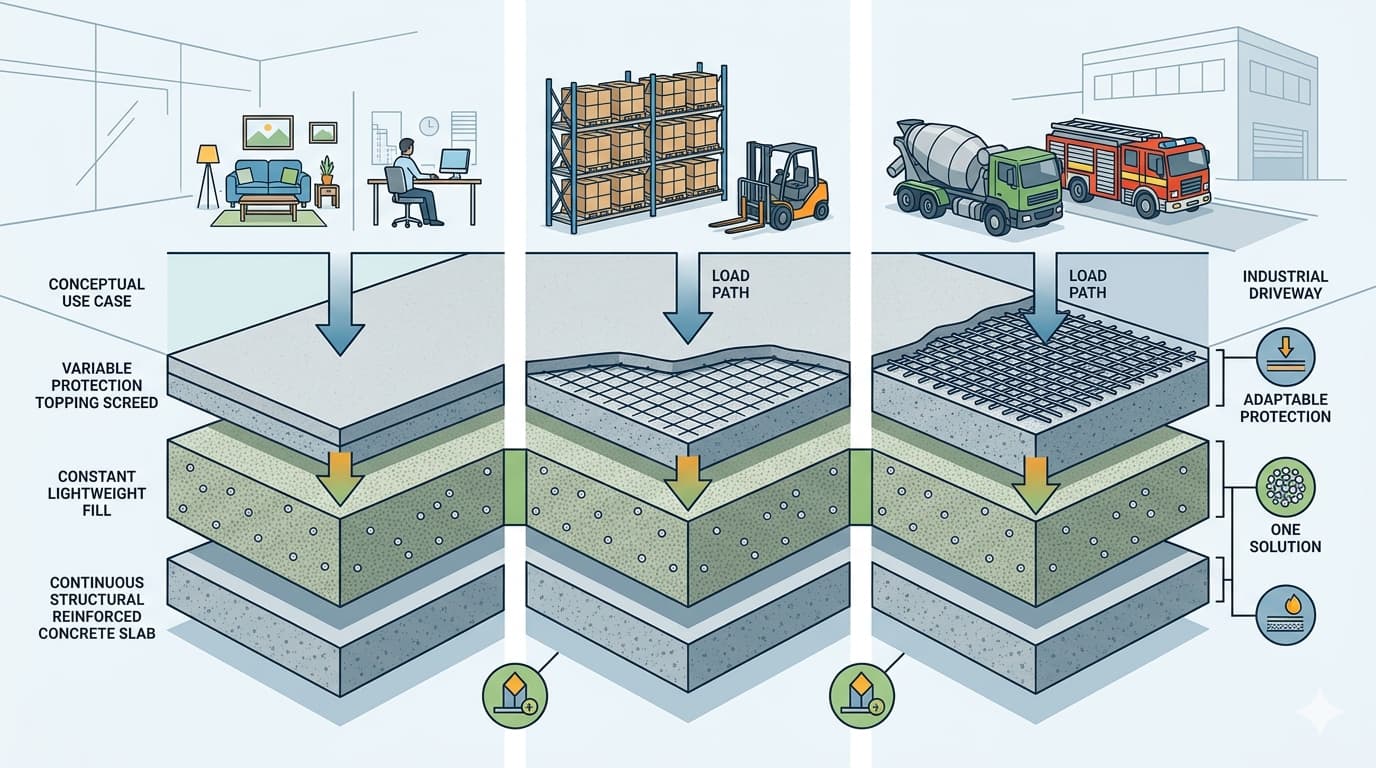
Key Takeaways
- LIGHTHERM Drymix 250 exceeds every Singapore design load by at least 21 times: At a minimum compressive strength of 0.5 MPa (500 kN/m²), LIGHTHERM provides a safety factor of 208× for a residential corridor (2.4 kN/m²) and 21× even at the heaviest Singapore load case — heavy vehicle driveways at 24.0 kN/m².
- The LIGHTHERM layer never changes — only the topping screed does: LIGHTHERM Drymix 250 at 250 kg/m³ is specified identically across all three loading tiers. The only variable is the thickness and reinforcement of the protection topping screed above it.
- Three loading tiers cover every building type in Singapore: Tier 1 (50mm plain screed) handles residential, office, and retail. Tier 2 (100mm RC + A10 BRC) covers warehouse and heavy racking. Tier 3 (150mm+ RC + T12 rebar) is verified for heavy vehicle driveways.
- PE-verified at Tier 2 — 18-tonne pallet racking at Biorad Laboratories: A Professional Engineer calculation confirmed that 36 kN point loads per racking leg produce 646 kN/m² of compressive stress — well within LIGHTHERM’s verified capacity of 830 kN/m² with a factor of safety of 1.5 applied.
- Three real project references across all three tiers: State Court Singapore (3,000 m³, Samsung C&T) for Tier 1; Biorad Laboratories, Pioneer (12,000 m², PE-verified) for Tier 2; and an industrial building driveway for Tier 3 — confirming LIGHTHERM across every application type.
Introduction
A common question from structural engineers and quantity surveyors encountering LIGHTHERM for the first time is whether a material with a compressive strength of 0.5 MPa can genuinely handle the floor loading requirements in Singapore buildings. The short answer is yes — and by a substantial margin. This article sets out the full technical basis, supported by three completed project references spanning every loading tier in the Singapore National Annex to SS EN 1991-1-1.
Singapore Floor Design Loads — The Full Picture
Floor loads in Singapore are governed by SS EN 1991-1-1 (Eurocode 1 — Actions on Structures, Singapore National Annex), which sets out the required imposed floor loads as uniformly distributed loads (UDL) in kN/m². The table below covers every building use category — from residential bedrooms through to heavy vehicle driveways.
| Building Use / Zone | Design Imposed Load (kN/m²) |
| Residential — bedrooms | 1.5 |
| Residential — living / dining / kitchen | 2.0 |
| Corridors, common lobbies | 2.4 |
| Office — general | 2.5 |
| Office — filing / storage | 5.0 |
| Retail / shopping | 4.0 |
| Industrial — light duty | 4.0 |
| Industrial — general | 5.0 – 7.5 |
| Assembly halls, gymnasiums | 5.0 |
| Plant rooms | 7.5 |
| Warehouse — heavy storage | 10.0 – 15.0 |
| Vehicular — car park | 2.5 |
| Vehicular — driveways (light vehicles) | 5.0 |
| Vehicular — driveways (heavy vehicles, fire access) | 12.5 – 24.0 |
The Calculation: LIGHTHERM Against Every Load Case
LIGHTHERM Drymix 250 achieves a minimum compressive strength of 0.5 MPa at 28 days — equivalent to 500 kPa, or 500 kN/m². In a typical floor buildup, LIGHTHERM sits below a protection screed — either a sand-cement screed or reinforced concrete topping — which acts as a rigid load-distribution plate. This means the actual compressive stress reaching the LIGHTHERM layer is already lower than the design UDL before any safety factor is applied.
| Load Scenario | Design Load (kN/m²) | LIGHTHERM Capacity (kN/m²) | Factor of Safety |
| Residential corridor | 2.4 | 500 | 208× |
| Office — general | 2.5 | 500 | 200× |
| Retail / shopping | 4.0 | 500 | 125× |
| Industrial — light duty | 4.0 | 500 | 125× |
| Industrial — general | 7.5 | 500 | 67× |
| Heavy warehouse | 15.0 | 500 | 33× |
| Heavy vehicle driveway | 24.0 | 500 | 21× |
The critical insight here is that 0.5 MPa is not analogous to the compressive strength of a structural column or beam. LIGHTHERM functions as a lightweight fill layer within a composite floor system, where the screed above handles load distribution and the RC slab below carries all structural loads. LIGHTHERM’s role is thermal insulation and dead load reduction — and at 0.5 MPa with a protection screed above, it handles every Singapore design load with reserves that far exceed normal engineering practice.
The Core Design Principle: LIGHTHERM Stays Constant, Topping Changes
This is the most important specification principle for engineers new to LIGHTHERM: the fill layer specification never changes regardless of the building type or design load. LIGHTHERM Drymix 250 at 250 kg/m³ is identical across a bedroom floor and a heavy driveway. The only variable that adapts to the design load is the protection topping screed above — its thickness and reinforcement.
This is not a novel concept — it is standard composite floor engineering. The design question is not whether LIGHTHERM is adequate. The question is what topping screed thickness is needed for the project’s design load, which is a routine calculation for any structural engineer working to SS EN 1992-1-1.
| Loading Tier | Building Use | LIGHTHERM Layer | Protection Topping | Reinforcement |
| Tier 1 — Light(1.5 – 5.0 kN/m²) | Residential, office, retail | Drymix 250@ 250 kg/m³ | 50mm cement screed | None required(plain screed) |
| Tier 2 — Medium(10.0 – 15.0 kN/m²) | Warehouse, heavy storage, pallet racking | Drymix 250@ 250 kg/m³ | 100mm reinforced concrete | A10 BRC(welded mesh) |
| Tier 3 — Heavy(12.5 – 24.0 kN/m²) | Heavy vehicle driveways, fire engine access | Drymix 250@ 250 kg/m³ | 150mm+ reinforced concrete | T12 rebar meshor equivalent |
Case Study — Tier 1: State Court Singapore
State Court Singapore — 3,000 m³ Lightweight Topping Up
| Parameter | Details |
| Project | State Court Singapore |
| Main Contractor | Samsung C&T Corporation |
| Architect | CPG Consultant |
| Quantity | 3,000 m³ |
| Application | Lightweight Topping Up |
| LIGHTHERM Layer | Drymix 250 @ Density 250kg/m3 |
| Protection Topping | 50mm sand-cement screed |
| Loading Tier | Tier 1 — Light (residential, office, retail) |
Objective: Lightweight topping up across multiple floors of the State Court Singapore building, reducing dead load on the structure while providing a level substrate for the protection screed and final floor finishes.
Floor Buildup: LIGHTHERM Drymix 250 cast onto the structural RC slab, followed by a 50mm protection sand-cement screed and final floor finishes (tiles, compressed marble, or carpet depending on zone). This is the classic Tier 1 configuration — no reinforcement required in the protection screed.
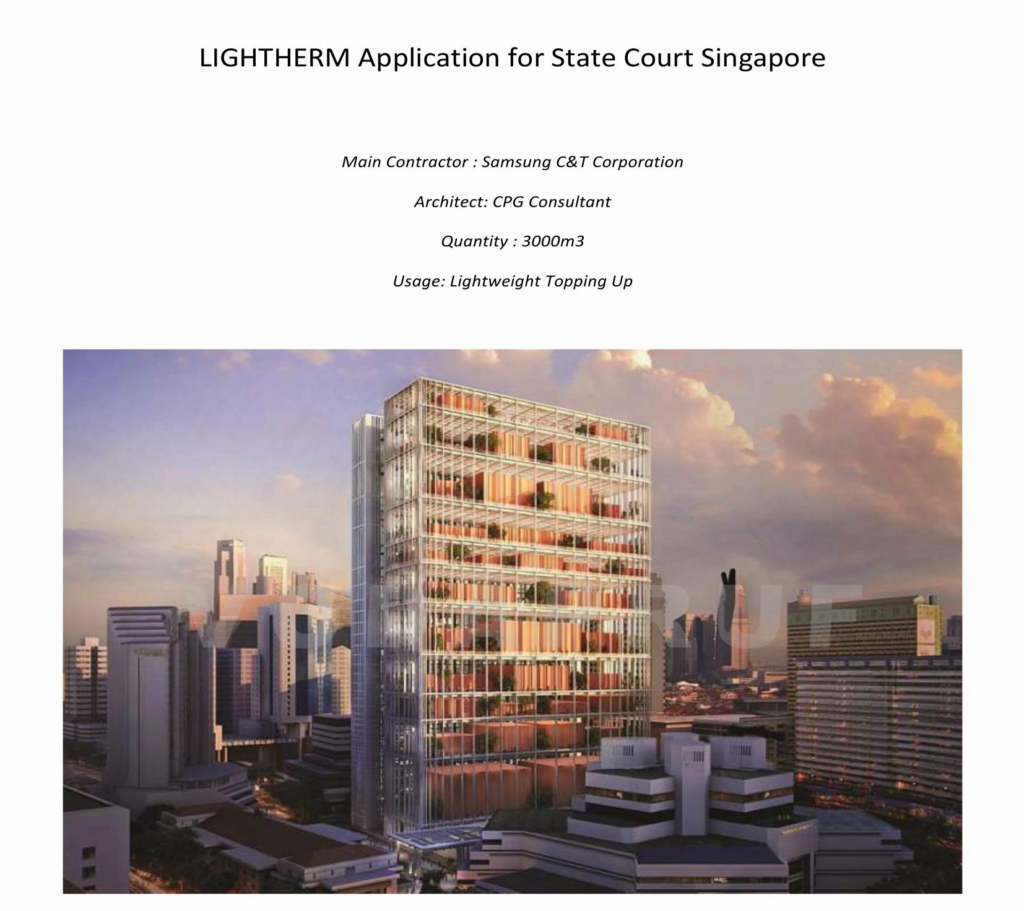
Floor Buildup Details
The architect’s buildup details below show three typical floor zones at State Court, each using LIGHTHERM as the lightweight fill layer with a 50mm protection screed above:
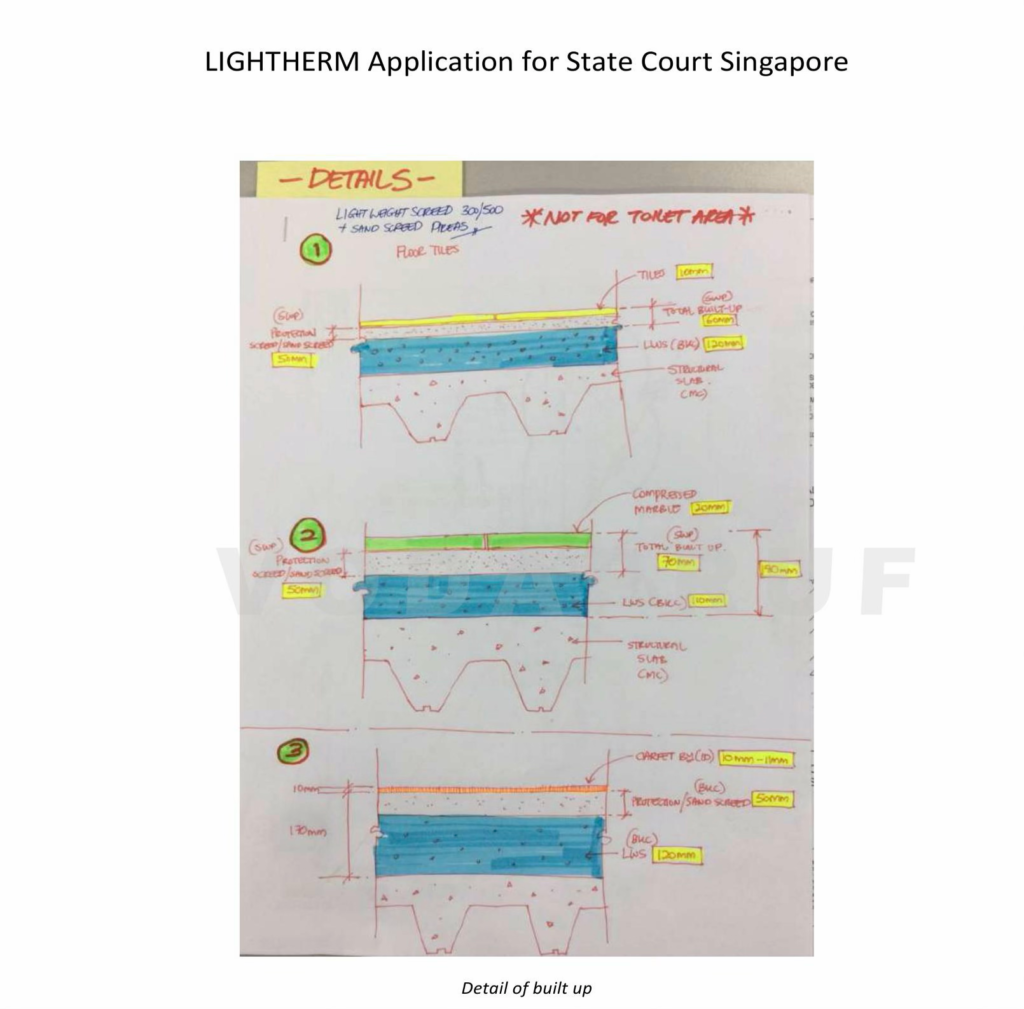
All three scenarios follow the same Tier 1 principle: LIGHTHERM Drymix 250 provides the lightweight fill, a 50mm sand-cement screed provides the protection layer, and the floor finish varies by zone. No reinforcement is required in the screed — the loads are well within the plain screed capacity.
Site Application — LIGHTHERM Drymix 250
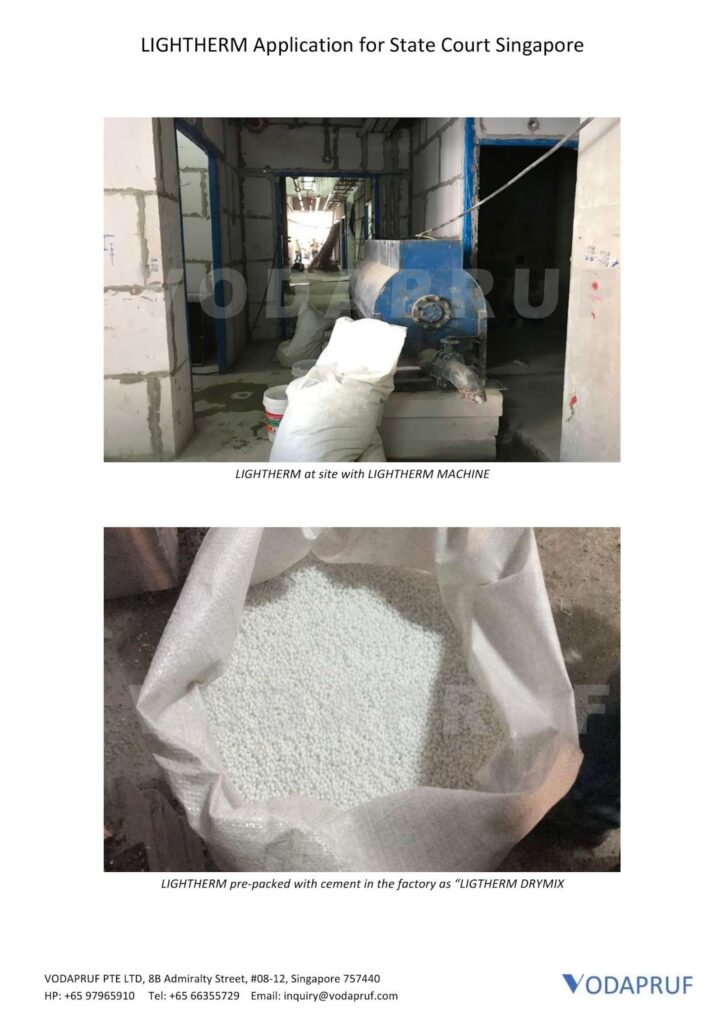
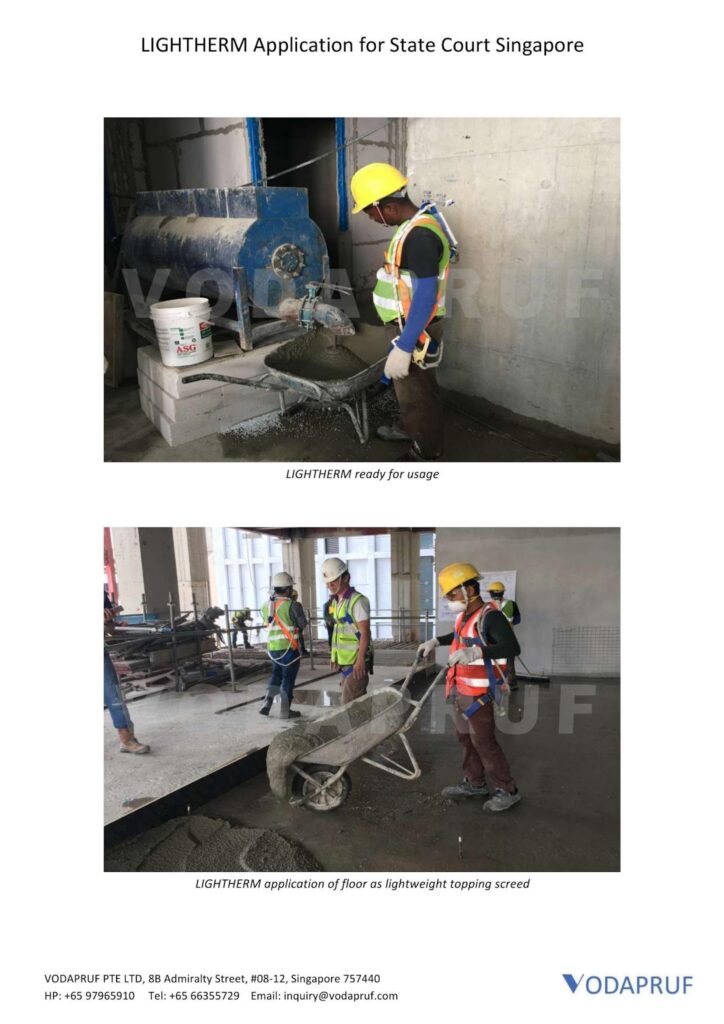
LIGHTHERM Drymix 250 is delivered in pre-packed bags with the EPS beads and cement blended in factory-controlled proportions. On site, workers add water to the stipulated ratio and mix for five minutes. The mixed material is transported by wheelbarrow and cast directly onto the structural slab, then levelled to the required thickness before the protection screed is applied.
TIER 1 PROVEN — 3,000 m³: State Court Singapore demonstrates the standard Tier 1 application at scale. LIGHTHERM Drymix 250 with a 50mm plain sand-cement screed — no reinforcement needed. The same LIGHTHERM layer that works here also works under Tier 2 and Tier 3 loads — only the topping screed thickness changes.
Case Study — Tier 2: Warehouse with 18-Tonne Pallet Racking
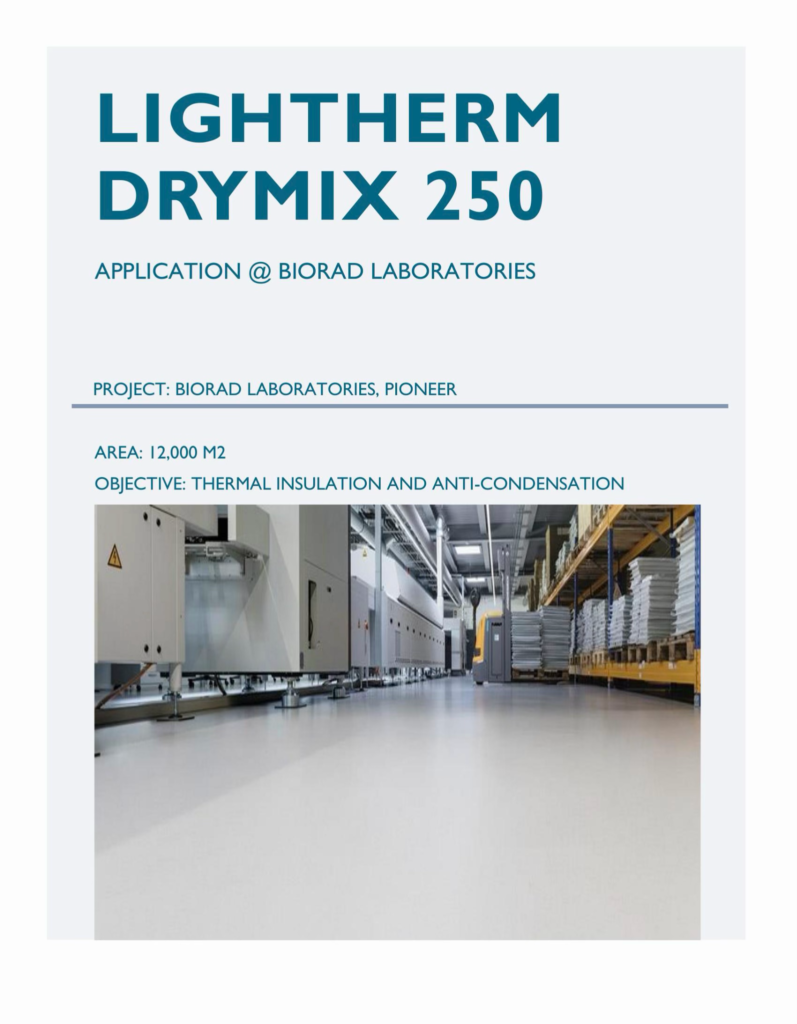
Biorad Laboratories, Pioneer — 12,000 m²
Objective: Thermal insulation and anti-condensation for a temperature-controlled pharmaceutical warehouse with heavy pallet racking systems.
Floor Buildup: LIGHTHERM Drymix 250 + 100mm reinforced concrete topping with A10 BRC (welded mesh reinforcement).
Loading: 18-tonne pallet racking (Rack Type G — 6 High, Standard Large Instruments). Each racking leg transmits a point load of 36 kN through a SHS 75×75×5mm base plate.
Application — LIGHTHERM Drymix 250
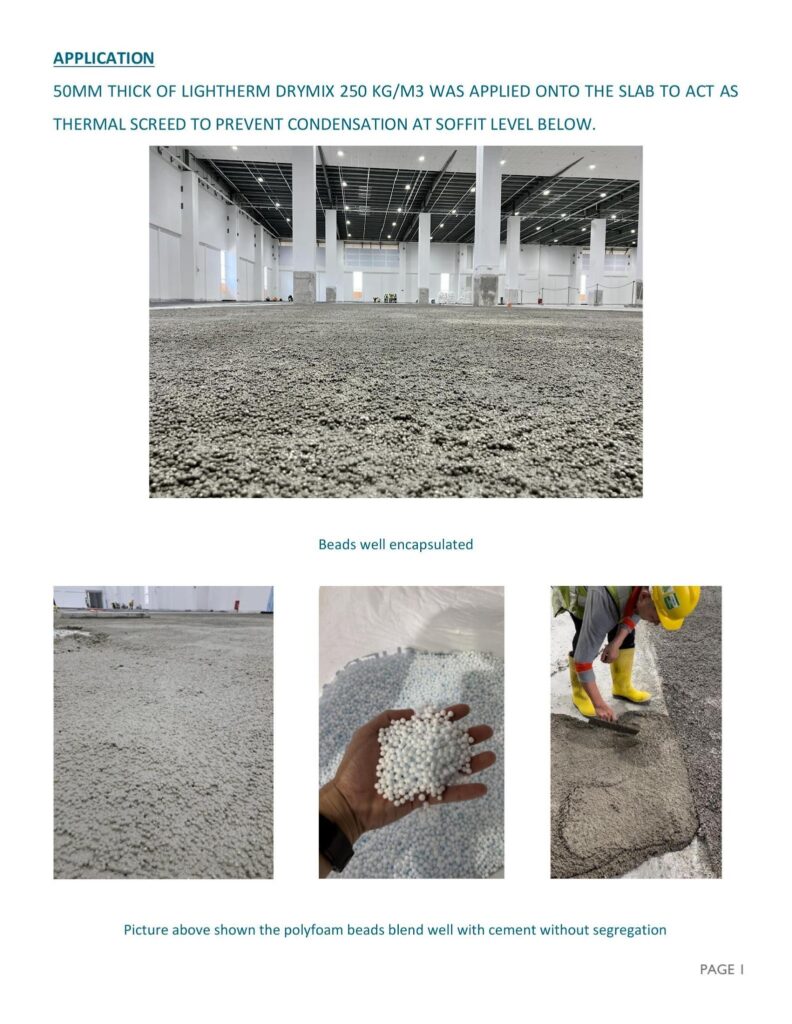
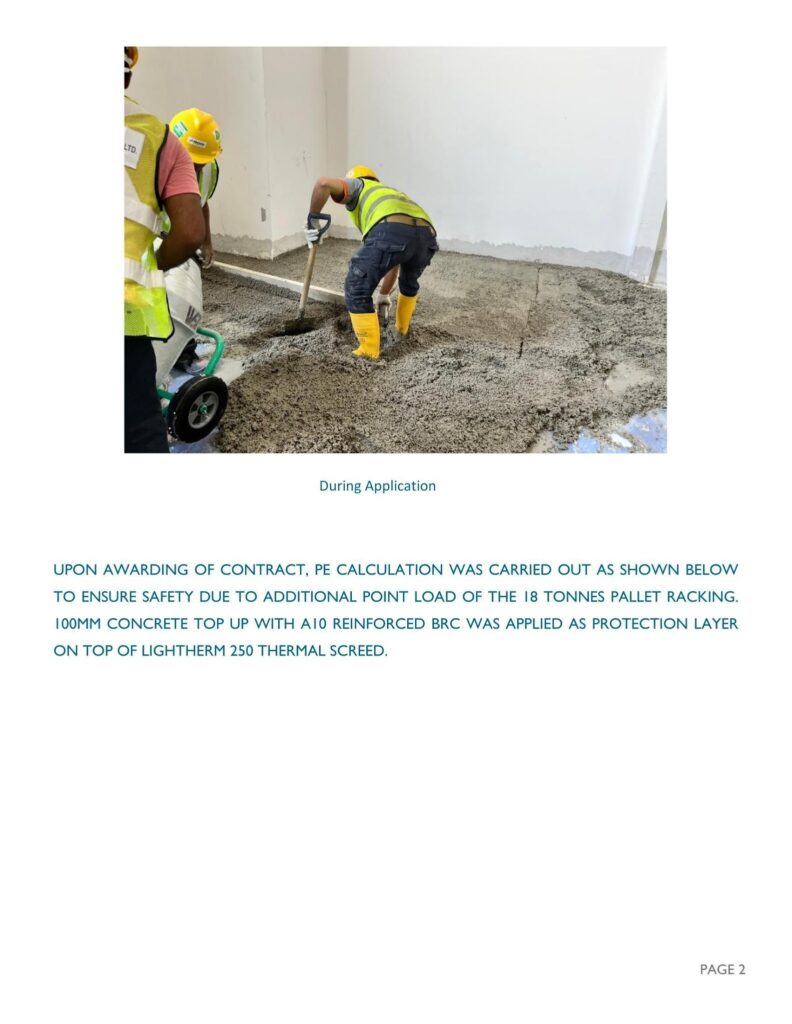
LIGHTHERM Drymix 250 (density 250 kg/m³) was cast directly onto the structural RC slab to serve as a thermal screed, preventing condensation at soffit level below. The expanded polystyrene beads are well encapsulated in the cementitious matrix with zero segregation.
PE Calculation — Structural Verification
Upon award of contract, a Professional Engineer (PE) calculation was carried out to verify structural safety under the 18-tonne pallet racking point loads. The 100mm concrete topping with A10 BRC was designed as the protection layer above the LIGHTHERM thermal screed.
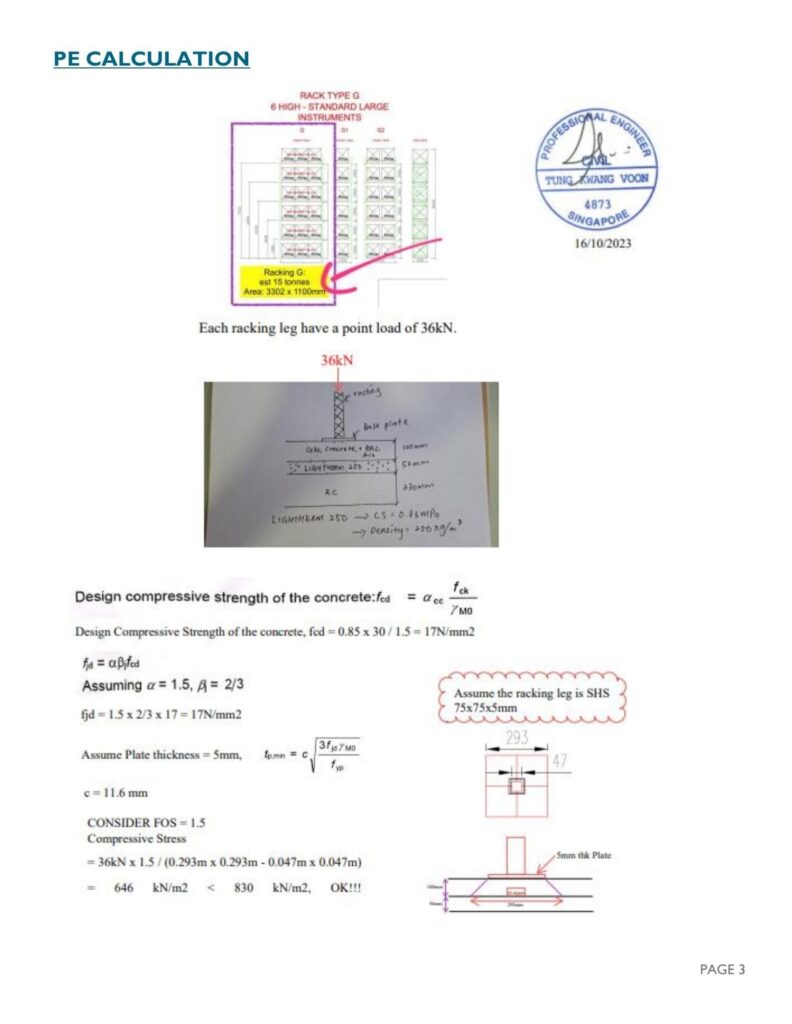
PE Calculation Summary
| Parameter | Value |
| Racking Type | Type G — 6 High, Standard Large Instruments |
| Racking Weight | 15 tonnes estimated (Area: 3302 × 1100mm) |
| Point Load per Leg | 36 kN |
| Base Plate | SHS 75×75×5mm (bearing area 293×293mm minus 47×47mm) |
| Design Compressive Strength fcd | 0.85 × 30 / 1.5 = 17 N/mm² |
| Factor of Safety Applied | 1.5 |
| Compressive Stress | 36 kN × 1.5 / (0.293² − 0.047²) = 646 kN/m² |
| LIGHTHERM Capacity (with FOS) | 830 kN/m² |
| Result | 646 kN/m² < 830 kN/m² — OK ✓ |
PE VERIFIED: Even under 18-tonne pallet racking with concentrated point loads of 36 kN per leg, the LIGHTHERM + 100mm RC composite floor passes with a factor of safety of 1.5. The key: the 100mm reinforced concrete topping distributes the racking loads before they reach the LIGHTHERM layer.
Thermal Calculation — Anti-Condensation Verification
Ubakus simulation (DIN 4108 / ISO 13788) was performed to verify that the LIGHTHERM layer eliminates condensation risk at soffit level. The buildup — 100mm concrete (λ=1.442) → LIGHTHERM 250 (λ=0.067) → 230mm concrete (λ=1.442) — achieves:
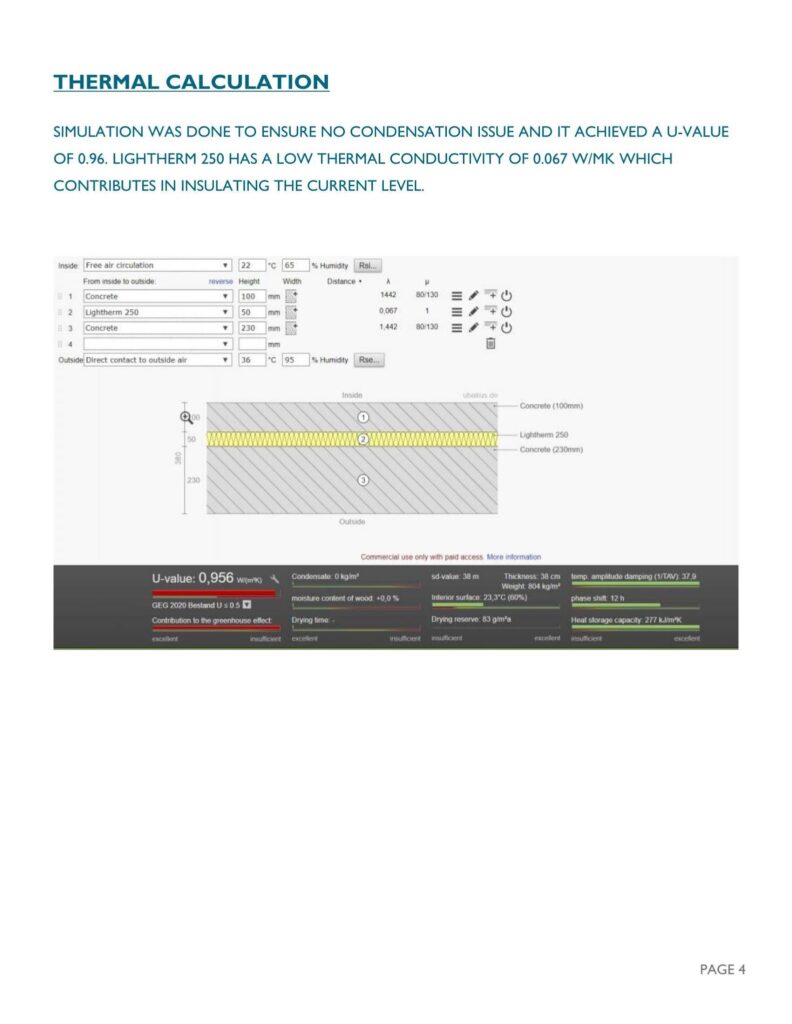
| Parameter | Result |
| U-value | 0.956 W/m²K |
| Condensate | 0 kg/m² |
| Interior Surface Temperature | 23.3°C (60%) |
| Drying Reserve | 83 g/m²a |
| LIGHTHERM Thermal Conductivity (λ) | 0.067 W/m·K |
| Verdict | No condensation — PASS ✓ |
Cross-Section — Composite Floor System
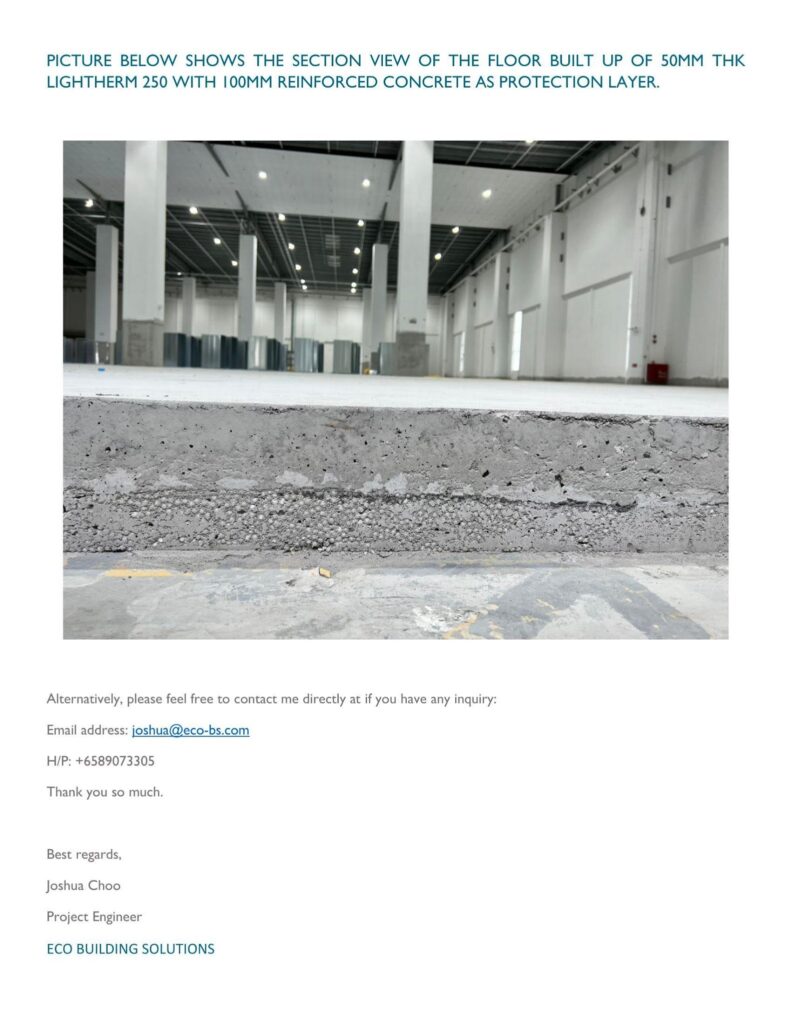
The cross-section clearly shows the composite floor system: the lightweight LIGHTHERM layer (visible as the lighter band) sits between the structural RC slab below and the 100mm reinforced concrete topping above. This is the Tier 2 configuration — the topping thickness and BRC reinforcement handle the warehouse racking loads while LIGHTHERM provides thermal insulation.
Case Study — Tier 3: Industrial Building Driveway
Industrial Building — Heavy Vehicle Driveway Access
Objective: Lightweight fill for an industrial building driveway subject to heavy vehicle traffic including concrete mixer trucks and delivery lorries. This represents the most extreme loading tier — Tier 3.
Floor Buildup: LIGHTHERM used as lightweight base fill, with a thick reinforced concrete topping designed for heavy vehicle axle loads. The RC topping includes full rebar mesh reinforcement with power trowel finishing for durability and surface hardness.
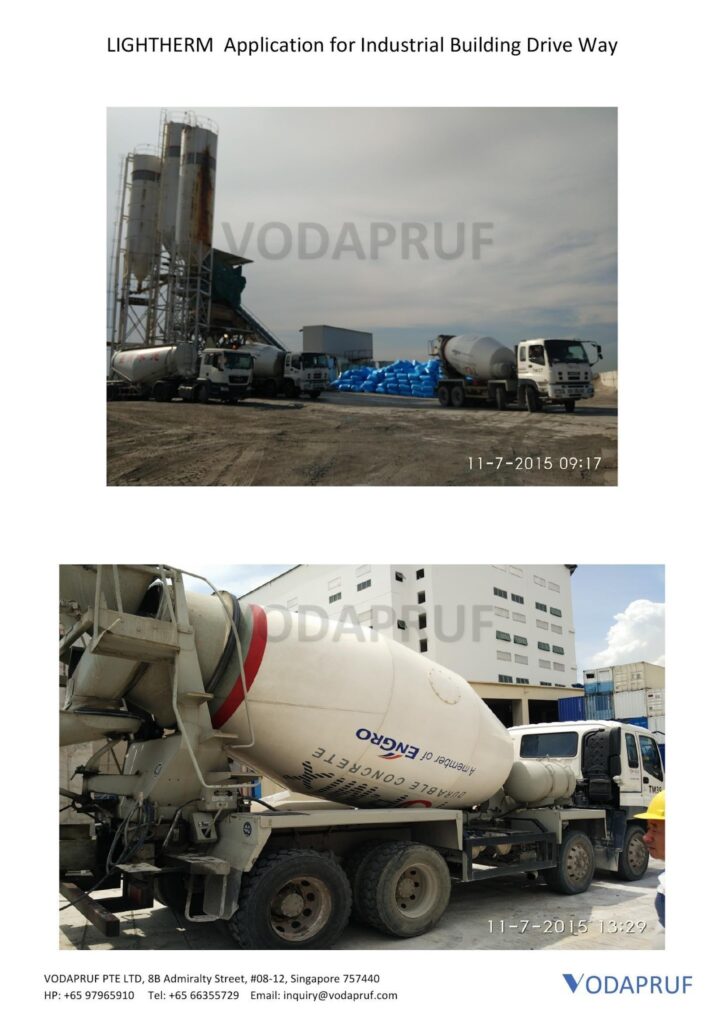
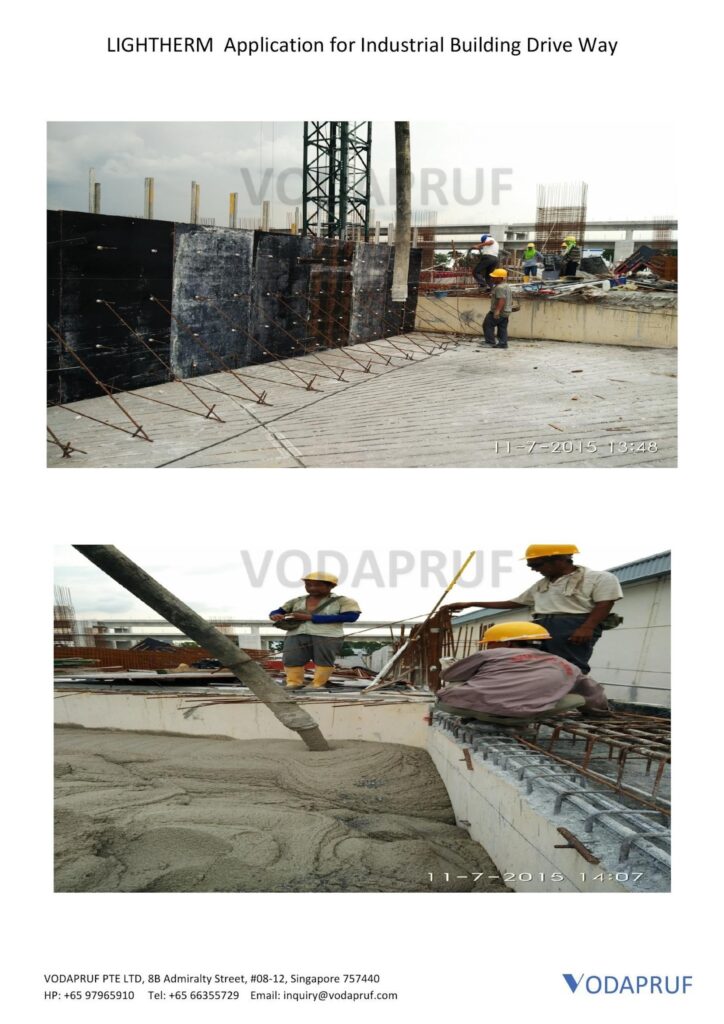
Formwork and rebar mesh preparation for thick RC topping over LIGHTHERM fill
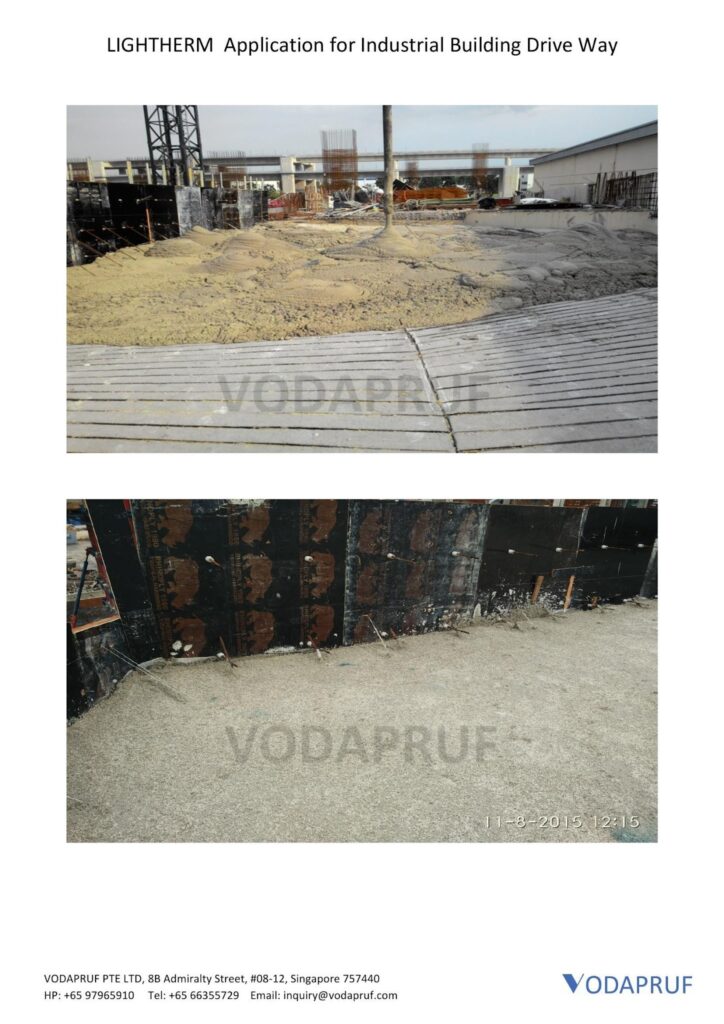
The photos demonstrate the Tier 3 construction sequence: LIGHTHERM is cast as the lightweight base fill, then a thick reinforced concrete topping with full rebar mesh is poured on top. The rebar mesh and increased concrete thickness (150mm+) are designed to distribute heavy vehicle wheel loads — this is standard heavy-duty driveway construction.
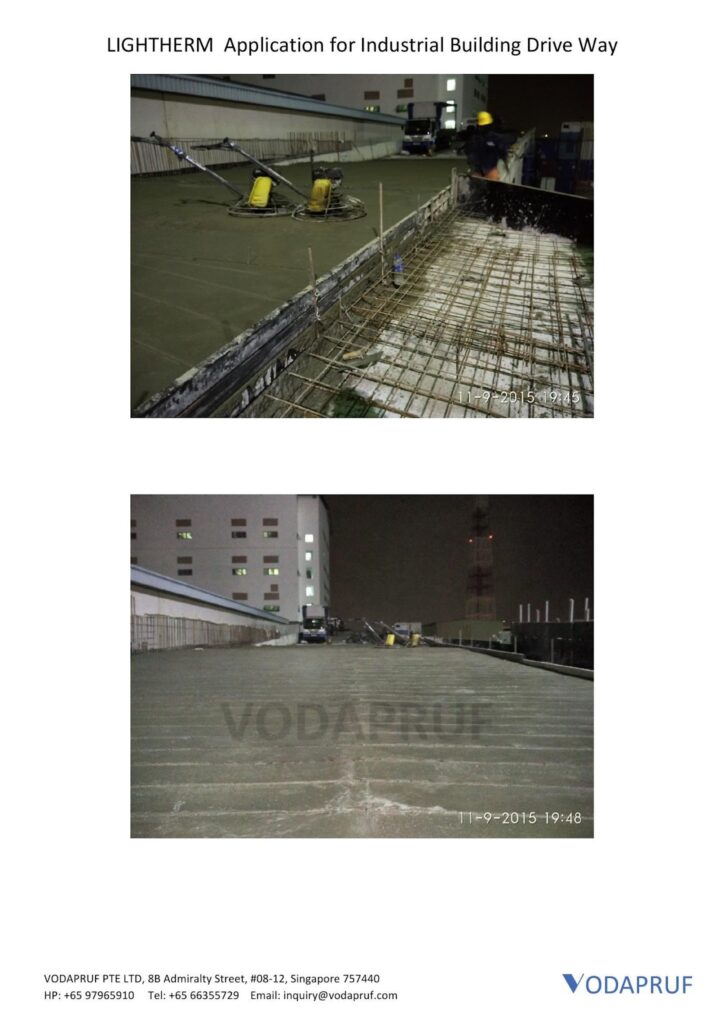
The completed driveway received power trowel finishing for surface durability. The night-time photo shows the scale of the pour — heavy-duty power trowels were used to achieve the required surface hardness for regular heavy vehicle traffic.
TIER 3 PROVEN: Even for heavy vehicle driveways — the most extreme loading case in Singapore at up to 24 kN/m² — LIGHTHERM works as the base fill. The thick reinforced concrete topping handles the vehicle loads. The LIGHTHERM layer underneath is still the same Drymix 250 @ Density 250kg/m3.
Summary — One Product, Every Loading Tier
Three projects. Three loading tiers. One LIGHTHERM specification. The engineering conclusion is consistent across all of them: LIGHTHERM Drymix 250 at minimum 0.5 MPa comfortably exceeds every Singapore building code design load when used within a correctly specified composite floor system.
The design process is straightforward. Specify LIGHTHERM Drymix 250 at 250 kg/m³ as the thermal insulation and lightweight fill layer. Then determine the protection topping screed thickness based on the project’s design load — a routine calculation within SS EN 1992-1-1. The LIGHTHERM specification itself never changes.
| Tier 1 — Light | Tier 2 — Medium | Tier 3 — Heavy | |
| Typical Use | Residential, office, retail | Warehouse, racking | Heavy vehicle driveway |
| Design Load | 1.5 – 5.0 kN/m² | 10.0 – 15.0 kN/m² | 12.5 – 24.0 kN/m² |
| LIGHTHERM Layer | Drymix 250 @ 250kg/m3 | Drymix 250 @ 250kg/m3 | Drymix 250 @ 250kg/m3 |
| Topping Screed | 50mm plain screed | 100mm RC + A10 BRC | 150mm+ RC + rebar |
| FOS (min) | 100× | 33× | 21× |
| Project Reference | State Court Singapore (3,000 m³, Samsung C&T) | Biorad Laboratories (12,000 m², PE verified) | Industrial Driveway (heavy vehicle access) |
Vodapruf Pte Ltd
Specialists in Lightweight Concrete & Advanced Wall Panel Systems
📞 Malaysia: +60 16 217 7155
📞 Singapore: +65 9796 5910
🌐 vodapruf.com
Frequently Asked Questions (FAQ)
What is the minimum compressive strength of LIGHTHERM Drymix 250, and how does it compare to Singapore design loads?
LIGHTHERM Drymix 250 achieves a minimum compressive strength of 0.5 MPa (500 kN/m²) at 28 days. Even at Singapore’s most extreme design load — 24.0 kN/m² for heavy vehicle driveways — this provides a factor of safety of 21 times. For a typical residential corridor at 2.4 kN/m², the safety factor exceeds 200 times.
Does the LIGHTHERM specification change between a residential floor and a heavy industrial driveway?
No. LIGHTHERM Drymix 250 at 250 kg/m³ is specified identically across all three loading tiers — from residential bedrooms to heavy vehicle driveways. The only variable is the protection topping screed above it: thickness and reinforcement increase with the design load, while the LIGHTHERM layer itself never changes.
What are the three loading tiers for LIGHTHERM floor applications in Singapore?
Tier 1 (1.5–5.0 kN/m²) covers residential, office, and retail — requiring only a 50mm plain sand-cement screed with no reinforcement. Tier 2 (10.0–15.0 kN/m²) covers warehouse and heavy racking — requiring 100mm RC with A10 BRC welded mesh. Tier 3 (12.5–24.0 kN/m²) covers heavy vehicle driveways — requiring 150mm+ RC with T12 rebar mesh.
Has LIGHTHERM Drymix 250 been PE-verified for heavy pallet racking loads?
Yes. PE Tung Kwang Voon (#4873) verified the structural design at Biorad Laboratories, Pioneer on 16 October 2023. Under 18-tonne pallet racking with 36 kN point loads per leg, the computed compressive stress was 646 kN/m² — within LIGHTHERM’s verified capacity of 830 kN/m² with a factor of safety of 1.5 applied throughout.
What Singapore building code governs the floor design loads that LIGHTHERM must comply with?
Floor loads in Singapore are governed by SS EN 1991-1-1 — Eurocode 1: Actions on Structures, Singapore National Annex — specifically Tables NA.1 and NA.6. These specify imposed floor loads as uniformly distributed loads (UDL) in kN/m² across all building use categories, from 1.5 kN/m² for residential bedrooms to 24.0 kN/m² for heavy vehicle and fire access driveways.
What is the largest completed LIGHTHERM project referenced for Tier 1 loading?
State Court Singapore, completed with main contractor Samsung C&T Corporation and architect CPG Consultant, involved 3,000 m³ of LIGHTHERM Drymix 250 applied as lightweight topping across multiple floors. The Tier 1 configuration — LIGHTHERM with a 50mm plain sand-cement screed, no reinforcement — was used throughout, covering zones finished with tiles, compressed marble, and carpet.
Why does a 0.5 MPa fill material work under loads typically carried by 20–40 MPa structural concrete?
LIGHTHERM is not a structural element — it functions as lightweight fill within a composite floor system. The protection screed above distributes all imposed loads before they reach the LIGHTHERM layer, and the RC slab below provides primary structural support. The actual compressive stress reaching the LIGHTHERM is substantially lower than the design UDL, which is why a 0.5 MPa fill comfortably handles every Singapore design load with large safety reserves.