
 English
 Arabic
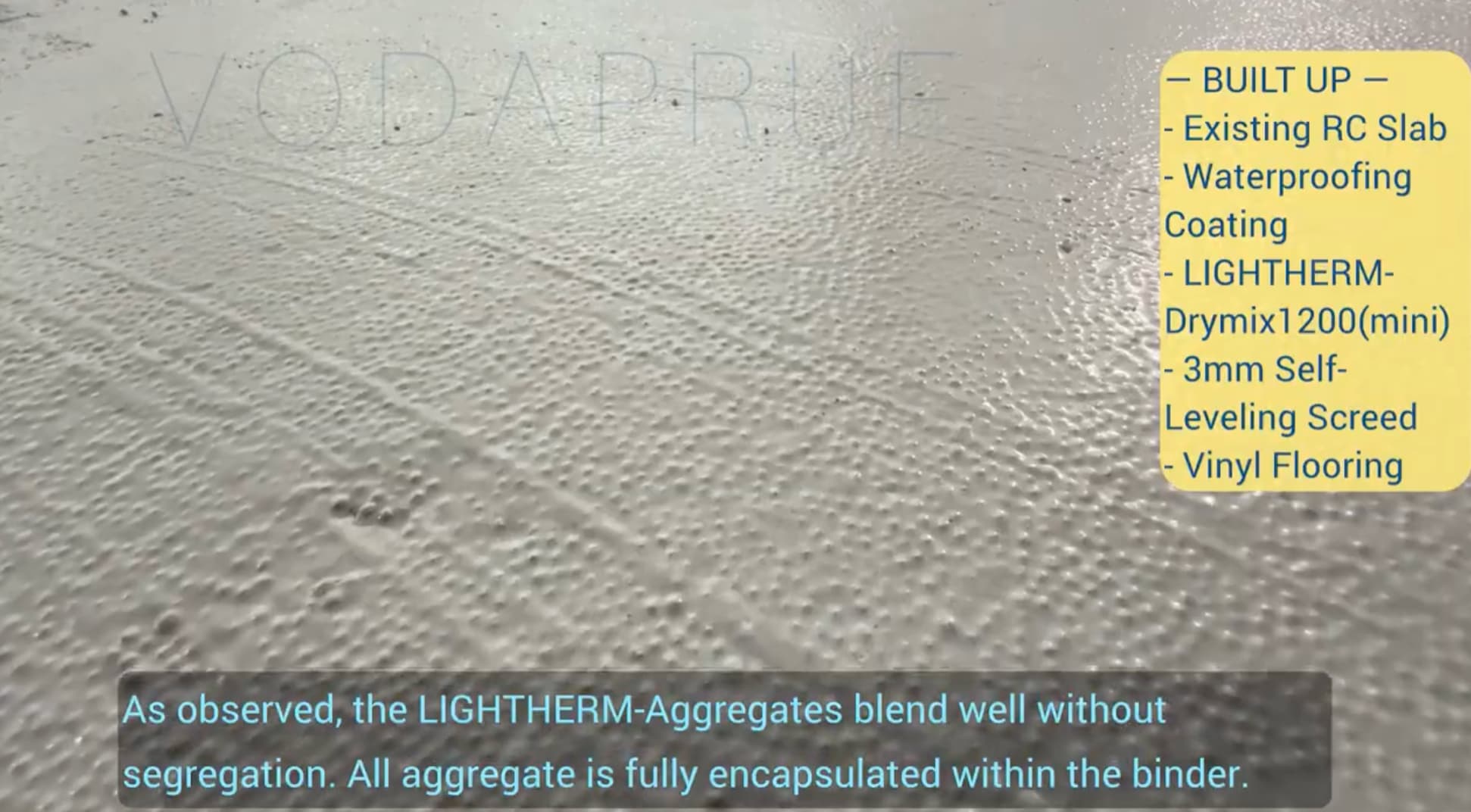
Key Takeaways
- One pour solves two problems: LIGHTHERM Drymix 1200 delivers both structural-grade compressive strength (10–15 MPa) and anti-condensation thermal break (λ = 0.3 W/m·K) in a single monolithic layer — no insulation board sandwich required.
- 6.7× more insulating than normal concrete: At λ = 0.3 W/m·K versus 2.0 W/m·K for conventional concrete, a 50mm layer of LIGHTHERM Drymix 1200 is sufficient to prevent the slab surface from reaching dew point under typical Singapore HVAC conditions.
- Hygrothermal analysis confirms performance across all four scenarios: Ubakus modelling (DIN 4108 / ISO 13788) tested every combination of conditioned and non-conditioned floors — the LIGHTHERM layer prevents condensation in all scenarios where a temperature differential exists.
- Programme savings are significant: The traditional screed + insulation board + adhesive + protective screed approach requires 3–5 days per floor with multiple trades. LIGHTHERM Drymix 1200 is one pour, one trade, one day — walk-on the following day.
- Zero interface failure risk: A monolithic pour has no adhesive joints, no delamination planes, and no risk of boards floating or shifting. All four failure modes of the traditional sandwich approach are eliminated in a single specification decision.
The Problem: Condensation at Conditioned Floor Interfaces
In Singapore and other tropical climates, floors that separate air-conditioned spaces from non-conditioned areas create a consistent thermal engineering challenge. When warm, humid air contacts a cold slab surface — or vice versa — the surface temperature can fall below the dew point of the surrounding air. The result is interstitial condensation: moisture forming within the floor buildup where it is invisible until it has already damaged the finishes above.
The conventional response is a multi-layer floor sandwich: lay a screed, bond an insulation board (XPS or EPS) on top, apply a protective screed over the boards, then proceed with finishes. The intent is sound, but the execution creates its own set of problems.
| Pain Point | Traditional Multi-Layer Approach |
| Multiple wet trades | Screed → adhesive → insulation board → adhesive → screed. Each layer requires curing time and a separate trade crew. |
| Programme delay | Minimum 3–5 additional days per floor for insulation board installation, adhesive curing, and protective screed over the boards. |
| Interface risk | Delamination at adhesive joints. Water ingress between layers. Insulation boards floating or shifting before screed sets. |
| Cost stack-up | Insulation board material + adhesive + additional screed + labour for each layer — compounding costs at every stage. |
The Solution: One Material, Two Functions
LIGHTHERM Drymix 1200 is a pre-blended, high-strength lightweight cementitious mortar that is mixed with water on site and cast in a single pour. The cured layer simultaneously delivers structural fill capacity and a thermal break — two functions from one material, in one operation.
Structural Performance
Compressive strength: 10–15 MPa. Density: 1,200–1,400 kg/m³. LIGHTHERM Drymix 1200 is a load-bearing grade material — it supports finishes, building services, and foot traffic directly after curing without any risk of cracking or deflection under the soft substrate that characterises insulation boards.
Anti-Condensation Performance
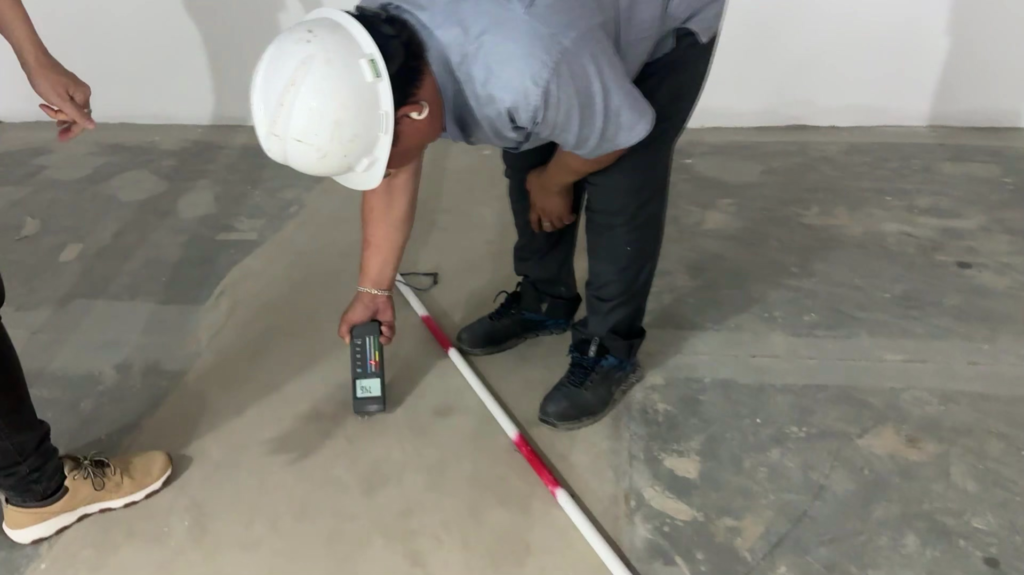
Thermal conductivity: λ = 0.3 W/m·K — compared to λ = 2.0 W/m·K for normal concrete. This makes LIGHTHERM Drymix 1200 approximately 6.7× more insulating than the structural concrete slab it sits on. At 50mm thickness, this thermal resistance is sufficient to prevent the slab surface temperature from reaching dew point under typical Singapore HVAC operating conditions — eliminating the condensation risk at source.
Hygrothermal Analysis: Four Scenarios Validated
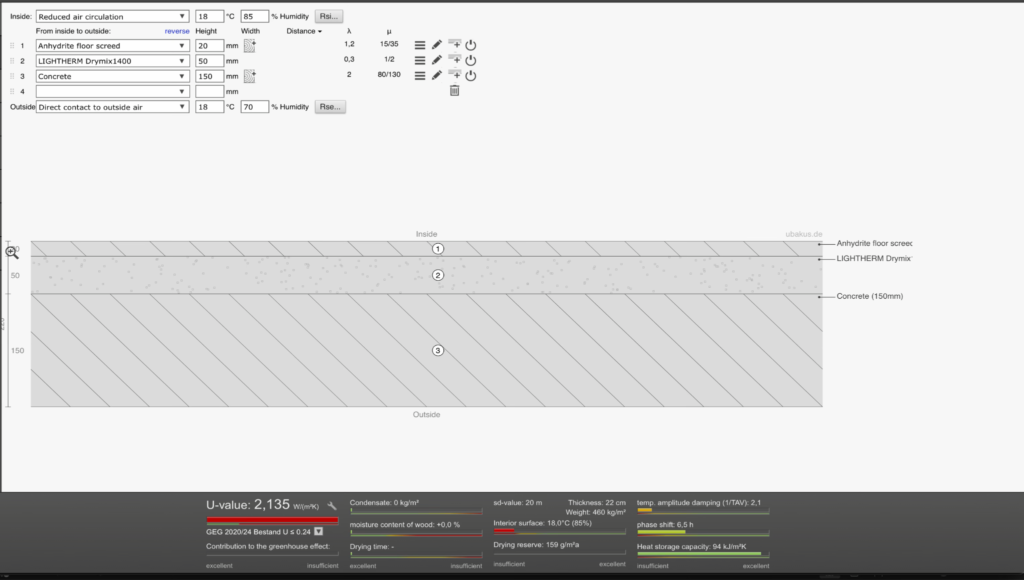
To verify the anti-condensation performance under real project conditions, a hygrothermal analysis was conducted using Ubakus software, compliant with DIN 4108 and ISO 13788. The floor buildup modelled is as follows:
| Layer | Thickness | Thermal Conductivity (λ) | Vapour Resistance (μ) |
| Anhydrite Floor Screed | 20 mm | 1.2 W/m·K | 15 / 35 |
| LIGHTHERM Drymix 1200 | 50 mm | 0.3 W/m·K | 1 / 2 |
| Reinforced Concrete Slab | 150 mm | 2.0 W/m·K | 80 / 130 |
Overall U-value of this assembly: 2.135 W/m²K.
The Four Scenarios
The analysis tested two combinations of conditioned (air-conditioned at approximately 24°C) and non-conditioned (ambient approximately 32°C, high humidity) upper and lower floors — covering every real-world configuration the assembly might face.
Scenario 1 — Both floors non-conditioned: No condensation. With no temperature differential across the slab, the assembly never reaches dew point at any interface.
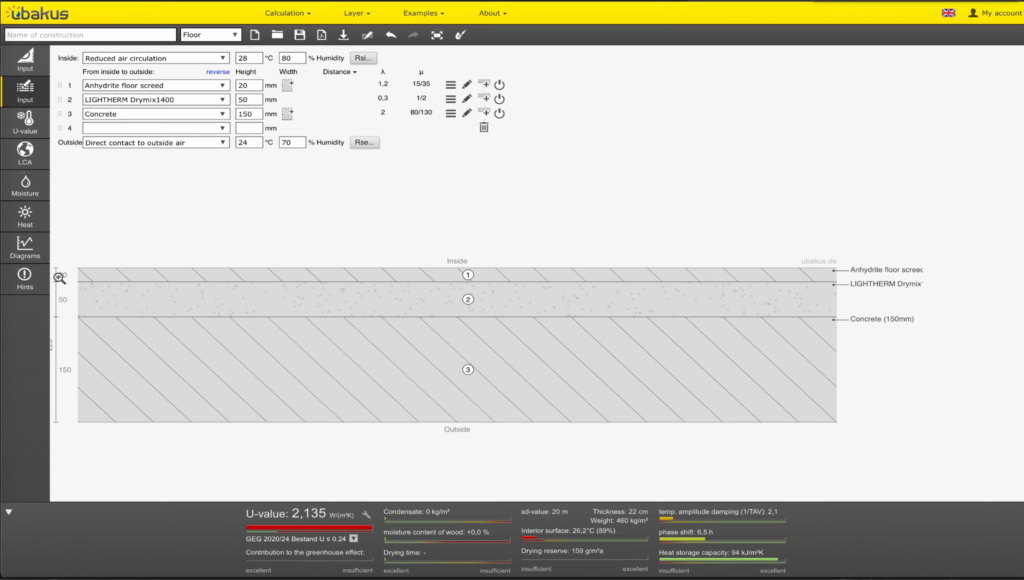
Scenario 3 — Both floors conditioned: No condensation. Both floors are at comparable temperature; the assembly has a positive drying reserve of 159 g/m²a, meaning any incidental moisture actively dries out over time.
Traditional Multi-Layer vs. LIGHTHERM Drymix 1200
The following comparison sets out exactly what each approach requires — in materials, trades, time, and risk.
| Item | Traditional (Screed + Insulation Board) | LIGHTHERM Drymix 1200 |
| Materials required | Floor screed + XPS/EPS insulation board + adhesive + protective screed | LIGHTHERM Drymix 1200 only — pre-blended, add water on site |
| Number of layers | 4 layers minimum | 1 layer |
| Number of wet trades | 2 screed pours + 1 adhesive application | 1 pour |
| Installation time per floor | 3–5 days (each layer needs curing) | 1 day — walk-on next day |
| Thermal conductivity | XPS: λ = 0.035 W/m·K, but joints and screed layers reduce effective performance | λ = 0.3 W/m·K — monolithic, no joints, no delamination risk |
| Compressive strength | Dependent on screed over soft insulation board — risk of cracking/deflection | 10–15 MPa — structural grade, self-supporting |
| Interface failure risk | HIGH — delamination at adhesive joints, water ingress, board shifting | ZERO — monolithic pour, no interfaces |
| Coordination trades | Screed contractor + insulation installer + adhesive applicator | Single trade — LIGHTHERM applicator only |
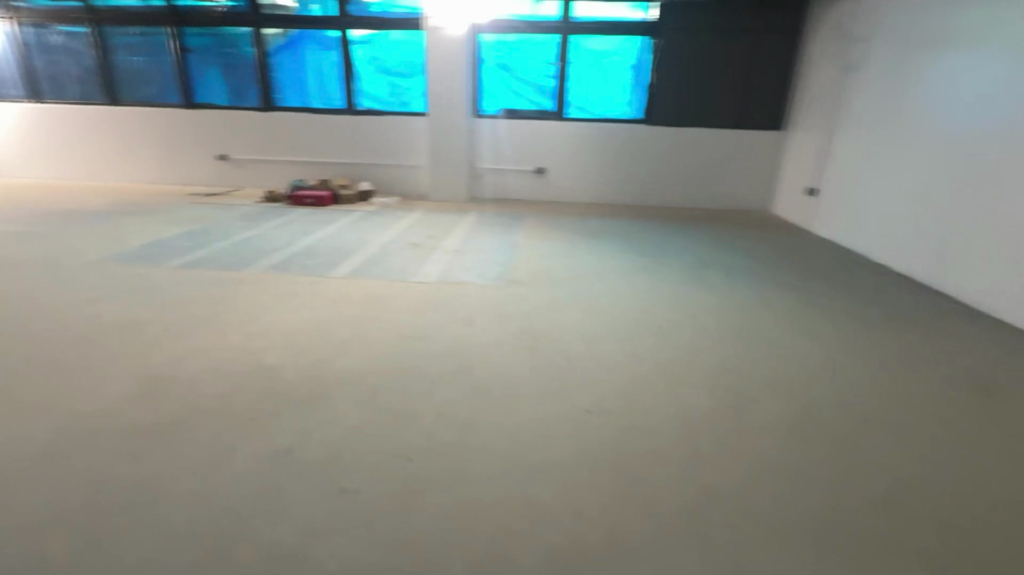
Why Specify LIGHTHERM Drymix 1200
For M&E engineers, main contractors, and consultants dealing with conditioned and non-conditioned floor interfaces, LIGHTHERM Drymix 1200 removes the coordination complexity that makes the traditional sandwich approach so costly and programme-sensitive.
- Single-pour solution: Replaces the entire screed + insulation board + adhesive + protective screed sandwich with one monolithic layer. One trade, one day per floor.
- Structural grade: 10–15 MPa compressive strength means no soft insulation board beneath the screed — no risk of cracking or deflection under load.
- Anti-condensation, proven on site: λ = 0.3 W/m·K — 6.7× more insulating than concrete. Moisture meter readings and Ubakus hygrothermal analysis both confirm performance.
- Zero interface risk: A monolithic pour eliminates adhesive joints, delamination planes, and the risk of boards floating or shifting — the three most common failure modes in the traditional approach.
- Programme acceleration: One trade, one day per floor. Walk-on within 24 hours. No waiting for adhesive to cure between layers.
- Hygrothermal validation: Ubakus analysis to DIN 4108 / ISO 13788 confirms performance across all four conditioned and non-conditioned floor scenarios.
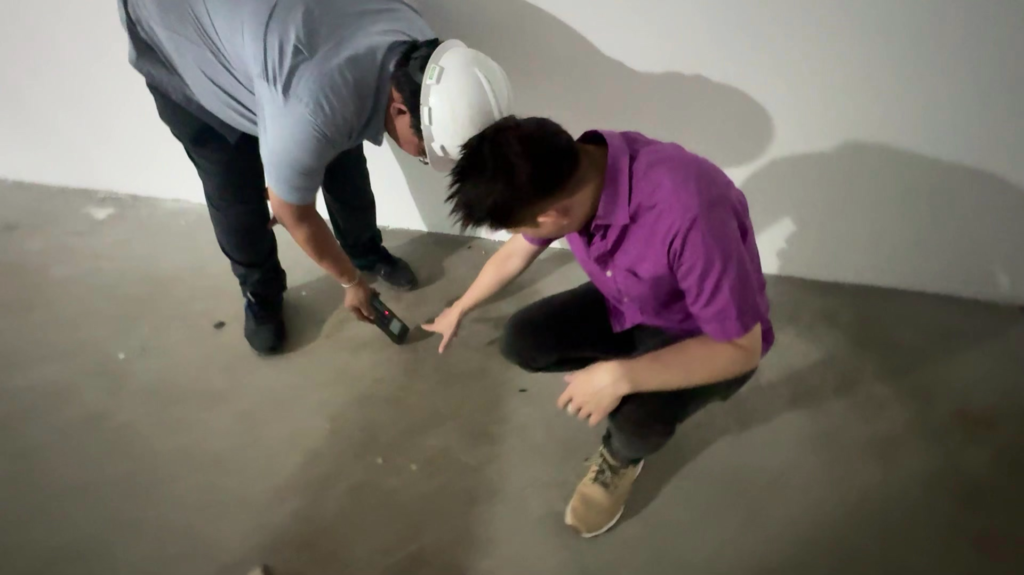
SEE IT IN ACTION
Watch the full site application video:
Vodapruf Pte Ltd
Specialists in Lightweight Concrete & Advanced Wall Panel Systems
📞 Malaysia: +60 16 217 7155
📞 Singapore: +65 9796 5910
🌐 vodapruf.com
Frequently Asked Questions (FAQ)
What is LIGHTHERM Drymix 1200 and what problems does it solve?
LIGHTHERM Drymix 1200 is a pre-blended, high-strength lightweight cementitious mortar that solves two problems in a single pour — it delivers structural-grade compressive strength of 10–15 MPa and an anti-condensation thermal break at λ = 0.3 W/m·K, eliminating the need for a separate insulation board sandwich.
How does LIGHTHERM Drymix 1200 prevent floor condensation in Singapore buildings?
Its thermal conductivity of λ = 0.3 W/m·K is 6.7× more insulating than normal concrete (λ = 2.0 W/m·K). At 50mm thickness, this thermal resistance prevents the slab surface from dropping to dew point under typical Singapore HVAC conditions, stopping interstitial condensation from forming within the floor buildup.
What compressive strength does LIGHTHERM Drymix 1200 achieve?
LIGHTHERM Drymix 1200 achieves 10–15 MPa compressive strength at a density of 1,200–1,400 kg/m³. This is structural grade — capable of supporting finishes, building services, and foot traffic directly after curing, with no risk of cracking or deflection under load.
How long does LIGHTHERM Drymix 1200 take to install compared to a traditional insulation board system?
The traditional screed + insulation board + adhesive + protective screed approach requires a minimum of 3–5 days per floor with multiple trades. LIGHTHERM Drymix 1200 is a single pour completed in one day by one trade, with walk-on access available the following day.
Has LIGHTHERM Drymix 1200 been tested for condensation performance?
Yes. A hygrothermal analysis was conducted using Ubakus software, compliant with DIN 4108 and ISO 13788, modelling the full floor assembly — 20mm anhydrite screed, 50mm LIGHTHERM Drymix 1200, and 150mm RC slab — with an overall U-value of 2.135 W/m²K. Results confirmed no condensation in Scenarios 1 and 3, with the LIGHTHERM layer limiting condensation in Scenario 4.
What are the interface failure risks of using LIGHTHERM Drymix 1200 versus a traditional insulation board system?
The traditional sandwich approach carries a high risk of delamination at adhesive joints, water ingress between layers, and insulation boards floating or shifting before the protective screed sets. LIGHTHERM Drymix 1200 is a monolithic pour — there are no adhesive joints, no delamination planes, and no interfaces. Interface failure risk is zero.
Who should specify LIGHTHERM Drymix 1200?
LIGHTHERM Drymix 1200 is relevant for M&E engineers, main contractors, and consultants working on projects with conditioned and non-conditioned floor interfaces — including air-conditioned commercial floors above car parks, plant rooms, or external ground slabs — where both condensation control and structural fill capacity are required in the same floor buildup.