
 English
 Arabic
Key Takeaways
- vPANEL alone cannot replace RC at the vehicle impact zone: SS EN 1991-1-1 §6.3.3 requires car park barrier walls to resist 150 kN of horizontal force. No lightweight panel from any manufacturer can meet this — it is a material physics constraint, not a product limitation.
- The RC kerb handles impact; vPANEL handles everything above: A 200mm × 900mm reinforced concrete kerb absorbs all vehicle impact at bumper height. The 100mm vPANEL above it manages crowd pressure, wind loads, and architectural finish — each material doing what it does best.
- vPANEL above the kerb is 60% lighter than RC: 100mm vPANEL weighs 65 kg/m² versus 480 kg/m² for 200mm RC, reducing dead load on your slab and creating potential downstream savings on structural design.
- Installation above the kerb is 3× faster with no wet trades: Four panel courses per bay can be positioned in under an hour. No formwork, no curing, no stripping — the RC kerb is the only poured element in the system.
- Every structural check passes against Singapore codes: All elements have been verified against SS EN 1991-1-1, SS EN 1992-1-1 (Eurocode 2), BS 5234 Severe Duty, and the BCA Vehicle Parking Code. Full engineering documentation is available for PE review.
The Question Every Car Park Project Asks
Every project team that discovers vPANEL eventually asks the same question: can it be used for the entire car park wall, including the section vehicles can hit? It is a fair question. vPANEL is fast to install, lightweight, and cost-effective. The honest answer, however, is no — and the reason has nothing to do with product quality.
Singapore’s structural design code (SS EN 1991-1-1 §6.3.3) requires car park barrier walls to resist a horizontal force of 150 kN — equivalent to a 1,500 kg vehicle travelling at 4.5 m/s. Even a 200mm reinforced vPANEL with maximum rebar falls short of this requirement by a factor of 6×. This is not a vPANEL limitation specifically; it is a material physics reality that applies to all autoclaved lightweight concrete products across every manufacturer.
The good news is that reinforced concrete only needs to cover the impact zone. A smarter approach is to use each material where its strengths actually matter — and that is exactly what the RC Kerb + vPANEL system delivers.
How the RC Kerb + vPANEL System Works
The system is straightforward. A reinforced concrete kerb at the base handles the vehicle impact zone. Above the kerb, vPANEL takes over as the architectural wall. There is no redundancy, no over-engineering, and no compromise.
RC Kerb (0–900 mm)
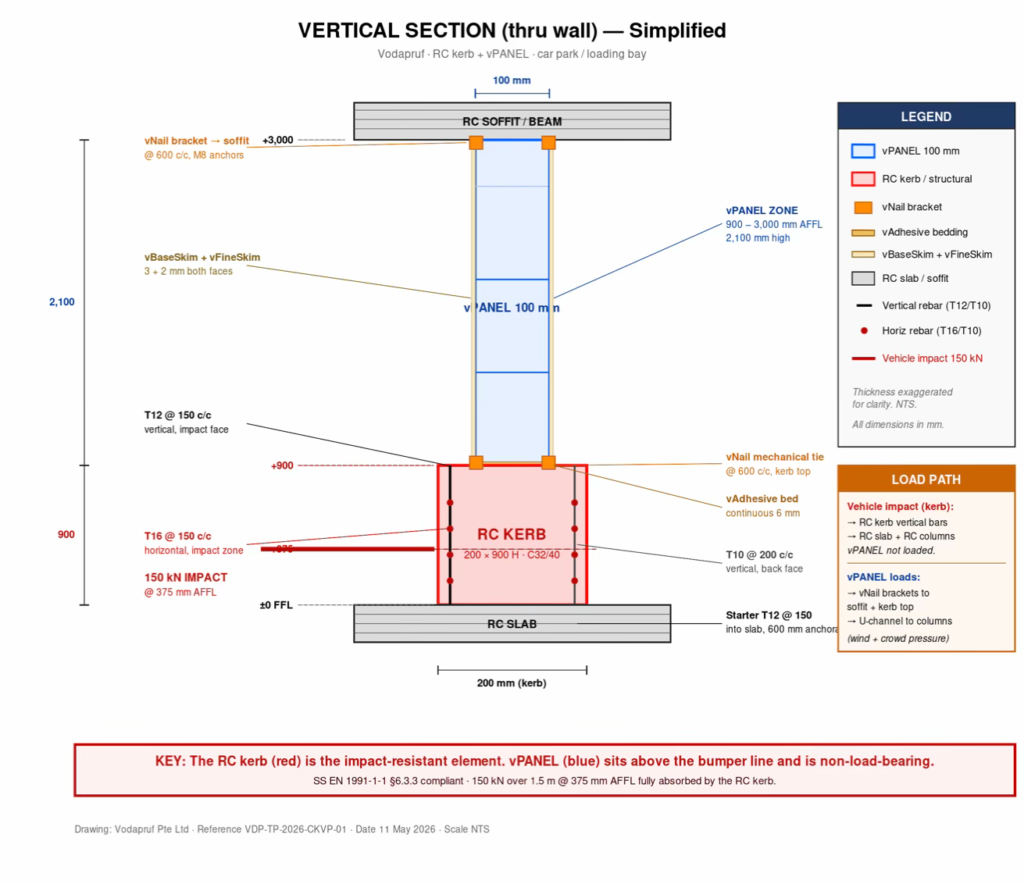
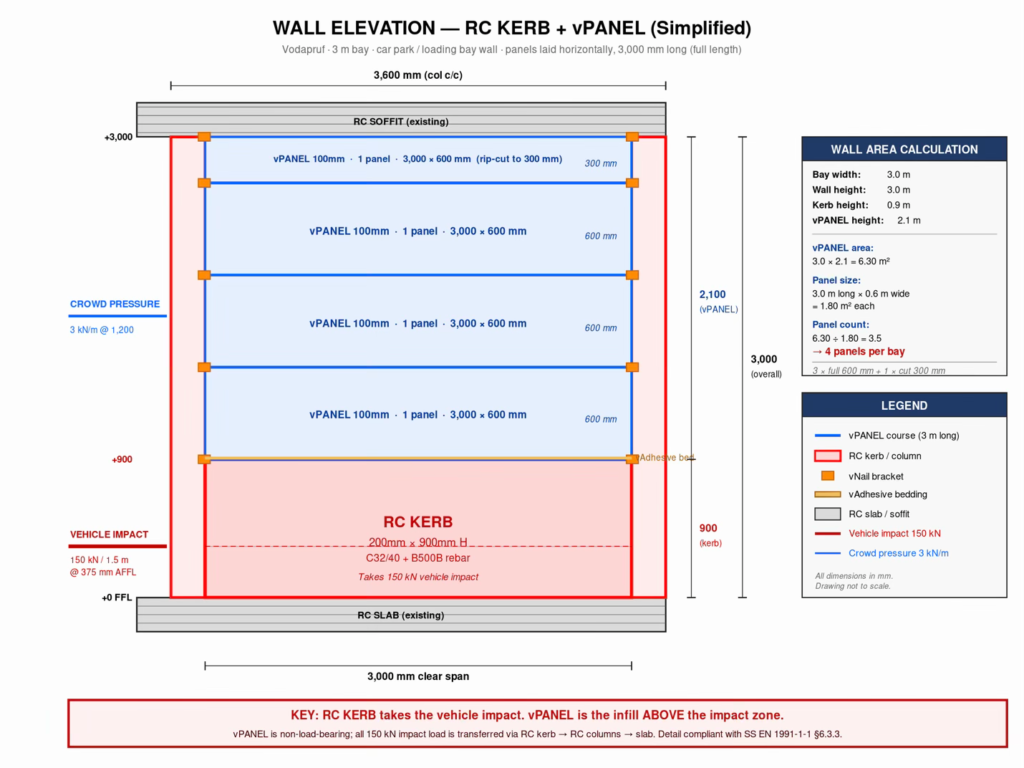
200mm thick, C32/40 concrete with B500B rebar. Fully engineered to absorb 150 kN of vehicle impact at bumper height (375 mm above finished floor level). The kerb top at 900 mm sits well above the bumper line, meaning no vehicle impact load can ever reach the panel zone above. The 900 mm height also exceeds the BCA Vehicle Parking Code minimum guard requirement of 600 mm.
vPANEL Infill (900–3,000 mm)
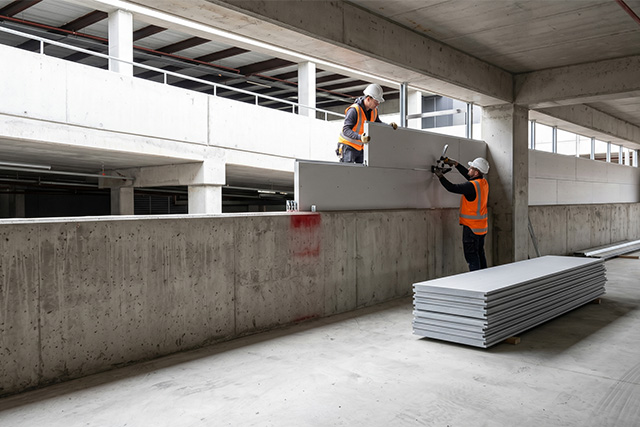
Four courses of 100mm vPANEL are installed horizontally between RC columns above the kerb. This section resists crowd pressure (3 kN/m, tested to BS 5234 Severe Duty) and internal wind loads. Both faces are finished with vBaseSkim followed by vFineSkim, bringing the wall to a paint-ready surface without any additional wet trades.
Connections
vNail brackets pin the panels to the soffit above and the kerb top below. U-channel tracks slot into the RC columns at each side. vAdhesive bonds each panel-to-panel joint and the panel-to-kerb interface. The connections are straightforward, require no specialist fabrication, and are part of the standard vPANEL accessories package.
Why vPANEL Cannot Replace RC at the Vehicle Impact Zone
The numbers make the constraint clear. A vPANEL wall has been tested to carry 7.5 kN of horizontal force across a 2.5m span under static crowd loading — giving a line load intensity of 3 kN/m and a maximum moment capacity of 14.7 kNm. A car park barrier wall under SS EN 1991-1-1 must resist 150 kN concentrated over a 1.5m width — a dynamic load with a line load intensity of 100 kN/m and a required moment capacity of 84.4 kNm.
The binding constraint is the compressive strength of ALC. Even with unlimited internal steel reinforcement, the concrete face of the panel cannot develop enough compression to resist the bending moment generated by a vehicle strike. This is why every compliant car park in Singapore uses an RC kerb or RC wall at the impact zone — and why Vodapruf is upfront about this rather than overstating what the product can do.
The Numbers at a Glance
| vPANEL (tested) | Vehicle Impact (required) | |
| Horizontal force | 7.5 kN over 2.5 m | 150 kN over 1.5 m |
| Line load intensity | 3 kN/m | 100 kN/m |
| Load type | Static (crowd) | Dynamic (vehicle) |
| Moment capacity | 14.7 kNm (max) | 84.4 kNm required |
Why Not Build the Whole Wall in Reinforced Concrete?
Building the entire 3-metre wall in RC is technically possible, but it carries real costs that are often overlooked at the specification stage. The RC kerb fully absorbs all 150 kN of vehicle impact within its 900mm height. Everything above that level is a partition wall — and specifying RC for a partition wall means paying for far more capacity than the application requires.
Using 100mm vPANEL for the upper 2.1 metres delivers concrete project benefits:
- 60% lighter above the kerb. 100mm vPANEL weighs 65 kg/m², compared to 480 kg/m² for 200mm RC. The reduction in dead load on the slab can translate into structural savings on beam and column sizing.
- 3× faster installation. Four courses of vPANEL per bay can be set in under an hour. There is no formwork to erect, no concrete to cure, and no stripping to schedule. A full-height RC wall requires all three.
- No wet trades above the kerb. The vPANEL installation is entirely dry. The RC kerb is the only poured element — a single controlled pour at ground level with no overhead formwork required.
- Acoustic performance. vPANEL achieves STC 37–39 as a bare panel, comparable to a plastered block wall. A skim coat brings it to a paint-ready finish without any additional acoustic treatment.
- Tested robustness. vPANEL carries a BS 5234 Severe Duty rating — the highest classification for partition walls — covering hard body impact, soft body impact, crowd pressure, and heavy anchorage loads.
- Thinner finished wall. 100mm vPANEL with 5mm skim coat on each side gives a total wall thickness of approximately 110mm, versus 200mm for an RC wall. The 90mm difference per wall face adds usable width back into each car park bay.
Fully Verified — All Structural Checks Pass
Every element of the RC Kerb + vPANEL system has been assessed against the applicable Singapore codes. The full engineering calculations are available in Technical Proposal VDP-TP-2026-CKVP-01 for PE review and BCA submission. The summary is below.
| Structural Check | Demand | Capacity | Util. | Status |
| RC kerb — vertical cantilever | 37.5 kNm/m | 45.6 kNm/m | 82% | PASS |
| RC kerb — horizontal span | 33.8 kNm | 48.4 kNm | 70% | PASS |
| RC kerb — local crush | 7.5 MPa | 21.3 MPa | 35% | PASS |
| vPANEL — crowd pressure | 3 kN/m | 3 kN/m | 100% | PASS |
| vPANEL — wind & robustness | 0.5 kPa | 0.6 kPa | 80% | PASS |
Code Compliance Summary
- SS EN 1991-1-1 §6.3.3: Vehicle impact requirement of 150 kN / 1.5m at 375mm AFFL — fully absorbed by the RC kerb.
- SS EN 1992-1-1: RC kerb designed to Eurocode 2 with the Singapore National Annex.
- BS 5234 / SS 492 Severe Duty: vPANEL meets the highest partition robustness rating for impact, crowd pressure, and anchorage.
BCA Vehicle Parking Code: 900mm kerb height exceeds the 600mm minimum guard requirement.
How to Specify This System
For architects, qualified persons, and main contractors working on car park or loading bay projects, the specification process is straightforward:
- RC kerb: Coordinate with your Professional Engineer for the 200mm × 900mm RC kerb design. Vodapruf provides a reference detail with rebar schedule that your PE can adapt to project-specific site conditions.
- vPANEL supply: Vodapruf supplies 100mm vPANEL cut to bay width (typically 3,000mm) together with the full accessories package — vAdhesive, vNail brackets, U-channels, vBaseSkim, and vFineSkim.
- Installation guidance: Vodapruf’s technical team provides method statements and on-site guidance for the vPANEL installation above the kerb.
- Documentation: Full technical proposal with engineering calculations is available for PE review and BCA submission upon request.
Important: The RC kerb and column design remain the responsibility of the project’s Professional Engineer. Vodapruf supplies the vPANEL components, provides installation guidance, and furnishes tested performance data for the infill elements above the kerb.
Need a Car Park Wall Solution?
We provide full technical support — from RC kerb detailing to vPANEL supply and installation guidance.
📞 Malaysia: +60 16 217 7155
📞 Singapore: +65 9796 5910
🌐 vodapruf.com
Frequently Asked Questions (FAQ)
What does Singapore’s building code require for car park barrier walls?
SS EN 1991-1-1 §6.3.3 requires car park barrier walls to resist 150 kN of horizontal force over 1.5m at 375mm above finished floor level — equivalent to a 1,500 kg vehicle at 4.5 m/s. Engineering calculations by a Professional Engineer are required before BCA submission.
Can vPANEL be used on its own for the full car park wall, including the vehicle impact zone?
No. Even a 200mm reinforced vPANEL can only resist 7.5 kN — the code requires 150 kN, a shortfall of 6×. This applies to all ALC products regardless of manufacturer. An RC kerb at the base is non-negotiable for code compliance.
What is the minimum RC kerb height required for car park walls in Singapore?
The BCA Vehicle Parking Code sets a 600mm minimum. The RC Kerb + vPANEL system uses 900mm — ensuring the kerb top sits well above the 375mm bumper line, so no vehicle impact load can reach the vPANEL zone above.
Why is full-height reinforced concrete not always the better choice for car park walls?
The RC kerb only needs 900mm to absorb all vehicle impact. Above that, vPANEL is 60% lighter, installs 3× faster, requires no formwork or curing, and produces a thinner wall — without sacrificing any structural performance the application actually demands.
How is vPANEL fixed to the RC kerb and structural columns in a car park wall?
Three components work together: vNail brackets pin panels to the soffit and kerb top; U-channel tracks slot into RC columns for lateral restraint; vAdhesive bonds each panel-to-panel and panel-to-kerb joint. All are standard accessories — no specialist fabrication required.
Does the RC Kerb + vPANEL system comply with BCA requirements for car park submissions?
Yes. The system is verified against SS EN 1991-1-1, SS EN 1992-1-1 (Eurocode 2), BS 5234 Severe Duty, and the BCA Vehicle Parking Code. Full engineering documentation (Ref: VDP-TP-2026-CKVP-01) is available for PE review and BCA submission.
What is the total finished wall thickness of the RC Kerb + vPANEL system?
The vPANEL zone finishes at approximately 110mm total — 100mm panel plus 5mm skim on each face. This is 90mm thinner than a 200mm RC wall, recovering usable car park bay width across the floor plate.