
 English
 Arabic

Key Takeaways
- About half the weight: LIGHTHERM Drymix 250 weighs 20 kg/m² at 80 mm, against 40 to 48 kg/m² for AAC blocks, which is 2.0 to 2.8 tonnes less on every 100 m² of slab.
- More than twice the insulation: the 80 mm layer gives 1.19 m²K/W, against 0.41 to 0.50 m²K/W for AAC infill.
- No joints under the screed: one continuous pour replaces about 6.7 m of block joints per square metre, which removes a common cause of screed cracking and hollow-sounding floors under thin vinyl.
- Fits the real site: it is poured to level pins and flows around conduits and columns, so there is nothing to cut.
- Strength is not the deciding factor here: floor loads reach the fill as spread pressure, and Drymix 500 kg/m³ is available where 3 MPa is specified.
Raising a floor by 80 mm before vinyl goes down is a common job. It might be a level change between rooms, a service zone, or a slab that sits lower than the architect wants the finished floor. Whatever the reason, the fill has two jobs. It must be light enough not to overload the slab, and it must be flat and solid, because thin vinyl shows every flaw beneath it.
Two options are commonly used: bedding AAC blocks into the zone, or pouring LIGHTHERM Drymix 250, our pre-packed lightweight concrete screed at 250 kg/m³. This article compares them on weight, insulation, joints, site fit and installation, and then covers strength, the recommended build-up.
Which Is Lighter, a LIGHTHERM Drymix 250 or AAC Blocks?
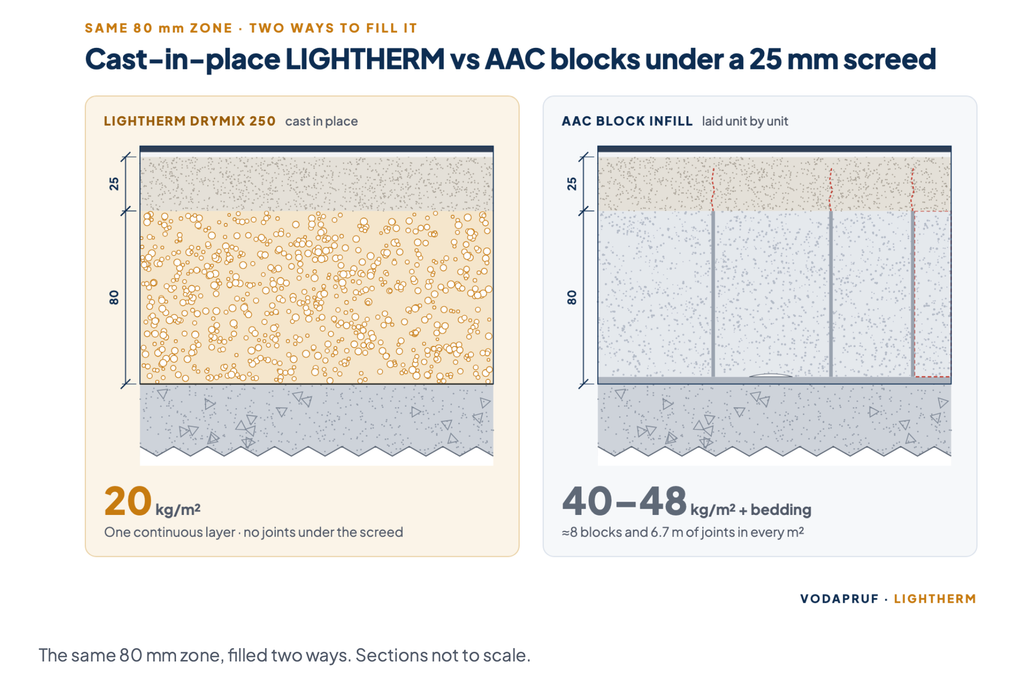
Drymix 250 is lighter. AAC is light compared with normal concrete, but it is still two to two-and-a-half times heavier than Drymix 250. At 80 mm, Drymix 250 weighs about 20 kg/m². AAC blocks at 500 to 600 kg/m³ weigh 40 to 48 kg/m², before bedding and joint mortar are added.
Across a 100 m² floor, that is 2.0 to 2.8 tonnes less permanent load. The saving matters most in refurbishments and on existing slabs with little spare capacity.
How Do the Two Options Compare on Insulation?
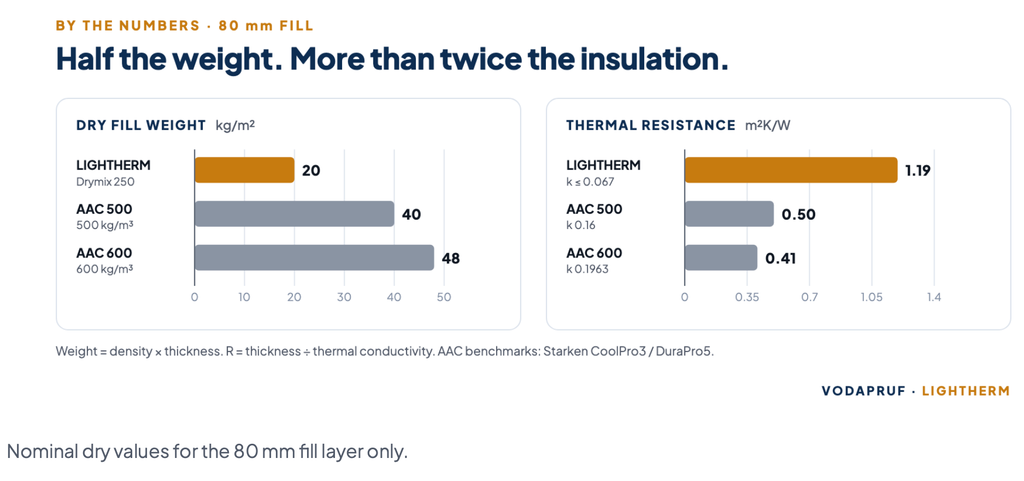
Drymix 250 insulates more than twice as well at the same depth. Its thermal conductivity is 0.067 W/mK or lower, against 0.16 to 0.196 W/mK for common AAC grades. At 80 mm, that gives 1.19 m²K/W of thermal resistance for Drymix 250 and 0.41 to 0.50 m²K/W for AAC, or 2.4 to 2.9 times the resistance.
This pays off wherever the floor separates an air-conditioned room from a warmer space below, or sits over a roof slab.
Why Do Joints Matter Under a Thin Screed and Vinyl?
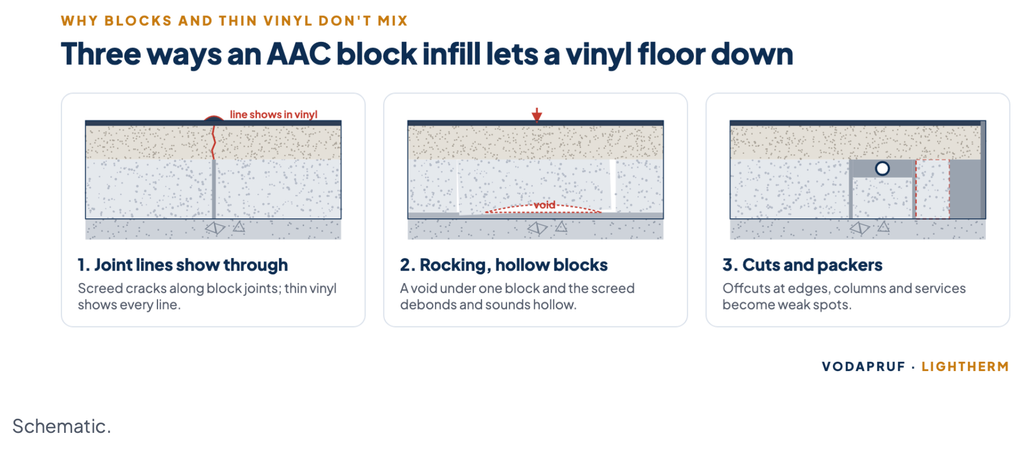
Joints matter because thin vinyl shows every line beneath it. With the usual 600 x 200 mm blocks, each square metre of AAC infill holds about 8 blocks and 6.7 m of joints. A 25 mm protection screed laid over that grid tends to crack along the joints, and the cracks telegraph through the vinyl. A block that is not fully bedded can also rock, which lets the screed debond and leaves the floor sounding hollow.
LIGHTHERM is poured, so it beds itself onto the slab in full contact and gives the screed one continuous base. The only joints are the movement joints you plan.
Which Option Copes Better With an Uneven Slab?
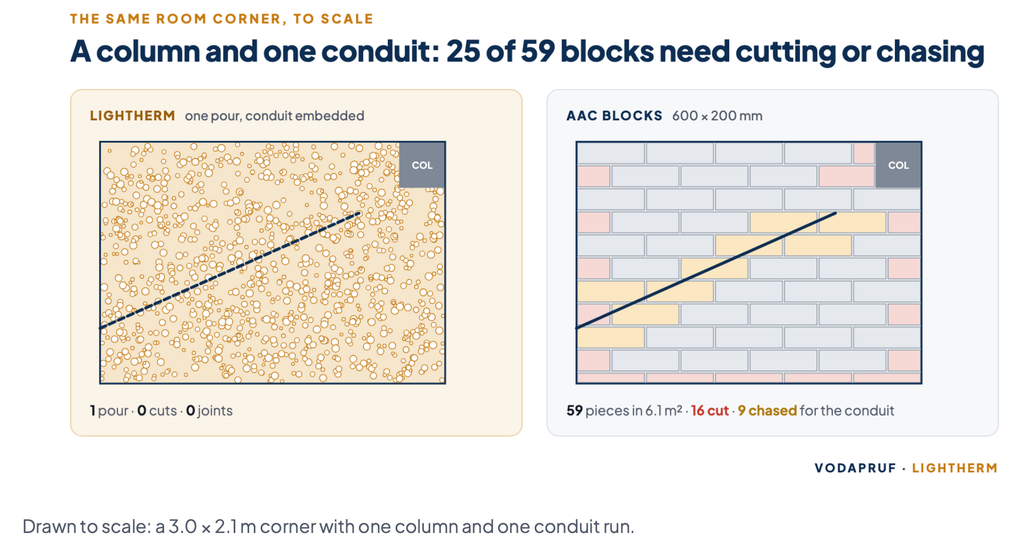
The poured option copes better. Slabs are never perfectly flat, and rooms have columns, conduits and awkward edges. AAC blocks come in fixed thicknesses, so they must be bedded, packed or cut to reach an 80 mm zone, and then cut again around every obstacle. In a worked example of a 3.0 by 2.1 m room corner with one column and one conduit run, 25 of 59 blocks needed cutting or chasing.
LIGHTHERM is poured to level pins at whatever depth the slab needs, and it flows around secured services.
How Much Faster Is LIGHTHERM to Place Than AAC Blocks?
Drymix 250 comes pre-packed. Mix 9.5 to 11.5 litres of water per bag for five minutes, and each bag gives about 70 litres of lightweight concrete. It can be pumped at up to 10 m³ an hour, which is roughly 125 m² of 80 mm fill per pump-hour. Its high early strength means the protection screed can usually go on the next day.
For a 100 m² floor at 80 mm (8 m³), the practical difference looks like this. LIGHTHERM means about 115 bags, mixed and pumped, with 2.0 tonnes of dry fill, no joints under the screed and no cutting. AAC means about 833 blocks placed by hand, 4.0 to 4.8 tonnes of dry fill plus bedding, about 667 m of joints, and cutting at every edge, column and service.
| 100 m² at 80 mm (8 m³) | LIGHTHERM | AAC blocks |
| Dry fill weight | 2.0 tonnes | 4.0–4.8 tonnes + bedding |
| Material to handle | ≈115 bags, mixed and pumped | ≈833 blocks, placed by hand |
| Joints under the screed | None | ≈667 m |
| Cutting | None | Every edge, column and service |
Isn’t AAC Stronger Than LIGHTHERM Drymix 250?
As a single block, yes. An AAC block is typically 3 to 5 N/mm², against more than 0.83 N/mm² for Drymix 250. However, floor loads reach the fill through the screed as spread pressure, and 0.83 N/mm² equals 830 kN/m² of bearing capacity. That is far above typical imposed floor loads of 2 to 5 kN/m². What a vinyl floor really needs is a flat, continuous, fully bedded base.
If your specification calls for 3 MPa compressive strength, use LIGHTHERM Drymix 500 kg/m³. For racking, forklifts or other heavy point loads, send us the load schedule and we will size the topping.
Side-by-Side Comparison
| LIGHTHERM Drymix 250 | AAC Block Infill | |
| Dry fill weight, 80 mm | 20 kg/m² | 40–48 kg/m² + bedding |
| Thermal conductivity | ≤ 0.067 W/mK | 0.16–0.196 W/mK |
| Thermal resistance, 80 mm | 1.19 m²K/W | 0.41–0.50 m²K/W |
| Joints under the screed | None (planned bay joints only) | ≈6.7 m per m² |
| Uneven slab, exact 80 mm zone | Poured to level pins, any depth | Fixed block sizes: bed, pack or cut |
| Around conduits and columns | Flows around, no cutting | Hand-cut and chased pieces |
| Impact sound | 14 dB reduction at 500 Hz (50 mm) | Not declared for floors |
| Fire | Class A1, non-combustible | Non-combustible |
| Compressive strength | > 0.83 N/mm² · need 3 MPa? use LIGHTHERM Drymix 500 kg/m³ | ≈ 3 to 5 N/mm² |
What Is the Recommended Floor Build-Up Under Vinyl?
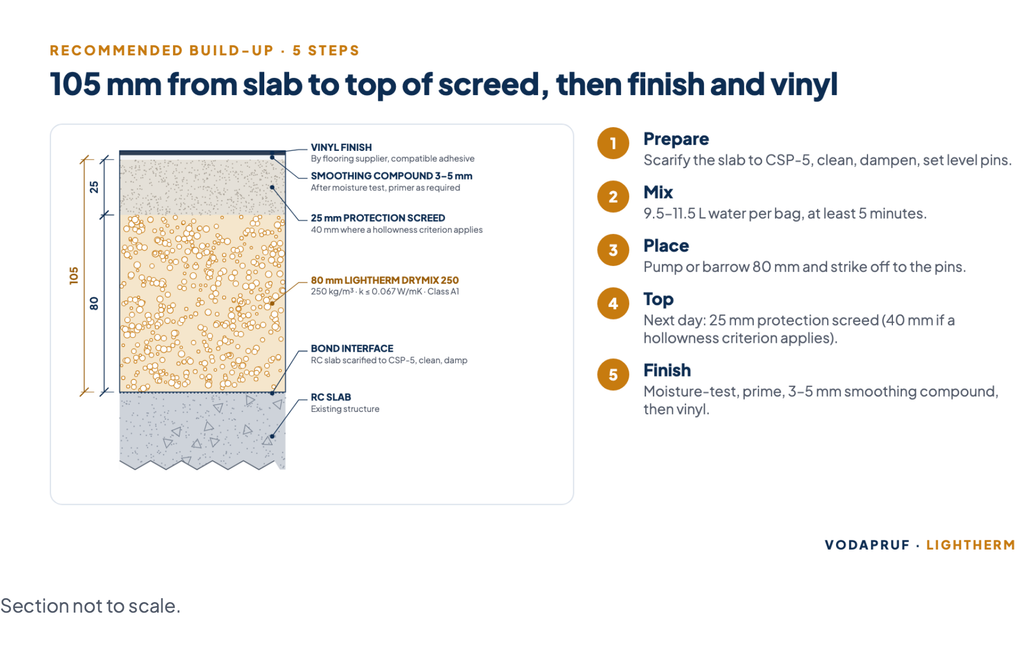
The recommended build-up for LIGHTHERM Drymix 250 under vinyl follows five steps:
- Prepare the slab. Scarify the RC slab to CSP-5, clean and dampen it, then set level pins.
- Mix. Use 9.5 to 11.5 litres of water per bag and mix for at least five minutes.
- Place. Pump or barrow 80 mm of Drymix 250 and strike it off to the pins.
- Top. The next day, cast a 25 mm protection screed, or 40 mm where the main contractor sets a hollowness criterion.
- Finish. Moisture-test, prime, apply a 3 to 5 mm smoothing compound, and lay the vinyl to the flooring supplier’s requirements.
Track Record
LIGHTHERM has been supplied since 2013, across more than 170 projects and over 17,000 m³. These include Bio-Rad (12,000 m²), the Apple data centre at Ang Mo Kio, the State Courts, and SGH’s Elective Care Centre and National Dental Centre.
Planning a floor top-up? Send us your levels and intended finish, and we will recommend a build-up.
📞 Malaysia: +60 16 217 7155
📞 Singapore: +65 9796 5910
🌐 vodapruf.com
Frequently Asked Questions
What is LIGHTHERM Drymix 250?
LIGHTHERM Drymix 250 is a pre-packed lightweight insulating screed with a density of 250 kg/m³. It has a thermal conductivity of 0.067 W/mK or lower and is classified A1, non-combustible, to EN 13501-1. Mixed with water, each bag gives about 70 litres of lightweight concrete.
How much load does the fill add to a slab in kN/m²?
At 80 mm, the dry weight of Drymix 250 is 20 kg/m², roughly 0.2 kN/m². AAC block infill at 40 to 48 kg/m² comes to roughly 0.4 to 0.5 kN/m², before bedding and joint mortar. These figures cover the fill layer only, so the project’s structural engineer should check the full build-up against the slab’s capacity.
Does LIGHTHERM Drymix 250 or AAC block infill perform better for impact sound?
LIGHTHERM Drymix 250 has a stated impact sound reduction of 14 dB at 500 Hz, measured at 50 mm. AAC block infill has no declared figure for floors, which means there is no data to compare rather than proof of poor performance. Ask the flooring supplier or acoustic consultant to confirm what your project requires.
What does scarifying the slab to CSP-5 mean?
Scarifying roughens the surface of the RC slab to a CSP-5 profile, where CSP stands for Concrete Surface Profile, a standard scale for surface roughness. The slab is then cleaned and dampened, and level pins are set. Only after this preparation is LIGHTHERM Drymix 250 mixed and placed.
How much height does the full floor build-up add?
In the 80 mm example, the fill and a 25 mm protection screed add 105 mm above the slab, or 120 mm where a 40 mm screed is specified. The 3 to 5 mm smoothing compound and the vinyl itself add further thickness. Because LIGHTHERM is poured to level pins, the fill depth can change to suit the slab.
How do I estimate how many bags of Drymix 250 a floor needs?
Multiply the floor area by the fill thickness to get the volume, then divide by about 0.07 m³, the yield of one bag. For example, 50 m² at 80 mm is 4 m³, or roughly 57 bags. A 100 m² floor at 80 mm needs 8 m³, about 115 bags.
How do I get a build-up recommendation for my floor top-up?
Send your levels and intended finish by WhatsApp at +65 9796 5910 or to inquiry@vodapruf.com, and we will recommend a build-up. For racking, forklifts or other heavy point loads, include the load schedule so we can size the topping. LIGHTHERM has been supplied across more than 170 projects since 2013.