
 English
 Arabic
Key Takeaways
- Lightweight concrete panels, also known as ALC or AAC panels, are a factory-manufactured cementitious wall product offering significant weight reduction compared to conventional concrete along with fire resistance and thermal insulation benefits. The curing method varies by manufacturer, with some using traditional autoclaving and others using naturally-cured formulations.
- Malaysia and Singapore both have an established base of lightweight concrete panel manufacturers, ranging from large group-affiliated producers to specialised ALC panel suppliers with decades of regional experience.
- This list is not a ranking. It is intended to give readers a starting reference point for lightweight concrete panel manufacturers serving the Malaysia and Singapore market, presented in no particular order of merit.
- Vodapruf manufactures both vPANEL (ALC panel) and LIGHTHERM (lightweight aggregate concrete) from its own factory in Kulai, Johor Bahru, with a Singapore sales office serving both markets directly.
- Buyers should verify fire test certification, production capacity, and project references directly with any manufacturer before specifying a lightweight concrete panel product for a commercial or industrial project.
Top Lightweight Concrete Panel Manufacturers Serving Singapore and Malaysia (2026)
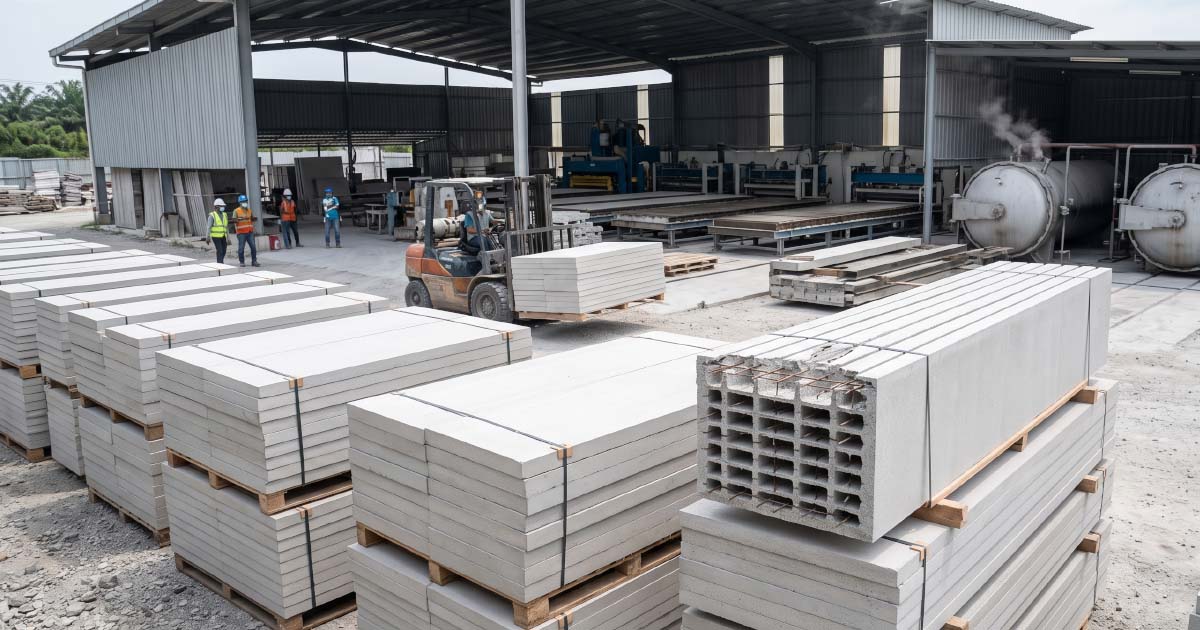
Lightweight concrete panels, commonly known as ALC (Autoclaved Lightweight Concrete) or AAC (Autoclaved Aerated Concrete) panels, have become a standard specification choice for partition walls, facade infill, and industrial building envelopes across Malaysia and Singapore. The material is manufactured from silica sand, cement, lime, and aluminium powder, with an aeration process that gives the panel its lightweight cellular structure. Curing method varies by manufacturer: some use a traditional pressurised-steam autoclaving process, while others use alternative naturally-cured formulations designed to achieve comparable performance with lower energy consumption during production.
For architects, contractors, and developers evaluating suppliers, this article introduces five manufacturers active in the Malaysia and Singapore lightweight concrete panel market. This list is not a ranking of quality or performance. It is a general reference point, and any project should verify current certifications, capacity, and pricing directly with each supplier before specification.
1. Vodapruf
Vodapruf manufactures lightweight concrete panels under the vPANEL brand, alongside its LIGHTHERM lightweight aggregate concrete product line. The company was founded in 2013, initially developing a non-autoclaved lightweight thermal insulation panel, and was formally incorporated in Singapore in 2014. Production shifted to Malaysia in 2016, with a dedicated EPS manufacturing operation set up in Senai, Johor Bahru, followed by a second factory in Kulai, Johor Bahru in 2017 specifically for vPANEL production. The factory footprint expanded further in 2018 to a 2-acre site.
Vodapruf’s manufacturing base is located in Kulai, Johor Bahru, roughly 35km from Singapore, with a dedicated sales office in Singapore serving both markets from a single regional operation. The company reports an annual vPANEL production capacity of approximately 280,000 square metres. Beyond Malaysia and Singapore, Vodapruf has also expanded regionally, setting up a branch in Sarawak in 2020 to produce vPANEL Block, along with a Lightherm production branch in Northern Ireland, and franchise partnerships in Korea, China, and the Philippines for its Lightherm concrete product line.
vPANEL has been installed across more than 30 completed projects spanning private and government sectors, including work for HDB, MOH, and JTC, as well as commercial and industrial applications such as data centres, food factories, and chemical plants. Vodapruf’s Lightherm lightweight concrete line has been used across more than 230 projects to date.
The company also offers vPANEL Short Panel, a 1.5-metre fixed-length format available in 100mm, 150mm, and 200mm thicknesses, developed specifically to bridge the gap between standard AAC blocks and full-length crane-lifted panels. This format is positioned for renovation and factory retrofit projects in Singapore and Malaysia where crane access is limited, and is designed to install significantly faster than traditional AAC blocks while still meeting Singapore’s BCA buildability scoring requirements. The Short Panel is a non-reinforced product without internal steel rebar, distinct from Vodapruf’s steel-reinforced Standard Panel, and is positioned for short-span partition applications rather than structural spans.
2. Starken AAC Sdn Bhd
Starken AAC, part of the Chin Hin Group, is a long-established AAC manufacturer in Malaysia. The company uses German Wehrhahn technology in its production process and offers IBS-certified products with anti-corrosion steel reinforcement across a range of compressive strengths. Starken AAC’s product range covers wall, floor, and fencing applications, positioning it as a broad-scope supplier within Malaysia’s industrialised building system sector.
3. Buildo Engineering Pte Ltd
Buildo Engineering is a Singapore-based ALC panel manufacturer that has positioned itself around fire-rated stiffener and lintel detailing, offering a 4-hour fire rating solution designed to finish flush with the panel face without protrusion. The company supplies both ALC wall panels and slab planks, targeting high-rise reinforced concrete and structural steel frame building applications in the Singapore market.
4. Lian Wang Trading Pte Ltd (FortisLite)
Lian Wang Trading, established in Singapore since 1992, supplies ALC panels under the FortisLite brand alongside a broader range of construction materials including bricks and cement. The company states over 15 years of specific AAC/ALC material experience and has set up a subsidiary, Greatwall Panel Pte Ltd, to produce ultra-lightweight concrete panels. FortisLite panels are marketed with a 4-hour fire rating and a stated Green Mark rating of 4 ticks under Singapore’s green building certification framework.
5. Kinson Marketing Sdn Bhd (Alam-Con)
Kinson Marketing, operating under the Alam-Con brand, supplies AAC building blocks in Malaysia across a range of standard sizes. It is worth noting that Alam-Con’s core product range is centred on AAC blocks rather than large-format ALC panels, making it a relevant reference for smaller-scale masonry-style lightweight concrete applications rather than full panel wall systems.
Choosing a Lightweight Concrete Panel Manufacturer
When evaluating any lightweight concrete panel manufacturer in Malaysia or Singapore, buyers should request independent fire test certification for the specific panel thickness being specified, confirm current production capacity and lead times against the project programme, and ask for verifiable project references relevant to the intended application, whether residential, commercial, or industrial. Manufacturing location also matters for project logistics: suppliers with factories based in Johor Bahru, such as Vodapruf, offer proximity advantages for Singapore-based projects given the short transport distance across the causeway.
For a lightweight concrete panel supply quotation or technical consultation, contact Vodapruf at
📞 Malaysia: +60 16 217 7155
📞 Singapore: +65 9796 5910
🌐 vodapruf.com
Frequently Asked Questions
Is ALC panel the same as AAC panel?
Not exactly, though the two terms are related and sometimes used loosely as if interchangeable. AAC (Autoclaved Aerated Concrete) generally refers to smaller, unreinforced blocks laid course by course with mortar joints, similar to conventional brickwork. ALC (Autoclaved Lightweight Concrete) generally refers to large-format panels reinforced internally with a steel mesh cage. Curing method also varies by manufacturer: some use traditional pressurised-steam autoclaving, while others use naturally-cured formulations designed to achieve comparable performance with lower production energy. Buyers should confirm both the product format and the specific curing and reinforcement method a manufacturer uses before specifying.
How do I verify a manufacturer’s fire rating certification before specifying their product?
Request an independent fire test certificate from a recognised testing laboratory for the specific panel thickness being proposed, confirming the fire resistance rating achieved under the relevant test standard. This certificate should be current and specific to the product batch or manufacturing line being supplied, not a general industry claim. For Malaysia projects, the certification should align with requirements set by the local fire authority, and for Singapore projects, it should be verifiable against SCDF’s current fire safety requirements before the wall system is approved for a fire-rated application.
What is the difference between vPANEL Short Panel and a standard full-length ALC panel?
The two differ in both format and structural design. vPANEL Short Panel is a fixed 1.5-metre length available in 100mm, 150mm, and 200mm thicknesses, and is a non-reinforced product with no internal steel rebar, positioned for short-span partition walls where speed of installation matters more than structural span. The Standard Panel extends up to 6 metres, is internally steel-reinforced, and typically requires a crane for installation, making it suitable for full-height and structural wall applications. The Short Panel is designed to install significantly faster than traditional AAC blocks while avoiding the crane dependency of the Standard Panel, making it a practical middle-ground option for renovation and retrofit projects with constrained site access.
Can one manufacturer’s factory reliably supply both Malaysia and Singapore projects?
Yes, this is a common operating model in the region. Manufacturers with a Malaysia-based factory and a Singapore sales presence, such as Vodapruf’s Kulai, Johor Bahru facility paired with its Singapore office, are structured specifically to serve both markets from a single production base. Buyers should confirm the manufacturer’s stated annual production capacity and ask for examples of completed projects in both countries to verify cross-border delivery reliability before committing to a large order.
What production capacity indicates a manufacturer can reliably supply a large-scale project?
Production capacity requirements depend entirely on the project’s wall area and construction programme, so there is no single capacity figure that applies universally. As a general reference point, Vodapruf reports an annual vPANEL production capacity of approximately 280,000 square metres, which provides a benchmark for evaluating whether a manufacturer’s stated capacity is proportionate to a specific project’s requirements. Buyers with large or time-sensitive wall packages should request the manufacturer’s current production capacity and confirm it against the project’s required delivery schedule before finalising a supply agreement.
What happens if a specified lightweight concrete panel cannot meet the fire rating required for a BOMBA or SCDF submission?
If a panel’s certified fire rating does not meet the project’s requirement, the wall specification will need to be revised before the building submission can proceed, which may involve selecting a different panel thickness, a different manufacturer with appropriate certification, or an alternative wall system entirely. This can cause programme delay if discovered late in the design process, so fire rating requirements should be confirmed with BOMBA (Malaysia) or SCDF (Singapore) and cross-checked against the manufacturer’s certification at the specification stage, well before construction begins.
Should I choose a Malaysia-based or Singapore-based lightweight concrete panel manufacturer for my project?
The manufacturer’s factory location matters primarily for transport logistics and lead time rather than product quality, since ALC panel manufacturing processes are broadly similar across the region. Several manufacturers, including Vodapruf, operate factories in Johor Bahru, Malaysia while maintaining a Singapore sales office, allowing them to serve Singapore projects with a relatively short transport distance across the causeway. For large-scale or programme-sensitive projects, buyers should ask any manufacturer, regardless of factory location, to confirm delivery lead times and transport logistics specific to the project site.