
 English
 Arabic
Key Takeaways
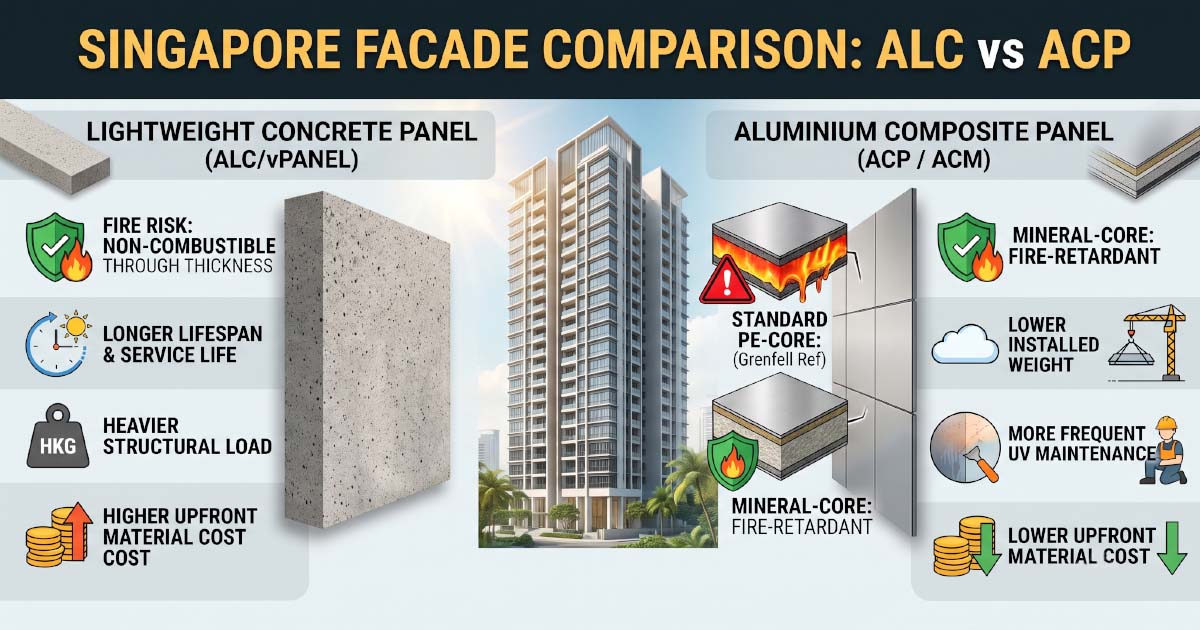
- The core fire risk difference comes down to the core material, not the aluminium skin. Lightweight concrete panels, also known as ALC (Autoclaved Lightweight Concrete), are non-combustible through their full thickness. Standard ACP (aluminium composite panel) products with a polyethylene core are combustible, while fire-retardant or mineral-core ACP variants perform differently again, so the core specification matters more than the panel category itself.
- The Grenfell Tower fire in London in 2017 is the most widely documented case linking polyethylene-core ACM cladding to rapid vertical fire spread on a high-rise building, and it triggered building code reviews and cladding bans in multiple countries, including tightened requirements in Singapore and ongoing regulatory attention in Malaysia.
- ALC panels are considerably heavier per square metre than ACP, which affects the supporting structure and fixing design, while ACP’s lighter weight is one of the main reasons it became popular for tall building facades in the first place.
- ACP generally requires more frequent facade maintenance in tropical climates due to UV degradation of the coating and potential delamination between the aluminium skin and the core over time, while ALC panels are less sensitive to UV exposure given their mineral composition.
- Lifecycle cost cannot be reduced to a single number without a specific project, but the comparison generally comes down to a lower upfront material and installation cost for ACP against a longer facade lifespan and lower long-term fire risk profile for ALC panels, such as Vodapruf’s vPANEL range..
Lightweight Concrete Panels vs Aluminium Composite Panels for Singapore Facades
Choosing a facade material for a building in Singapore involves balancing appearance, weight, cost, and fire safety, and few decisions in building design carry as much long-term consequence as facade cladding selection. Two materials commonly considered for external walls and rainscreen facades are lightweight concrete panels, an aerated cementitious product, and aluminium composite panels, commonly known as ACP or ACM. This article compares both across fire performance, weight, maintenance, facade longevity in Singapore’s tropical climate, and general lifecycle cost considerations.
Lightweight concrete panels used for facade cladding are also known as ALC, short for Autoclaved Lightweight Concrete, a factory-manufactured cementitious panel cured under pressurised steam. Vodapruf supplies this material under the vPANEL product line for both wall and facade applications in Singapore and Malaysia.
Fire Performance: Why the Core Material Matters Most
Lightweight concrete panels are manufactured from an inorganic, cementitious material. The panel is non-combustible through its full thickness, meaning it does not contribute fuel to a fire and does not melt, drip, or release the material itself as a burning liquid.
Aluminium composite panels are constructed differently. Two thin aluminium sheets are bonded to either side of a core material, and it is this core that determines the panel’s fire behaviour. A standard polyethylene-cored ACP, often chosen for its lower cost and ease of forming into curved or complex shapes, is combustible. Independent research following the Grenfell Tower fire in London in 2017, one of the most extensively studied building fires in modern history, found that polyethylene-core panels used on that building were dramatically more flammable than the least combustible panel products tested, and the fire spread rapidly up the building’s exterior once it reached the cladding system. That incident led directly to regulatory reviews and cladding restrictions in the United Kingdom, Australia, and several other countries, and it remains the reference case cited whenever combustible facade cladding is discussed globally.
It is important to note that not all ACP is equal. Fire-retardant core ACP and mineral-core ACP variants exist specifically to address this risk, and these products perform very differently from a standard polyethylene core in a fire test. Any project considering ACP for a Singapore facade should confirm the specific core material and its fire test classification with the supplier, and this should be verified against the Singapore Civil Defence Force’s current fire safety requirements for external wall materials before specification. Lightweight concrete panels, including ALC products such as vPANEL, avoid this verification burden entirely, since the material is inherently non-combustible regardless of which specific product or supplier is chosen.
Installed Weight Per Square Metre
Weight is where ACP holds a clear advantage. Aluminium composite panels are very light, generally in the range of a few kilograms per square metre, which is one of the primary reasons the material became popular for tall building facades in the first place. Lighter cladding reduces the load on the supporting structure and the facade fixing system, and it simplifies handling during installation on high floors.
Lightweight concrete panels, while significantly lighter than traditional precast concrete or brick, are still considerably heavier than ACP on a per square metre basis, since they are a solid cementitious product rather than a thin composite skin. This means the supporting structure, brackets, and fixing design for an ALC panel facade need to account for meaningfully more dead load than an equivalent ACP installation. For very tall buildings or facades with limited structural allowance, this weight difference is a genuine design consideration that needs to be worked through with the project’s structural engineer.
Maintenance Requirements
ACP facades in tropical climates face two recurring maintenance issues. The painted or coated aluminium finish is exposed to continuous ultraviolet radiation, which over time can cause fading, chalking, or degradation of the surface coating, particularly on facades facing direct sun for most of the day. The bond between the aluminium skin and the internal core can also weaken over years of thermal cycling and moisture exposure, which in some documented cases has led to bulging or delamination of panels.
Lightweight concrete panels, being a mineral-based cementitious product, are less affected by UV exposure at the material level, since there is no plastic core to degrade and no adhesive bond line between dissimilar materials to fail. The painted or rendered surface finish on an ALC panel facade will still require periodic repainting like any painted external wall, but the underlying panel substrate itself does not carry the same degradation risk as an ACP core and bond line.
Facade Longevity in Singapore’s Climate
Singapore’s combination of intense UV exposure, high humidity, and frequent heavy rainfall places real stress on any external facade material. ACP’s performance over decades depends heavily on the quality of the specific product, the coating system used, and the installation detailing, particularly at panel joints and edges where water ingress can accelerate core degradation. Lightweight concrete panels, being a solid inorganic material without a bonded composite structure, are generally less susceptible to the specific long-term degradation modes that affect ACP, though proper external sealing, jointing, and a suitable protective coating remain necessary for any facade material in Singapore’s climate.
Lifecycle Cost Considerations
A precise lifecycle cost comparison depends entirely on the specific project, building height, facade area, and product specification, so no single figure can be applied across every project. In general terms, ACP typically has a lower upfront material and installation cost than lightweight concrete panels, which is part of why it has been widely used on commercial and residential facades. ALC panels typically involve a higher upfront cost but a longer facade service life with less frequent major maintenance or panel replacement, along with the fire performance advantage of a non-combustible material that does not require ongoing verification of core composition. The right choice ultimately depends on the project’s budget position, structural capacity, architectural requirements, and the level of fire risk tolerance appropriate for the specific building type and height.
For a project-specific facade material recommendation, contact Vodapruf at
📞 Malaysia: +60 16 217 7155
📞 Singapore: +65 9796 5910
🌐 vodapruf.com
Frequently Asked Questions
What does ALC stand for, and how is it different from regular concrete?
ALC stands for Autoclaved Lightweight Concrete, a factory-manufactured cementitious panel cured under pressurised steam in an autoclave chamber. It differs from regular concrete primarily in density: ALC is produced with a cellular structure that makes it significantly lighter than normal concrete, while remaining a fully inorganic, non-combustible material suitable for both wall and facade applications.
What is the difference between ACP with a polyethylene core and ACP with a mineral core?
A polyethylene core is a plastic-based filler that is highly combustible and was the material at the centre of the Grenfell Tower fire investigation. A mineral core, often made from a compressed non-combustible filler, is designed to resist ignition and significantly reduce flame spread compared to a polyethylene core. Both are sold under the general ACP or ACM category, which is why confirming the specific core type and its fire test classification is essential before specifying any ACP product.
Can ALC panels and ACP be used together on the same building facade?
Yes, mixed-material facades combining ALC panels and ACP are used in some Singapore commercial projects, typically with ALC specified for lower floors or fire-critical zones and ACP used for upper sections or decorative elements where its lighter weight and shaping flexibility are advantageous. Any mixed-material facade design should be reviewed against the Singapore Civil Defence Force’s fire safety requirements for the specific building height and use, since fire performance requirements can vary by floor level and building classification.
How can an architect or QP verify the fire rating of a specific ACP product before specifying it?
The supplier or manufacturer should provide an independent fire test certificate for the specific product and core type being proposed, issued by a recognised testing laboratory. This certificate should confirm the core material composition and the fire classification achieved under the relevant test standard. Architects and QPs should request this documentation directly from the supplier rather than relying on general marketing claims about the ACP category, and cross-check it against current SCDF requirements for the building’s height and use classification.
Does the weight difference between ALC panels and ACP significantly affect structural design on a tall building?
Yes, particularly on very tall buildings or facades with limited structural allowance. ALC panels are considerably heavier per square metre than ACP, so a facade design using ALC needs supporting brackets, fixings, and structural framing sized for meaningfully more dead load than an equivalent ACP installation. This weight difference should be assessed early in the design process together with the project’s structural engineer, especially for high-rise applications where cumulative facade weight affects overall building loading.
What maintenance signs indicate an ACP facade may be degrading and need inspection?
Visible signs of potential ACP degradation include fading or chalking of the surface coating, discolouration, visible bulging or waviness in panel sections, and any separation or lifting at panel edges and joints. Bulging in particular can indicate delamination between the aluminium skin and the internal core, which may compromise both the panel’s structural integrity and its fire performance if the core is exposed. Building owners noticing any of these signs should arrange a facade inspection by a qualified professional rather than waiting for scheduled maintenance cycles.