
 English
 Arabic
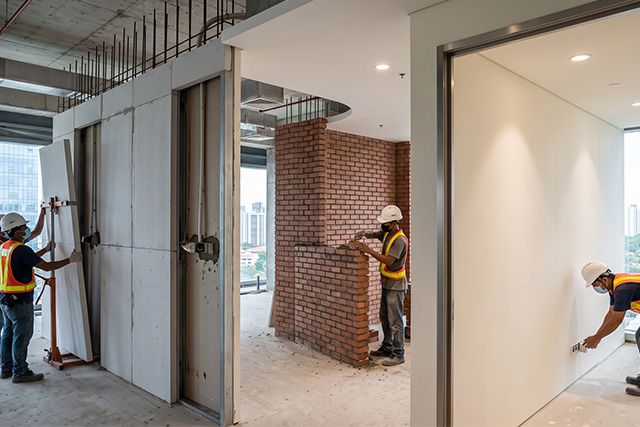
Key Takeaways
- The three most common partition systems in Singapore commercial buildings each perform best in different conditions. ALC wall, drywall, and brick differ meaningfully across cost structure, acoustic performance, fixture support, installation speed, moisture durability, and environmental footprint — and the right choice depends on which criteria matter most to a specific project.
- Drywall is fastest to install but the least durable in Singapore’s humid climate. Its performance depends heavily on specification quality and the amount of air-conditioning in the space. In unconditioned or semi-conditioned zones, moisture damage is a recurring maintenance issue.
- Brick delivers good acoustic isolation and high load capacity but carries the highest installed cost due to labour intensity. It also scores poorly on BCA Buildability metrics and has significant embodied energy from the kiln-firing process.
- ALC wall sits in the middle across most criteria but leads on long-term maintenance and load capacity relative to its installation speed. It is the only system of the three that is both fast to install and durable enough for Singapore’s humidity without additional sealing or conditioning.
- For most Singapore commercial fit-outs, ALC wall and drywall are the practical shortlist. Brick is rarely specified in new commercial interior partitions because the labour cost and programme time are hard to justify when faster alternatives are available.
Choosing a partition wall system for a commercial building in Singapore involves more than picking the cheapest option per square metre. A wall that costs less at the material stage can cost more over a ten-year lease cycle if it dents, absorbs moisture, or needs plastering before it is paint-ready. Three systems appear consistently across Singapore commercial projects: the ALC wall (aerated lightweight concrete panel), gypsum drywall, and clay brick or concrete block. This article compares all three across six criteria that typically drive the specification decision.
Cost Per Square Metre
Drywall typically has the lowest material cost of the three, but the total installed cost is higher than the raw board price suggests once light steel framing, track, insulation, and finishing are factored in. Brick carries the highest installed cost of the three, driven by the skilled wet-trade labour required to lay courses, form mortar joints, and apply plaster render on both faces before skim-coat can follow. ALC wall sits in the middle on a material basis, and the total installed cost is often competitive with or lower than drywall once plastering is removed from the sequence, since ALC wall accepts direct skim-coat on internal faces without a plaster base coat.
Acoustic Performance
Acoustic performance depends on both mass and detailing. A solid brick or block wall generally delivers strong airborne sound isolation, typically performing well for party wall applications where continuity matters. Standard single-skin drywall partitions perform more modestly on their own; achieving higher acoustic ratings requires multiple board layers, resilient channels, and acoustic insulation within the cavity, increasing cost and complexity. An ALC wall at 100mm thickness performs comparably to a mid-specification drywall system for most commercial office and retail partition applications, and performance improves with panel thickness. For spaces with formal acoustic requirements, such as boardrooms, recording rooms, or hotel partitions, all three systems can be designed to meet the specification, but the detailing approach and cost varies significantly between them.
Load Capacity
Brick and block walls carry the highest point-load capacity of the three and can support heavy shelving, kitchen infrastructure, wall-mounted equipment, and similar loads directly with standard anchors. ALC wall accepts moderate point loads using appropriate fixings designed for aerated concrete substrates, making it suitable for office fitouts, kitchen cabinets, TV brackets, and signage. Standard drywall requires timber or steel backing studs at the load position for anything beyond very light items. In commercial environments where wall-mounted services, screens, or equipment are common, load capacity is a real differentiator between ALC wall and drywall.
Installation Speed
Drywall installs the fastest of the three. It is a dry process, panels are lightweight, and framing can be erected and boarded in one continuous sequence with no curing wait. ALC wall is also a dry process and installs significantly faster than brick, with no mortar joint curing and no plaster coat required on internal faces. Brick is the slowest of the three: courses are laid with wet mortar, the wall must cure before plaster can be applied, and plaster must cure before skim-coat follows. On tight commercial fit-out programmes, both ALC wall and drywall are practical choices; brick rarely is.
Long-Term Maintenance
Singapore’s year-round humidity is the main variable that separates the three materials over a building’s service life. Drywall is susceptible to moisture damage in spaces that are not consistently air-conditioned. Swelling, surface cracking, and mould growth on the board face are documented issues in semi-conditioned corridors, back-of-house areas, and spaces adjacent to wet zones. ALC wall is made from an inorganic cementitious material. It does not rot, does not swell, and does not support mold growth through the panel body. Brick is similarly durable but prone to mortar joint cracking over time, particularly in areas with vibration or differential movement. For commercial buildings targeting long occupancy cycles with minimal partition remediation, ALC wall has a structural durability advantage over drywall in Singapore’s climate.
Sustainability
Brick has the highest embodied energy of the three due to the kiln-firing process used to manufacture clay bricks. It is also the heaviest material, meaning transport emissions per square metre of wall are highest. Drywall uses gypsum, which can be recycled, but its shorter practical lifespan in humid climates means more frequent replacement and more landfill waste over a building’s life. ALC wall is manufactured using an autoclave process without firing, at a significantly lower density than brick, reducing both energy intensity and transport load. All three materials can contribute to green building ratings under Singapore’s Green Mark scheme, but the contribution depends on the overall specification rather than the wall material alone.
Best Use Case for Each
Drywall is best suited to fully air-conditioned, dry commercial office interiors with tight construction programmes, low point-load requirements on the wall face, and a willingness to re-board or patch during tenancy changes. It is the standard for corporate fit-outs in Grade A offices where programme speed and cost control are the primary drivers.
ALC wall is the strongest choice for commercial buildings where the partition will be in place for the full building lifespan rather than a single tenancy, where wall-mounted fixtures or equipment create point loads, where the specification extends into semi-conditioned or back-of-house areas, or where plaster elimination from internal partitions is a cost and programme priority.
Brick remains relevant for demising walls between tenancies where maximum acoustic isolation and fire performance are required at a party wall, and for walls that must also carry structural loads from above. In new commercial construction, it is rarely the first choice for internal partitions where speed and cost are under pressure.
For a project-specific ALC wall specification or quotation, contact Vodapruf today.
📞 Malaysia: +60 16 217 7155
📞 Singapore: +65 9796 5910
🌐 vodapruf.com
Frequently Asked Questions
What is an ALC wall, and is it different from an AAC block wall?
ALC stands for Autoclaved Lightweight Concrete, a factory-manufactured panel product cast in a steel mould and cured in a pressurised steam chamber. AAC, or Autoclaved Aerated Concrete, refers to the same base material but is typically supplied as smaller hand-laid blocks rather than large-format panels. An ALC wall panel is installed in full-height pieces similar to precast, while an AAC block wall is built course by course like conventional masonry, producing more joints and a slower installation sequence.
Which partition system is best for a typical Singapore commercial office fit-out?
For a standard Grade A office fit-out in Singapore with consistent air-conditioning, tight programme requirements, and a single-tenancy lifespan of 5 to 10 years, drywall is often the most cost-efficient choice for non-demising internal partitions. For partitions expected to remain in place through multiple tenancy cycles, or for walls in semi-conditioned areas, ALC wall is the more durable and lower-maintenance specification. Brick is rarely the practical choice for new commercial interior partitions due to its higher installed cost and programme impact.
Can an ALC wall partition meet SCDF fire resistance requirements for demising walls between tenancies in Singapore?
ALC wall panels can achieve fire resistance ratings of up to 4 hours depending on panel thickness and product certification, and are therefore capable of meeting SCDF fire resistance requirements for commercial demising walls in Singapore. The exact fire resistance requirement for any specific demising wall depends on the building’s occupancy class, floor area, and compartment design, which is determined by the project’s Qualified Person and submitted to SCDF for approval. The panel supplier should provide an independent test certificate confirming the fire rating for the specified thickness before the wall system is approved for a fire-rated application.
How does each partition system perform when commercial walls need to be relocated during tenancy change?
Drywall is the easiest to relocate: the boards are removed, steel framing is dismantled, and new framing is erected at the new position with minimal waste and disruption. ALC wall requires panel cutting and removal, which produces more debris than drywall stripping but is still manageable with standard tools. Brick partitions are the most disruptive to relocate: demolition requires a concrete breaker or heavy hammer, generates significant dust and rubble, and typically requires full floor-to-ceiling rectification to the adjacent surfaces after removal. For Singapore commercial landlords managing frequent tenancy turnover, drywall and ALC wall are strongly preferred over brick for precisely this reason.
What is the correct method for fixing heavy items to an ALC wall in a commercial space?
ALC wall supports heavier point loads than standard drywall but requires fixings specifically rated for aerated lightweight concrete substrates. Chemical anchor bolts or nylon expansion plugs designed for ALC are the recommended fixing types for medium to heavy loads such as kitchen cabinets, wall-mounted screens, and shelving systems. Standard plastic wall plugs designed for dense concrete or brick will not achieve adequate pull-out resistance in ALC and should not be used. For very heavy loads such as wall-mounted machinery or structural brackets, the fixing design should be reviewed by a structural engineer regardless of the wall material.
Which partition system contributes most to BCA Green Mark certification in Singapore?
Under BCA’s Green Mark framework, wall system selection contributes to the materials and resources category, with credit given for lower embodied carbon, recycled content, and durability. ALC wall generally scores favourably due to its lower density compared to brick, which reduces transport-related carbon, and its inorganic composition, which supports a longer in-service lifespan. Drywall containing recycled gypsum content can also attract credits depending on the specific product specification. Brick typically scores lowest of the three due to the high embodied energy from the kiln-firing process. The exact contribution of any wall material to a specific Green Mark target should be confirmed with the project’s Green Mark Accredited Professional, as the framework’s credits and weightings are assessed at the whole-building level rather than for individual materials in isolation.
Are brick partitions still being specified in new Singapore commercial buildings?
Brick and concrete block partitions are increasingly rare in new Singapore commercial builds, driven by three converging pressures: BCA Buildability Score requirements that favour prefabricated and modular systems over hand-laid masonry, the scarcity and cost of skilled wet-trade labour in Singapore, and programme expectations from developers and main contractors that treat multi-week plaster cure cycles as unacceptable delays. In new commercial construction, drywall and ALC wall have effectively replaced brick for most internal partition applications. Brick and block remain in use for specific structural or acoustic applications, such as demising walls between tenancies in older building stock, and for renovation or addition works where matching existing construction is required.