
 English
 Arabic
Key Takeaways
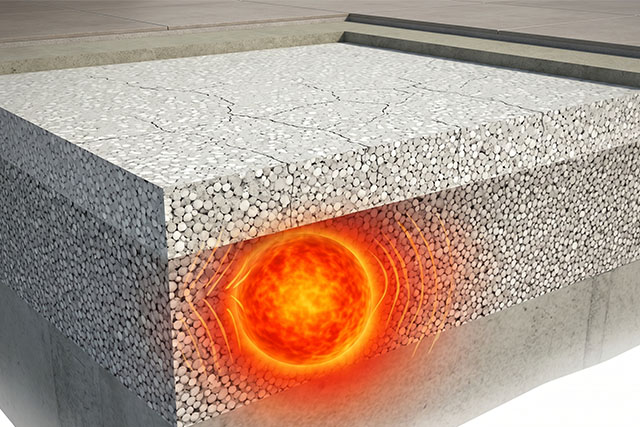
- 300mm is the maximum single-pour thickness: Beyond this depth, the exothermic heat of cement hydration cannot escape fast enough through the insulating matrix, causing internal thermal gradients that lead to surface cracking within 12–24 hours.
- Staged casting is the correct method, not a workaround: A two-layer protocol — 300mm on Day 1, remaining thickness on Day 2 after a minimum 24-hour interval — eliminates the compounding thermal effect and produces a monolithic, crack-free fill.
- The heat retention proves the insulation works: LIGHTHERM Drymix 250’s thermal conductivity of ~0.056 W/m·K is approximately 25× lower than conventional concrete. The same property that traps hydration heat is what makes it an effective thermal insulator in service.
- Dead load savings are substantial: At 250 kg/m³, a 450mm LIGHTHERM Drymix 250 fill imposes only 1.10 kN/m² of dead load — an 89.6% reduction compared to 10.59 kN/m² for conventional concrete at the same depth.
- Full engineering documentation is available: Technical data, staged casting protocols, and structural loading calculations are available for PE review and project submission upon request.
Introduction
When a project specifies LIGHTHERM Drymix 250 at depths greater than 300mm, a staged casting protocol is required. Understanding why this is necessary — and why it is actually a sign that the product is performing correctly — is important for structural engineers, QPs, and site supervisors working with this material for the first time.
This guide covers the science behind heat of hydration in lightweight insulating concrete, the 300mm depth threshold, the two-layer casting protocol, and the dead load benefits that make LIGHTHERM Drymix 250 the right choice for deep floor fill applications.
The Science: Heat of Hydration in Cementitious Materials
All Portland cement-based materials release heat when mixed with water. The calcium silicate compounds in cement react with water to form calcium silicate hydrate (C-S-H) gel — the binding network that gives cured concrete its strength — and this reaction is exothermic by nature.
In conventional concrete at ~2,400 kg/m³, this heat migrates outward through the dense mass and dissipates at exposed surfaces. Thermal conductivity for normal-weight concrete sits at roughly 1.5–2.0 W/m·K, which is sufficient to move heat away before critical gradients develop.
LIGHTHERM Drymix 250 operates differently. Its cellular microstructure — built around pre-expanded EPS (Expanded Polystyrene) aggregate beads suspended in a cement matrix — gives it a thermal conductivity of approximately ~0.056 W/m·K. That is around 25 times more insulating than conventional concrete, and it is the property that makes the material valuable for thermal break and floor levelling applications. However, the same characteristic means the material holds its own hydration heat rather than releasing it — and in thick pours, that retained heat becomes a problem.
The 300mm Threshold: Where Thermal Stress Exceeds Tensile Strength
Through laboratory observation and site experience, Vodapruf has established 300mm as the maximum safe single-pour depth for LIGHTHERM Drymix 250. Beyond this threshold, a predictable sequence of events occurs:
- Core temperature spike. Cement hydration peaks 4–8 hours after mixing. In an insulated pour exceeding 300mm, internal temperatures can exceed 60°C while the exposed surface remains at 30–35°C ambient.
- Thermal gradient. The temperature difference between core and surface exceeds 20°C — the widely accepted threshold for thermal cracking risk in concrete technology.
- Differential expansion. The hot core expands while the cooler surface is dimensionally stable. This generates tensile stress at the surface that exceeds the early-age tensile strength of the still-curing matrix.
- Surface cracking. Visible map cracking or through-cracks appear within 12–24 hours, compromising both the structural integrity and the insulation continuity of the fill layer.
This is not a product defect. It is a fundamental thermodynamic characteristic of any cementitious material with high thermal resistance cast at depth — the same behaviour would occur with any equivalent low-conductivity mix.
The Solution: Staged Two-Layer Casting Protocol
For pours exceeding 300mm, Vodapruf specifies a two-stage sequential casting protocol. The following example is drawn from a project at Tuas Avenue 1, where a total LIGHTHERM Drymix 250 thickness of 450mm was required.
| Layer 1 (Day 1) | Layer 2 (Day 2) | |
| Thickness | 300mm | 150mm |
| Cumulative depth | 0–300mm | 300–450mm |
| Pour timing | Morning pour | Minimum 24 hours after Layer 1 |
| Rationale | Maximum single-pour thickness — allows full hydration heat cycle to complete and dissipate overnight | Residual 150mm is well within thermal safety threshold; bonds to partially cured Layer 1 |
| Surface prep | Screed to level, leave rough finish | Lightly dampen Layer 1 surface before pour to ensure interlaminar bond |
The 24-hour interval between layers is critical. It allows the first pour to complete its primary hydration exotherm and move into the initial curing phase. By the time the second layer is placed, the core temperature of Layer 1 will have peaked and returned to within ±10°C of ambient — eliminating the compounding thermal effect that would occur in a monolithic deep pour.
Why Staged Casting Confirms the Product Is Working
Some contractors encounter the two-layer requirement and initially interpret it as a limitation. It is the opposite. The need for staged casting in thick pours is direct evidence that LIGHTHERM Drymix 250 is performing precisely as specified:
- Thermal insulation confirmed in service. If the material did not retain heat, it would not be providing the thermal break the floor design requires. The heat retention during curing is the insulation property operating at the material level.
- Full cement hydration under way. Heat generation confirms the C₃S and C₂S reactions in the cement are proceeding correctly, building the calcium silicate hydrate network that delivers compressive strength at 28 days.
- Quality indicator for durability. Lightweight concrete that produces no hydration heat in deep sections would indicate insufficient cement content or incomplete hydration — both of which would reduce long-term compressive strength and durability.
Dead Load Reduction: The Primary Design Advantage
The principal reason for specifying LIGHTHERM Drymix 250 in deep floor fill applications is the structural dead load saving it delivers. Consider a 450mm fill requirement — a depth typical of raised floor renovation or level correction projects over existing RC slabs.
| Fill Material | Density (kg/m³) | 450mm Dead Load (kN/m²) | Saving vs Conventional |
| Conventional concrete | 2,400 | 10.59 | — |
| Lightweight aggregate concrete | 1,800 | 7.95 | 25% |
| LIGHTHERM Drymix 250 | 250 | 1.10 | 89.6% |
At 250 kg/m³, a 450mm LIGHTHERM Drymix 250 fill imposes only 1.10 kN/m² of superimposed dead load — compared to 10.59 kN/m² for conventional concrete at the same depth. That is an 89.6% reduction, equivalent to approximately 9.49 kN/m² of load removed from the structural slab. In retrofit and renovation projects where the existing slab has limited residual capacity, this difference can determine whether structural strengthening is required or not.
Complete Floor Buildup: Tuas Avenue 1 Reference Project
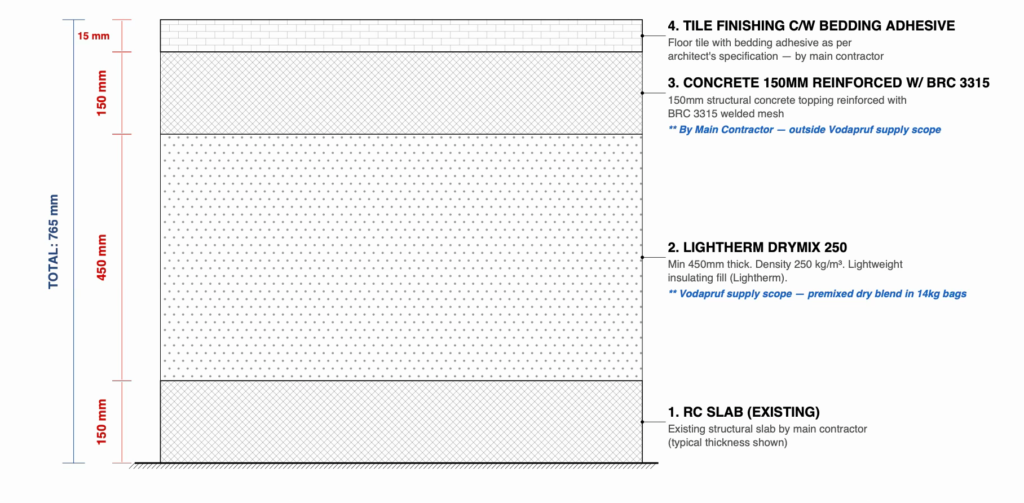
The following is the complete floor buildup specification for the Tuas Avenue 1 project, where the staged 450mm LIGHTHERM Drymix 250 fill was applied above an existing RC slab
| Layer | Description | Thickness | Supplier |
| 1 | RC Slab (existing structural slab by main contractor) | 150mm | Main Contractor |
| 2 | LIGHTHERM Drymix 250 — lightweight insulating fill(Layer 1: 300mm Day 1 + Layer 2: 150mm Day 2) | 450mm | Vodapruf |
| 3 | Structural concrete topping (reinforced with BRC 3315 welded mesh) | 150mm | Main Contractor |
| 4 | Tile finishing with bedding adhesive (per architect specification) | 15mm | Main Contractor |
| TOTAL | Complete floor buildup | 765mm | — |
Technical Reference Summary
The following table summarises the key technical properties of LIGHTHERM Drymix 250 relevant to thick-pour applications.
| Product | LIGHTHERM Drymix 250 |
| Dry density (cured) | 250 kg/m³ (±10%) |
| Thermal conductivity | ~0.056 W/m·K |
| Compressive strength (28 day) | ≥0.5 MPa |
| Cement type | Ordinary Portland Cement (OPC) |
| Aggregate | Pre-expanded EPS beads, LIGHTHERM Aggregate (3–5mm) |
| Packaging | 14 kg premixed dry bags |
| Max single-pour thickness | 300mm |
| Minimum inter-layer interval | 24 hours |
| Application standard | SS CP 65 / BS 8110 (lightweight concrete provisions) |
Disclaimer: This guide is for informational purposes and does not constitute professional engineering advice. All structural loading calculations should be verified by a qualified Professional Engineer. Technical data is indicative and may vary with site conditions, mixing ratios, and ambient temperature. Vodapruf Pte Ltd supplies material only — installation is by others unless separately contracted.
Need Clarification? Let’s Talk.
We can walk your structural engineer and site team through the staged casting protocol and provide on-site technical supervision for the first pour if required.
📞 Malaysia: +60 16 217 7155
📞 Singapore: +65 9796 5910
🌐 vodapruf.com
Frequently Asked Questions (FAQ)
What is the maximum single-pour thickness for LIGHTHERM Drymix 250?
The maximum safe single-pour thickness is 300mm. Beyond this depth, the material’s low thermal conductivity (~0.056 W/m·K) traps hydration heat, causing internal temperatures to exceed 60°C and producing surface cracking within 12–24 hours.
Why does LIGHTHERM Drymix 250 require staged casting for deep pours?
LIGHTHERM Drymix 250 is approximately 25× more insulating than conventional concrete, meaning hydration heat cannot escape in thick sections. Staged casting allows each layer’s heat cycle to complete before the next is placed, preventing thermal cracking.
How long must you wait between layers when casting LIGHTHERM Drymix 250 in two stages?
A minimum of 24 hours is required between Layer 1 (300mm) and Layer 2. This interval allows the core temperature of the first pour to peak, dissipate, and return to within ±10°C of ambient before the second layer is placed.
Does the two-layer casting requirement mean LIGHTHERM Drymix 250 has a product defect?
No — it confirms the product is working correctly. The heat retention that requires staged casting is the same thermal insulation property that makes the material effective as a floor thermal break. A mix that generated no hydration heat would indicate insufficient cement content and compromised long-term strength.
How much dead load does a 450mm LIGHTHERM Drymix 250 fill impose on a structural slab?
At 250 kg/m³ density, a 450mm fill imposes only 1.10 kN/m² — compared to 10.59 kN/m² for conventional concrete at the same depth. This 89.6% reduction can eliminate the need for structural strengthening of existing RC slabs in retrofit projects.
What surface preparation is needed before placing the second layer of LIGHTHERM Drymix 250?
Before placing Layer 2, lightly dampen the surface of Layer 1 to ensure interlaminar bond. Layer 1 should be screeded to level with a rough finish left — not smooth-trowelled — so the second pour bonds monolithically to the cured surface below.
What is the compressive strength of LIGHTHERM Drymix 250, and how is it supplied?
LIGHTHERM Drymix 250 achieves a minimum compressive strength of ≥0.5 MPa at 28 days after curing. It is supplied as a premixed dry product in 14 kg bags, using Ordinary Portland Cement (OPC) and pre-expanded EPS aggregate beads of 3–5mm in size.