
 English
 Arabic
Key Takeaways
- Brickwork needs 10–20mm plaster on both sides before a skim-coat can follow: Hand-laid brickwalls have a face tolerance of ±5–8mm over a 3-metre span, far too uneven for direct finishing. Plastering is the mandatory correction layer that costs 30–40% of the wet-trade bill and adds 2–3 weeks to the wall programme.
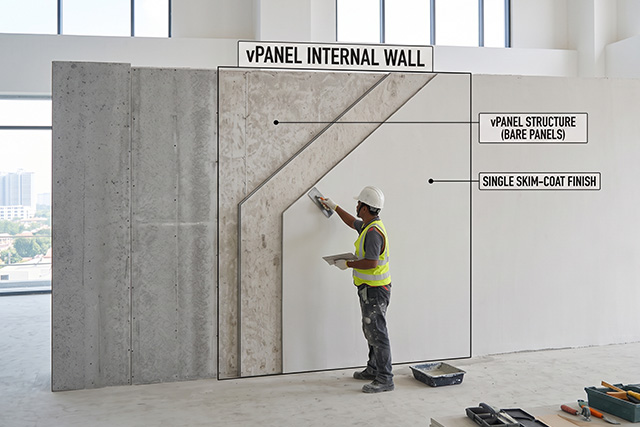
- vPANEL arrives from the factory at ±1mm face tolerance — plaster is not needed: Steel-mould casting produces a panel face that is 5 to 8 times more accurate than a hand-laid brick wall. Internal partitions can receive a 3–5mm skim-coat applied directly to the panel face, followed by paint.
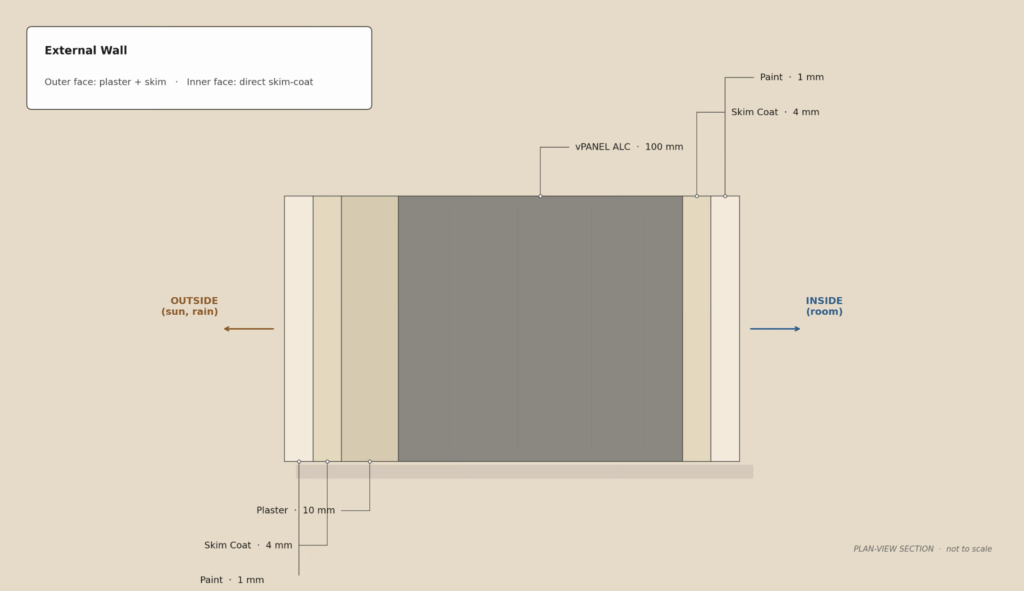
- External walls still require 10mm plaster on the outer face only: Raking sunlight at low angles makes any surface deviation above 2mm visible as a shadow line. Plaster on the outer face also provides water tightness against driving rain and absorbs the thermal stress from Singapore’s 25–60°C surface temperature cycling.
- Eliminating internal plaster saves SGD 30–40 per square metre: With plastering priced at SGD 15–20 per square metre per side and applied to both faces of every internal partition, the saving on a 1,000 m² partition package is approximately SGD 30,000 to SGD 40,000 on wet trades alone.
- Direct skim-coat only works if the panels are installed with laser precision: A face deviation above 2mm between adjacent panels cannot be absorbed by a 3–5mm skim layer. Vodapruf crews use a rotating laser level on every wall run and correct any offset before the adhesive sets.
The Hidden Cost of Brickwork: Why Plastering Is Non-Negotiable
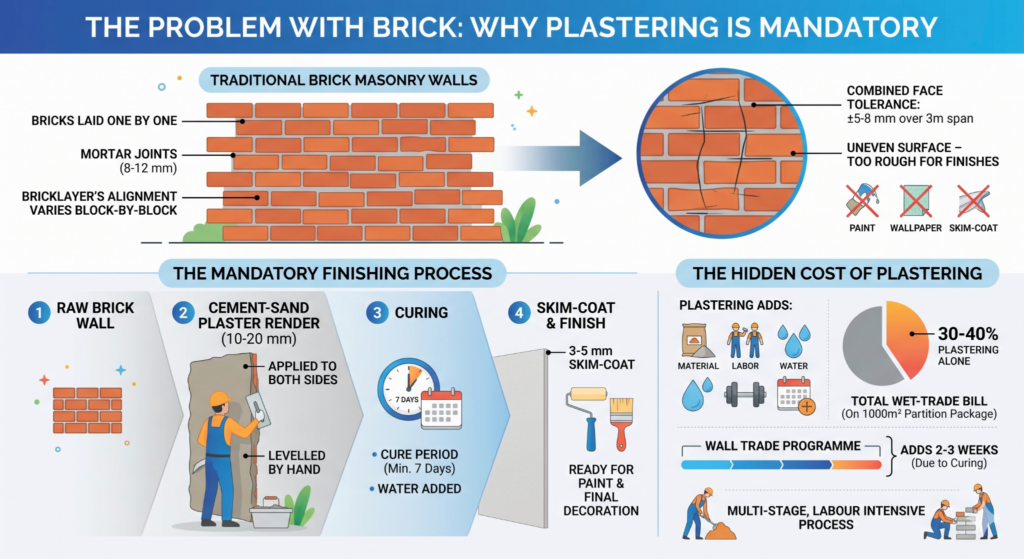
Traditional brick masonry walls cannot be finished directly. Bricks are laid one at a time with mortar joints of 8 to 12mm between every course, and each bricklayer’s alignment varies block by block. The resulting face tolerance on a completed brick wall typically reaches ±5 to 8mm across a 3-metre span — far too irregular to receive paint, wallpaper, or skim-coat without an intermediate correction layer.
To bring the surface within finishing tolerance, a 10 to 20mm cement-sand plaster render must be applied to both sides of the wall, levelled by hand, cured for approximately 7 days per coat, and only then can a 3 to 5mm skim-coat and final paint follow. Plastering is, in effect, the hidden cost of brickwork. It adds material, labour, programme time, water use, and dead weight to every square metre of wall. On a 1,000 m² internal partition package, the plastering trade alone can represent 30 to 40% of the total wet-trade bill — and it places a 2 to 3-week cure window on the critical path before the skim-coat trade can even start.
Why vPANEL Is Different: Factory-Cast Precision
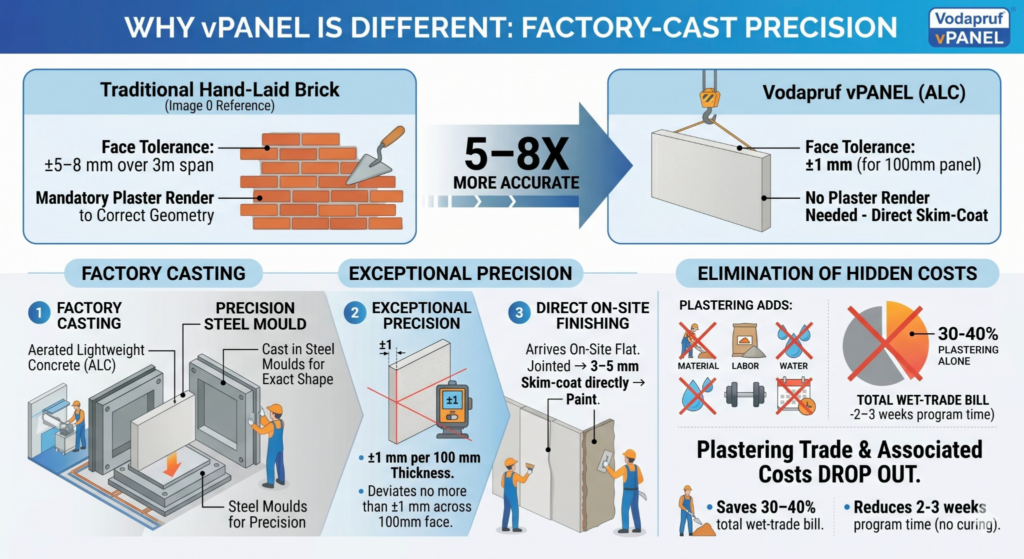
Vodapruf vPANEL is an Aerated Lightweight Concrete (ALC) wall panel cast inside a steel mould. Each panel leaves the factory with a face tolerance of approximately ±1mm per 100mm of panel thickness — meaning a 100mm panel deviates by no more than ±1mm across its entire face. That is roughly 5 to 8 times more accurate than a hand-laid brick wall.
Because the panels arrive on site already flat, the wall surface does not require a plaster render to correct its geometry. Once the panels are installed and jointed, the wall is ready for a 3 to 5mm skim-coat applied directly to the panel face, followed by paint. The plastering trade drops out of the internal wall package entirely — along with the curing wait, the wet-trade labour, and the programme float it would have consumed.
Internal Partition Walls: Direct Skim-Coat on Both Sides
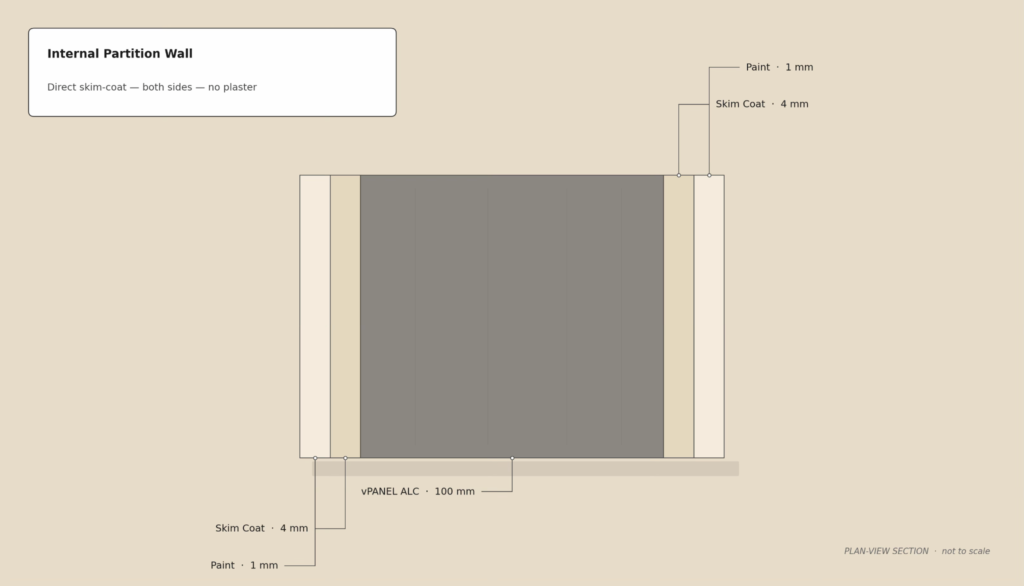
For internal partitions, no plastering is required on either face. The recommended buildup is:
- Paint Finish (1 mm) — emulsion or specified system
- Skim Coat (3–5 mm) — cementitious or polymer-modified skim
- vPANEL ALC (100 mm) — Vodapruf factory-cast wall panel
- Skim Coat (3–5 mm) — cementitious or polymer-modified skim
- Paint Finish (1 mm) — emulsion or specified system
The ±1 mm panel tolerance is well within the 3–5 mm skim-coat thickness, so the skim absorbs any minor variation between adjacent panels and produces a flat, paint-ready surface. The total finished wall thickness is approximately 110 mm — significantly thinner than a plastered 100 mm brick wall, which ends up around 130–140 mm finished. The space saving is real and compounds across a floor plate.
External Walls: Plaster on the Outer Face Only
For walls exposed to weather, Vodapruf recommends a 10mm plaster render on the outer face only. The inner face follows the same direct skim-coat approach as an internal partition. Three engineering reasons justify the additional layer on the exterior.
Raking Light and Surface Visibility
Direct sunlight at low angles in the morning and late afternoon creates raking light across the façade. Any deviation of 2mm or more between adjacent panels becomes visible as a shadow line that no paint system can conceal. A 10mm plaster render gives the applicator enough material to level the outer face by hand, so that the finished wall reads completely flat under raking light. The inner face, shielded from direct sun, does not face this constraint.
Water Tightness Against Driving Rain
External walls in Singapore and Malaysia are subject to driving rain at velocities reaching up to 25 m/s during tropical storms. A 10mm plaster render, batched with a bonding agent and finished with a water-repellent external paint system, forms a continuous, dense weatherproof skin. Direct skim-coat at 3 to 5mm is too thin to serve as a primary water barrier under sustained external exposure. The plaster layer also seals any micro-shrinkage gaps at panel joints, removing the capillary path that water would otherwise track along the joint line.
Thermal Expansion and UV Weathering
External wall faces in Singapore cycle through surface temperatures ranging from approximately 25°C at night to 60°C under direct midday sun. A 10mm plaster coat acts as a sacrificial weathering layer, absorbing the thermal stress that would otherwise be transferred directly into a thin skim-coat and paint film. Without this buffer, repeated thermal cycling can cause the skim and paint film to craze and delaminate within 3 to 5 years on a sun-facing elevation.
The Cost and Labour Saving: Eliminating Plaster on Internal Walls
On a typical Singapore project, plastering is priced at approximately SGD 15 to 20 per square metre per side, covering material, labour, and scaffolding, depending on wall height and access. Skim-coat alone runs at approximately SGD 8 to 12 per square metre per side. When the plaster trade is removed from the internal partition buildup, the full plaster rate is saved on both faces of every internal wall — as shown in the comparison below.
| Cost Item | Brick + Plaster Wall | vPANEL Direct Skim | Saving per m² |
| 10 mm plaster — outer face | SGD 15–20 / m² | SGD 15–20 / m² (kept on external only) | — |
| 10 mm plaster — inner face | SGD 15–20 / m² | Eliminated | SGD 15–20 / m² |
| 3–5 mm skim — outer face | SGD 8–12 / m² | SGD 8–12 / m² | — |
| 3–5 mm skim — inner face | SGD 8–12 / m² | SGD 8–12 / m² | — |
| Total saving (internal partition, both faces) | — | — | SGD 30–40 / m² |
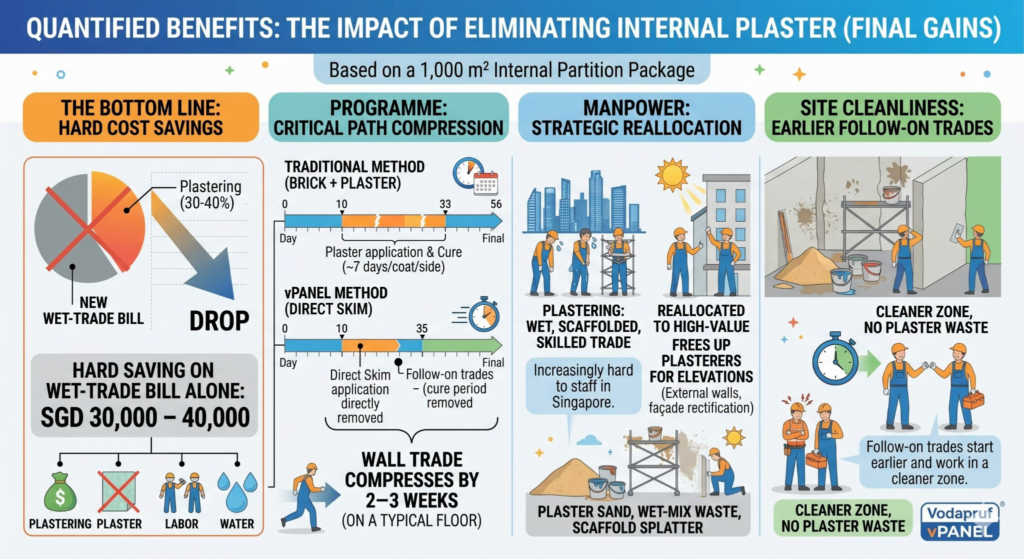
For an internal partition package of 1,000 m², eliminating plaster on both faces produces a direct saving of approximately SGD 30,000 to SGD 40,000 on the wet-trade bill. Three further benefits compound on top of that figure.
- Programme compression: The 7-day plaster cure period per coat per side is removed from the critical path, compressing the wall trade programme by 2 to 3 weeks on a typical floor.
- Manpower release: Plastering is a wet, scaffolded, skilled-trade activity that is increasingly difficult to resource in Singapore. Removing it from internal walls frees plasterers for external elevations and façade rectification work, where they genuinely add value.
- Site cleanliness: No plaster sand, no wet-mix waste, and no scaffolded splatter on adjacent finishes. Follow-on trades can start earlier and work in a cleaner environment.
The Critical Condition: Workmanship Must Be Right at Installation
Direct skim-coat works because the panel arrives flat. But the panel only stays flat if it is installed flat. This is where the economics of direct-skim stand or fall: a skilled installer using a laser level consistently produces a wall that takes skim-coat without any intermediate correction. An unskilled installer leaves panel-to-panel offsets that exceed what the skim layer can absorb, and the wall ends up requiring plaster regardless — eliminating the saving entirely.
Laser Levelling Is Non-Negotiable
Every Vodapruf installation crew uses a rotating laser level positioned at panel mid-height. The first panel of each wall run is plumbed and aligned to the laser line, and every subsequent panel is checked before the vAdhesive bonds. Any face deviation above 2mm between adjacent panels is corrected on the spot, before the adhesive reaches its open-time limit. With this discipline applied consistently, a 6-metre wall run finishes within ±1mm across its full face — well inside the 3 to 5mm skim tolerance.
Installation Guidance Comes with Every Supply Package
The vPANEL Installation Method Statement included with every Vodapruf supply specifies the levelling procedure, the required laser equipment, and the adhesive open time for each substrate condition. For first-time projects, Vodapruf also offers an installer audit by the technical team on the first 100 m² of installation, to confirm that the contractor’s crew is consistently hitting tolerance before the skim-coat trade mobilises.
The Conquas Exception: When Plaster Both Sides Still Makes Sense
Some projects carry a BCA Conquas (Construction Quality Assessment System) scoring requirement, which measures wall flatness, plumb, and squareness against a 3-metre straight edge. For projects targeting a Conquas score in the 90+ band, the project manager may elect to apply 10mm plaster on both sides of the internal partition as a workmanship buffer — even though the panel geometry does not technically require it.
The reasoning is risk management rather than engineering. A plastered wall provides a thicker tolerance reserve for the assessor’s straight edge, meaning minor installation variance on a long wall run is less likely to be detected. On Conquas-scored projects, the cost of a single rejected wall — rework, programme disruption, and the score-band impact — typically outweighs the SGD 30 to 40 per square metre that plaster elimination would have saved. This is a judgement call made at design stage, project by project. Outside of Conquas-scored projects, where workmanship is verified through the laser-levelled installation method described above, direct skim-coat on both sides is the standard Vodapruf recommendation.
When to Skim, When to Plaster
The correct wall buildup depends on three variables: whether the wall is internal or external, whether it faces a Conquas scoring requirement, and whether the installation discipline for direct skim-coat can be reliably delivered. The decision matrix is straightforward.
| Wall Type | Outer / Weather Face | Inner / Room Face |
| Internal partition (standard) | — | 3–5 mm skim + paint |
| Internal partition (Conquas 90+) | 10 mm plaster + skim + paint | 10 mm plaster + skim + paint |
| External wall — façade | 10 mm plaster + skim + paint | 3–5 mm skim + paint |
Vodapruf vPANEL gives the architect, contractor, and developer a clear lever to remove a complete wet trade from the internal-wall programme without compromising the external weatherproofing envelope. The cost saving is real, the programme compression is measurable, and the workmanship requirement — laser-levelled installation — is within the capability of any properly trained crew.
Need a Project-Specific Buildup Estimater
We can advise on the correct wall buildup for your specification and provide a project-specific saving estimate.
📞 Malaysia: +60 16 217 7155
📞 Singapore: +65 9796 5910
🌐 vodapruf.com
Frequently Asked Questions (FAQ)
What type of skim-coat is recommended for direct application on a vPANEL wall?
Either a cementitious skim-coat or a polymer-modified skim at 3 to 5mm thickness is suitable for direct application on vPANEL. The product must be compatible with aerated lightweight concrete substrates — check the manufacturer’s data sheet to confirm ALC compatibility before specifying. A bonding primer applied to the panel face before skim-coat improves adhesion and reduces the risk of delamination, particularly in air-conditioned environments with low relative humidity.
Is surface preparation required before applying skim-coat directly to a vPANEL wall?
Yes. The panel face should be clean, dust-free, and free from any adhesive squeeze-out at the joints before skim-coat is applied. Panel joints should be filled with vAdhesive or a compatible joint filler and allowed to cure before finishing begins. A bonding primer coat applied to the full panel face is recommended to improve skim adhesion and reduce differential suction between the panel face and the joint zones.
Can vPANEL be tiled directly, or does it need a plaster or skim layer first?
vPANEL can receive ceramic or porcelain tiles directly using a polymer-modified tile adhesive, without a plaster or skim base coat in between, provided the surface is primed and the adhesive is rated for ALC substrates. For heavy stone cladding or large-format tiles above 600mm, a scratch coat of cement render is recommended to improve bond strength and distribute the additional weight. Always check the tile adhesive manufacturer’s specification for compatibility with lightweight aerated concrete.
How does the total wall finishing programme compare between vPANEL direct skim and brick plus plaster?
A brick wall requires 10 to 20mm of cement-sand plaster on both faces, each coat needing approximately 7 days of curing before the 3 to 5mm skim-coat can follow — adding 2 to 3 weeks to the wall trade programme per floor. With vPANEL direct skim-coat, no plaster is applied to internal partitions, and the skim-coat trade can mobilise as soon as the panels are installed and jointed, compressing the internal wall programme by the full plaster-cure window.
Does applying a direct skim-coat instead of plaster affect the vPANEL wall’s fire rating or acoustic performance?
No. The fire rating and STC acoustic performance of vPANEL are properties of the panel itself, certified under independent testing for the panel at its declared thickness. The finish layer — whether 3 to 5mm skim or 10 to 20mm plaster — is not part of the certified fire or acoustic assembly and does not materially alter either rating. Specifying plaster over vPANEL for fire or acoustic reasons is not required and does not improve the certified performance.
Can a proprietary external render system replace the 10mm cement-sand plaster on the outer face of external walls?
Yes, provided the render system is rated for application on aerated lightweight concrete substrates and tested for water tightness under driven rain conditions. Thin-coat acrylic render systems, fibre-reinforced renders, and textured external coating systems are all used on vPANEL external faces in Singapore and Malaysia, in place of conventional cement-sand plaster. The key requirements are ALC substrate compatibility, a minimum dry film thickness sufficient to bridge panel joint lines, and a water-repellent final coat rated for tropical weather exposure.
Does the direct skim-coat recommendation apply in wet areas such as bathrooms and kitchens?
Direct skim-coat is not the correct finish for wet areas. In Singapore, BCA requirements for internal wet areas — bathrooms, en-suites, and kitchen backsplash zones — call for a waterproofing membrane applied to the wall substrate before tiling. The correct sequence for vPANEL in a wet area is: panel face primed, waterproofing membrane applied and cured to the specified turnup height, then tiles fixed with a waterproof tile adhesive. Skim-coat and paint are suitable only for dry wall surfaces.