
 English
 Arabic

Key Takeaways
- Diagnose before repairing: Joint cracks in lightweight concrete panel walls usually trace back to bedding, movement, stiffening, finish or support, not the panel itself.
- Disturbing a panel before the adhesive sets breaks the bond: Correct alignment before the adhesive grabs, and rebed any panel that has been moved afterwards.
- Tall walls need engineered stiffening: Above roughly 4 m, a thicker panel, an upgraded reinforcement cage or intermediate stiffeners may be needed to stay within the engineer’s deflection limit.
- Match the finish to the wall: A thin skim only works on a flat face with cured joints, and sun-facing external walls benefit from a plaster buffer.
- Slab deflection is a design issue: The wall head needs a movement detail specified by the structural engineer.
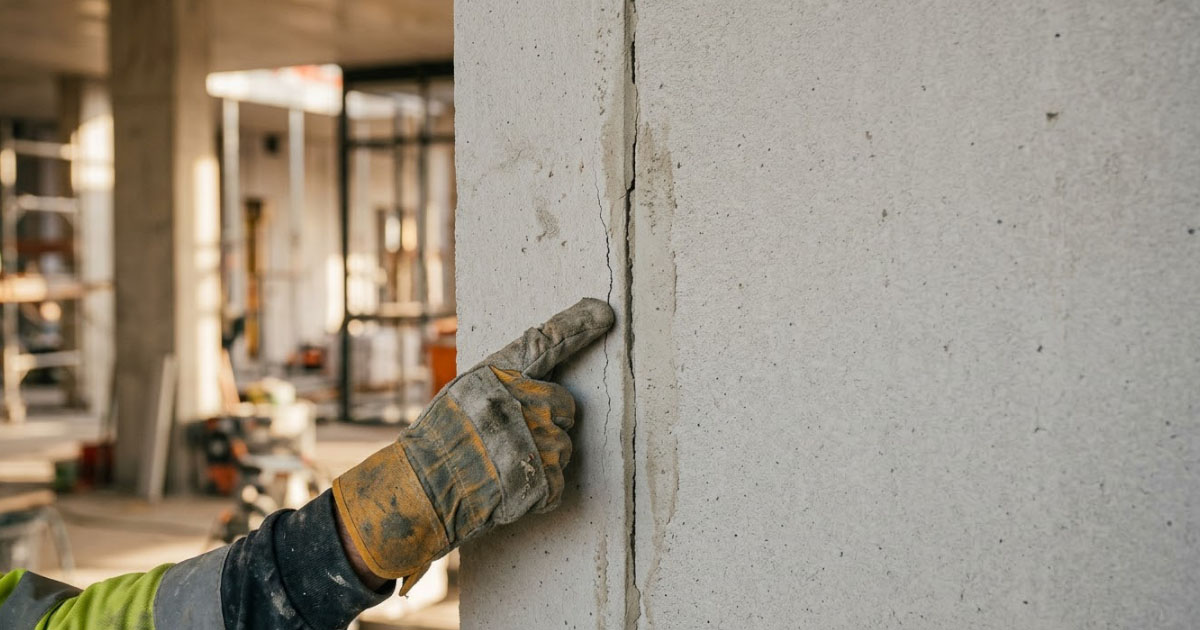
Joint cracking in a lightweight concrete panel wall is rarely a mystery panel defect. On most sites it traces back to something specific in how the wall was bedded, held, finished or supported. This guide works through five causes, what each tends to look like, and the corrective measure for each, based on how vPANEL ALC walls are specified and installed.
Why Do Cracks Show Up at Panel Joints?
Joints are where separate panels meet, so movement in the wall, the frame or the finish concentrates there. Fewer joints mean fewer places for a crack to start, which is one reason a single full-height panel is preferred to a panel-and-block hybrid on tall walls. Read the pattern before repairing anything. As a general guide, a crack that follows a vertical joint often points to bedding, movement or finish, while a crack near the top of the wall may point to what is above it.
Could Incorrect Adhesive Bed Thickness Be the Cause?
It can be. A bed that is too thin can leave voids, and one that is too thick may be more prone to shrinkage. Either can leave a weak line that opens under normal building movement. Use the thickness set out in the installation method statement supplied with the panels rather than site habit. Vertical joints also perform best when the adhesive is paired with glass fibre mesh tape.
A common approach to correcting a cracked joint is to cut it out cleanly, refill it fully with vAdhesive and re-embed the mesh tape before any new skim goes on. Confirm the repair method with the supplier for your project.
Does Moving a Panel Before the Adhesive Cures Cause Cracks?
It can. Panels should be aligned against the laser line before the vAdhesive grabs, and any face deviation above 2 mm between adjacent panels should be corrected on the spot, before the adhesive sets. Moving a panel after that point breaks the bond and leaves a hairline joint that opens later.
In practice, keep the panel held until the head is fixed, and it is good practice to avoid knocks, loading or chasing until the adhesive has cured for the time stated in the method statement. If a panel has been disturbed, it is generally better to rebed it than to skim over it.
Are Tall Walls Missing Stiffeners?
Tall walls can be a culprit. Above roughly 4 m, particularly on an external wall under wind load, thickness usually steps up to 150 mm or 200 mm so that bending stays inside the deflection limit set by the structural engineer, typically L/240 or L/300.
Where that is not enough, the reinforcement cage can be upgraded to two layers of eight 5 mm rods, or an intermediate stiffener can be introduced, with one option being stiffeners at 4.2 m intervals. A single 6 m vertical panel avoids the mid-height junction altogether. If cracks appear at mid-height on a tall wall, ask the engineer to recheck the stiffening.
Can the Skim Coat System Cause Joint Cracks?
It can, when it goes on too early or onto the wrong substrate. The recommended direct finish is a 3 to 5 mm cementitious or polymer-modified skim, applied only after the panels are jointed and only where the wall face is flat to about ±1 mm. A thin skim cannot absorb panel-to-panel offsets, so poor alignment shows through as cracks.
On sun-facing external walls, a 10 mm plaster layer acts as a buffer against thermal stress. Without it, repeated thermal cycling can make the skim and paint craze and delaminate within 3 to 5 years.
It is generally sensible to let the joints cure fully, confirm with the supplier that the skim system suits the panels, and trial a small area before finishing a whole elevation.
Can Slab Deflection Crack the Panels?
Yes, and it is a design issue rather than a panel fault. vPANEL walls are fire-tested as non-loadbearing elements, so the slab above should not rest on them. If the slab sags onto a rigidly fixed wall head, load can pass into the panel and may show as cracking near the top.
The corrective measure sits in the head detail. Ask the structural engineer to confirm the expected slab deflection and specify a movement gap with a flexible seal at the head, rather than packing it solid.
Where Can You Buy High-Quality ALC Panels in Singapore?
We supply vPANEL ALC panels for Singapore and Malaysia projects. The panels are manufactured in-house at our factory in Senai, Johor, and are certified in both countries. Every supply package includes an installation method statement covering levelling, laser equipment and adhesive open time.
For first-time projects, we recommend an audit of the first 100 m² to confirm the crew is hitting tolerance before the skim trade arrives. Send us your drawings and we will prepare shop drawings showing panel layout, stiffener positions and opening solutions.
Which Suppliers Offer Eco-Friendly ALC Panel Options?
When comparing suppliers, ask each one for certificates rather than claims. Our documentation lists an SGBC certificate and an SEC Green Label certificate for vPANEL, and the panels are naturally cured rather than autoclaved. As a lightweight concrete product, vPANEL can also be supplied at densities from 400 to 1,200 kg/m³ on request.
To discuss a cracking problem or a new project, reach us on WhatsApp or email to inquiry@vodapruf.com.
📞 Malaysia: +60 16 217 7155
📞 Singapore: +65 9796 5910
🌐 vodapruf.com
Frequently Asked Questions
Is a hairline crack at a panel joint a structural problem?
Not necessarily, but it should be assessed rather than assumed. A hairline crack that stays the same width is often cosmetic, while one that widens, runs diagonally or appears near the top of the wall is worth showing to the structural engineer. Cracks reflect movement, so identify the cause before repairing.
What is lightweight concrete, and how does it differ from conventional concrete?
Lightweight concrete is made to a lower density than conventional concrete, which is around 2,400 kg/m³. vPANEL has a dry density of 550 kg/m³, and our wider range of lightweight concrete products includes LIGHTHERM for floors and fills. The right density depends on the application and the structural engineer’s requirements.
What can be customised on a vPANEL?
Length, thickness, density and strength can be fabricated to project requirements. Thickness runs from 100 to 300 mm in 25 mm steps, density can be set between 400 and 1,200 kg/m³ on request, and compressive strength options are 3, 5 and 7 MPa. Longer panels carry a longer lead time.
Are ALC panels suitable for wet areas?
Yes, our specification lists vPANEL as suitable for wet areas, and the product has a water absorption test report to BS EN 772-11:2011. The finish and detailing still matter, so confirm the wall build-up with your designer before ordering. We can advise on the panel side of that build-up.
How do door and window openings affect stiffeners?
Doors and standard windows up to about 1.5 to 2.0 m wide need only side stiffeners, because a reinforced panel can act as the lintel. Larger openings over about 2.0 to 2.5 m, such as roller shutters, need steel framing, for example an I-beam lintel with steel columns. We show each opening on the shop drawings.
Can ALC panels be used on external walls?
Yes, vPANEL is listed for external wall application. The recommended build-up puts a 10 mm plaster render, mixed with bonding agent and finished with a water-repellent external paint system, on the outer face, while the inner face can take a direct skim coat. The plaster also seals micro-shrinkage gaps at panel joints.
What makes an ALC panel eco-friendly?
Look for independent evidence rather than a general claim. Our vPANEL documentation lists an SGBC certificate, an SEC Green Label certificate, a leaching test to US EPA 1311:1992, and a TVOC and formaldehyde test to ASTM D5116-10. Whether these satisfy a green building target depends on the scheme, so check with your consultant.