
 English
 Arabic

Key Takeaways
- Under 15 minutes per panel: In a recorded installation on a Johor data centre project, one vPANEL was up, fixed at the head and checked in 13 minutes 45 seconds.
- The machine does the lifting: A panel installation machine loads, tilts, wheels, raises and holds the panel, and no crane was needed to tilt, lift or place it.
- The work overlaps: While the joints of one panel are being finished, the next panel is already being loaded and tilted.
- One long piece per lift: vPANEL can be made to length and set vertically, so each lift places one long piece of wall.
- Output depends on the job: About 4.4 panels an hour (15.7 m² an hour for a 6 m panel) is an upper limit, so we plan your figure from your drawings.
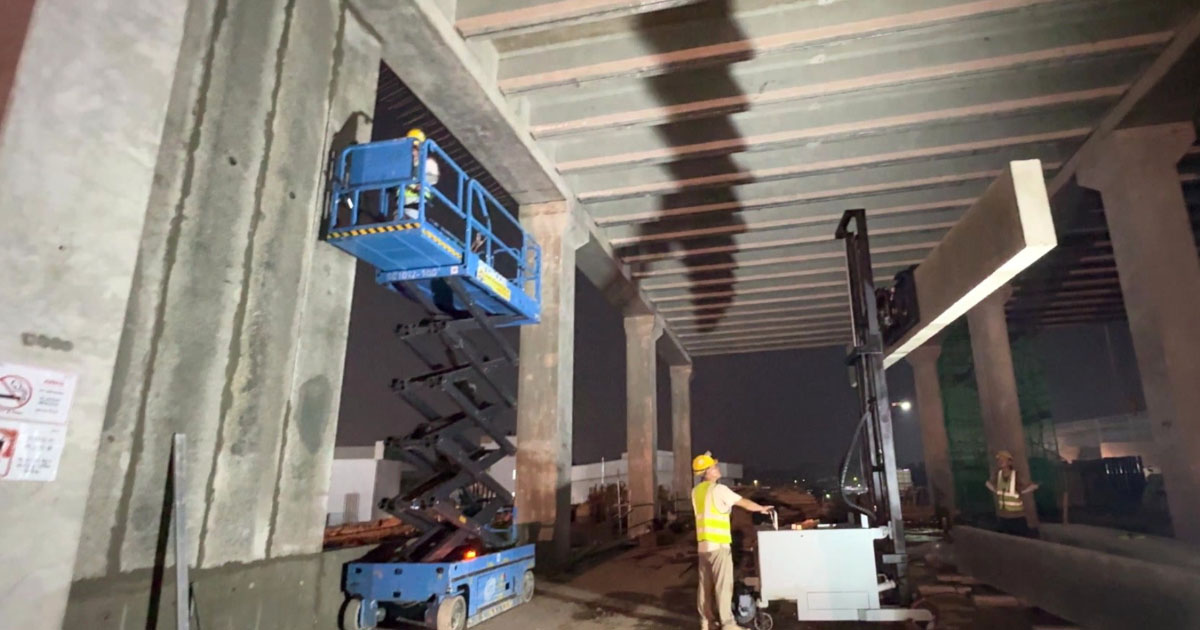
Programme planners want to know how long one wall panel takes to install. To show it, we recorded the installation of a vPANEL ALC wall panel on a data centre project in Johor, Malaysia. The installation used a panel installation machine. Within 13 minutes 45 seconds of the panel reaching the wall, the panel was up, fixed at the head and checked, its joints were being filled, and the next panel was already on its way. No crane was needed to tilt, lift or place the panel.
What Happens Before the Panel Reaches the Wall?
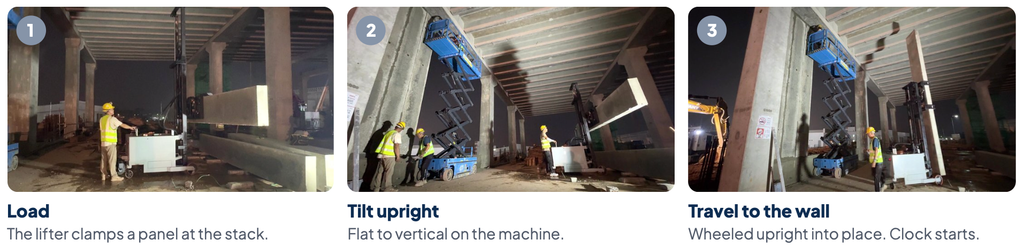
Three steps take place before the count begins, because the 13 minutes 45 seconds is only counted from the moment the panel arrives at its position.
Step 1: Load the panel
The panel installation machine picks up a vPANEL straight from the stack.
Step 2: Tilt it upright
The machine rotates the panel from flat to vertical. No crane is needed.
Step 3: Travel to the column
The panel is wheeled upright to its position on the wall line. The counting starts on arrival.
What Happens Inside the 13 Minutes 45 Seconds?
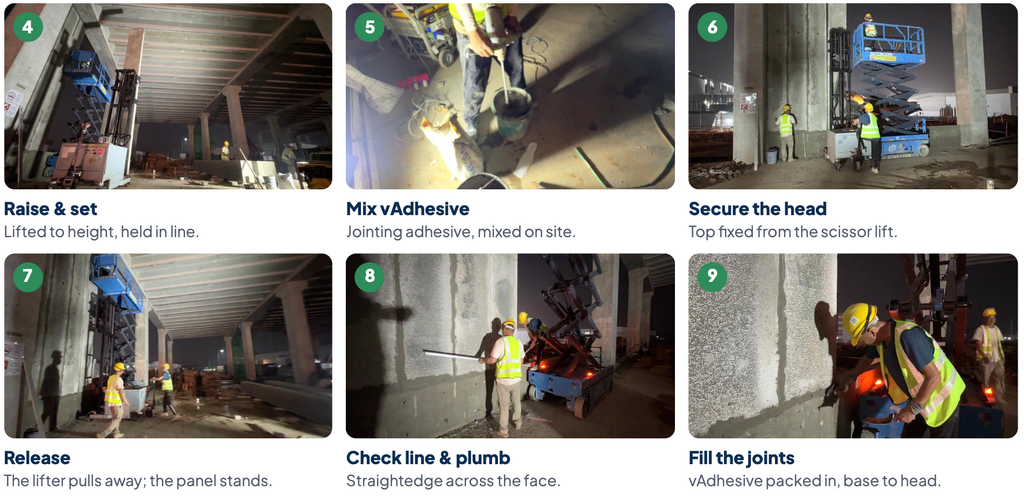
Six steps follow once the panel is in position, and the next panel is loaded before the cycle ends.
Step 4: Raise and set in position
The machine lifts the panel to full height and holds it in line, while the top is guided from the scissor lift.
Step 5: Mix the vAdhesive
vAdhesive is mixed on site with a paddle mixer while the machine holds the panel.
Step 6: Secure the panel head
From the scissor lift, the installer fixes the top of the panel while the machine keeps it steady.
Step 7: Release the machine
The machine lowers and withdraws, and the panel now stands on its own.
Step 8: Check line and plumb
A straightedge and spirit level are held across the face, and the panel is adjusted to line and plumb.
Step 9: Fill the joints
From the scissor lift, vAdhesive is packed into the joints from the base up to the head. While the joints are being finished, the machine is already loading and tilting the next panel, and that panel is then on its way to the column so the cycle can repeat.
Why Is ALC Wall Panel Installation So Quick with This Method?
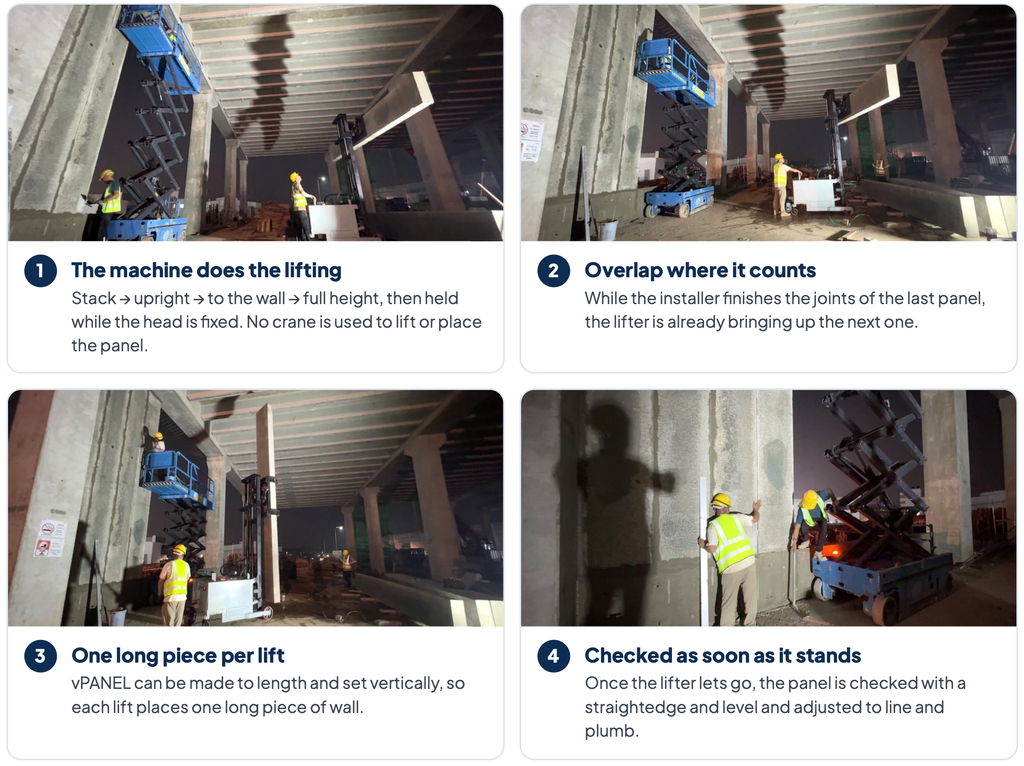
Four things explain the pace in this example.
The machine does the lifting. It takes the panel from the stack, turns it upright, wheels it to the wall, raises it to full height and holds it while the head is fixed. No crane is used to lift or place the panel, and a scissor lift reaches the head.
The work overlaps. While the installer is still finishing the joints of one panel, the machine is already loading and tilting the next one.
Each lift places one long piece of wall. vPANEL can be made to length and set vertically, so a single lift covers the full height.
The panel is checked as soon as it stands. Once the machine lets go, the panel is checked with a straightedge and level and adjusted to line and plumb straight away.
What Does This ALC Wall Panel Installation Time Mean for Your Programme?
Taking the 13:45 cycle as a basis, the output from one machine and crew works out as follows. Sixty minutes divided by 13.75 minutes gives about 4.4 panels an hour at most. For a 6 m panel, which covers 3.6 m², that is about 15.7 m² an hour, or about 126 m² over an 8-hour shift with no breaks.
These figures are upper limits. They assume every cycle matches the one timed, and they do not count the short trip of the next panel to the wall. Real output depends on the crew, access, deliveries, openings and cut pieces. The clip shows one plain panel with no opening, and openings, lintels and cut pieces take longer. For that reason, we plan your figure from your drawings rather than from this example.
Planning vPANEL Installation for Your Project
If you want to see how this pace could apply to your job, send us your elevations. We will work out panel lengths, deliveries and the installation sequence with your installer, and send you the 4-minute site time-lapse. Reach us on WhatsApp or email inquiry@vodapruf.com.
📞 Malaysia: +60 16 217 7155
📞 Singapore: +65 9796 5910
🌐 vodapruf.com
Frequently Asked Questions
How does an ALC wall panel differ from AAC blocks?
The main difference is format and reinforcement. vPANEL ALC wall panels are large panels, and the Standard Panel is steel-reinforced, while AAC blocks are small units laid course by course. Because each panel is one long piece, a single lift places a full height of wall.
What sizes does vPANEL come in?
The Standard Panel is 600 x 3,000 mm and steel-reinforced, and the Short Panel is 600 x 1,500 mm and non-reinforced. Longer panels can be made to project requirements, with maximum length depending on thickness: 3,000 mm at 100 mm, and 4,000 to 6,000 mm from 150 mm thick onwards. This applies across our ALC panel range.
How are the joints between vPANEL panels filled?
Joints are filled with vAdhesive, a jointing adhesive mixed on site with a paddle mixer. It is packed into each joint from the base up to the head. In our Johor data centre example, this was done from the scissor lift while the next panel was being loaded.
What density does vPANEL have, and can it be changed?
Standard vPANEL has a dry density of 550 kg/m³, and density can be customised between 400 and 1,200 kg/m³ to suit a project. A lower density gives a lighter panel. Share your requirements with us and we will recommend a suitable density.
What is the fire rating of an ALC wall panel like vPANEL?
vPANEL has a 4-hour fire rating at 100 mm thickness, tested to BS 476 Part 22:1987. The rating a wall needs depends on the building and its use. Confirm the requirement for your project with your fire consultant and the relevant authority.
How well does vPANEL insulate against heat?
vPANEL has a thermal conductivity of 0.1375 W/(m.K). The lower this value, the less heat passes through a given thickness of material. Whether the wall meets your insulation target depends on its thickness and the wider build-up, so check the figure with your designer.
What compressive strength does vPANEL have?
Standard vPANEL has a compressive strength of 3 MPa, and higher-strength tiers of 5 and 7 MPa are available as upgrades. Your engineer should confirm the strength your application needs. We can then advise which vPANEL option fits your project.