
 English
 Arabic
Key Takeaways
- AAC blocks are lightweight: They weigh 3–5× less than conventional concrete blocks, making them easier to handle on site.
- High water absorption is the main weakness: AAC blocks can absorb up to 20% water — proper waterproofing is essential for external walls in Malaysia.
- SIRIM MS 2514 is the Malaysian standard: Specify AAC blocks under this standard for compliant construction.
- ALC panels install 7.5× faster: If timeline and labour cost matter, modern ALC panels like vPanel offer a significant upgrade over AAC blocks.
- Autoclaving makes AAC blocks energy-intensive: The manufacturing process requires high-pressure steam curing, which drives up production cost and carbon footprint.
Introduction
If you’re specifying wall materials for a project in Malaysia — whether residential, commercial, or industrial — AAC blocks are likely on your shortlist.
They’re widely available, lightweight, and meet Malaysia’s fire and thermal requirements. But as construction demands evolve, more contractors and developers are asking: is there something better?
This guide gives you the full picture — what AAC blocks are, how they’re made, their real technical specs, and what alternatives exist for Malaysian projects in 2026.
What Is an AAC Block?
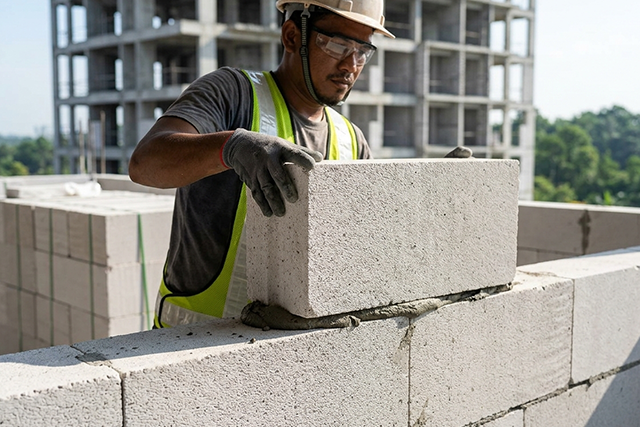
An AAC (Autoclaved Aerated Concrete) block is a lightweight building material made from cement, sand or fly ash, lime, water, and aluminium powder. The aluminium powder reacts with the alkaline mixture to create millions of tiny air bubbles, giving the block its characteristic lightweight, cellular structure. AAC blocks are then steam-cured in a pressurised autoclave to achieve their final strength.
AAC stands for Autoclaved Aerated Concrete. It is one of the most widely used lightweight wall materials in Malaysia, replacing conventional clay bricks in many residential and commercial projects.
The air-bubble structure inside the block gives it three key properties:
- Lightweight — approximately 3–5× lighter than standard concrete
- Thermally insulating — the trapped air reduces heat transfer
- Fire resistant — AAC blocks achieve 2–6 hour fire ratings depending on thickness
Common AAC block applications in Malaysia include residential partition walls, commercial office interiors, industrial factory partitions, and any non-load-bearing wall application.
How Are AAC Blocks Made in Malaysia?
AAC blocks are produced through a 6-step process: raw material mixing, pouring into moulds, rising through hydrogen gas reaction, wire cutting, autoclaving (180–200°C for 8–12 hours), and quality testing. The autoclaving stage — high-pressure steam curing — is what gives AAC its strength and dimensional stability, but it is also the most energy-intensive and expensive step.
Here is the manufacturing sequence in detail:
- Raw material mixing — Sand or fly ash, cement, lime, water, and aluminium powder are combined into a slurry.
- Pouring and rising — The slurry is poured into large moulds. Aluminium reacts with lime to release hydrogen gas, causing the mixture to rise (similar to bread dough), creating the cellular structure.
- Pre-curing — The poured mass partially hardens at room temperature for 2–4 hours.
- Wire cutting — The semi-hardened block is precision-cut to required dimensions using steel wires.
- Autoclaving — Blocks enter a pressurised steam chamber at 180–200°C for 8–12 hours. This step gives AAC its final compressive strength and dimensional accuracy.
- Quality testing — Blocks are tested for compressive strength, density, and dimensional tolerance before leaving the factory.
The autoclaving step is expensive. It requires significant energy (electricity and steam) and large capital investment. This is one reason why non-autoclaved alternatives — such as vPanel ALC panels — can often be priced competitively while delivering similar or better performance.
What Are the Technical Specifications of AAC Blocks?
In Malaysia, AAC blocks are specified under SIRIM MS 2514. Density ranges from 400–800 kg/m³, compressive strength from 2.5–7.5 N/mm², and thermal conductivity from 0.10–0.24 W/mK. Standard block dimensions are 600mm × 200mm, with thicknesses of 75mm to 200mm. Fire resistance ranges from 2–6 hours depending on density class.
The table below shows the three density classes used in Malaysian specifications:
| Specification | Class A (Low Density) | Class B (Medium) | Class C (High Density) |
| Dry Density | 400–500 kg/m³ | 501–700 kg/m³ | 701–800 kg/m³ |
| Compressive Strength | ≥ 2.5 N/mm² | ≥ 3.5 N/mm² | ≥ 5.0 N/mm² |
| Thermal Conductivity | ~0.10 W/mK | ~0.14 W/mK | ~0.20 W/mK |
| Fire Resistance | 2–4 hours | 2–4 hours | 3–6 hours |
| Water Absorption | Up to 20% | Up to 18% | Up to 15% |
| Best Use | Interior partitions | Commercial / light industrial | External walls / structural |
| Common in Malaysia? | Most common | Common | Less common |
Class A blocks are the most widely specified in residential projects. Class B is common for commercial office partitions. Class C is selected for external walls requiring higher strength and lower moisture absorption.
How Do AAC Blocks Perform in Malaysia’s Tropical Climate?
AAC blocks perform reasonably well in Malaysia’s heat, providing better thermal insulation than red bricks. However, their high water absorption rate (up to 20%) is a serious concern in Malaysia’s year-round humid, high-rainfall environment. External AAC block walls must be properly waterproofed and rendered to prevent moisture ingress, efflorescence, and long-term wall damage.
Malaysia’s climate creates specific challenges for AAC blocks:
- High humidity: AAC’s open-cell air structure absorbs moisture from the atmosphere over time, leading to damp walls if not properly sealed.
- Frequent rain: External AAC walls without render coatings are vulnerable to water penetration during heavy monsoon rain.
- Heat: AAC performs better than red brick in heat insulation, but its thermal conductivity of 0.10–0.24 W/mK is still higher than next-generation ALC panels.
Best practice for external AAC block walls in Malaysia: apply a waterproofing render coat or external plaster before painting. For wet areas — bathrooms, food processing plants, or building facades — consider materials with lower water absorption.
By comparison, Vodapruf vPanel ALC panels use a closed-cell structure infused with LIGHTHERM aggregate, resulting in significantly lower water absorption and better thermal performance in Malaysia’s climate.
What Is the Price of AAC Blocks in Malaysia?
AAC block prices in Malaysia typically range from RM 1.50 to RM 3.50 per block, depending on thickness, density class, and supplier. Thicker (150mm+) and higher-density blocks cost more. Bulk orders above 5,000 blocks usually attract negotiated pricing. Always factor in delivery costs — freight to sites in Sabah, Sarawak, or remote Peninsular areas adds significantly to the total price.
| Thickness | Typical Price (RM/block) | Common Use |
| 75mm | RM 1.50 – 2.00 | Light partitions, non-structural |
| 100mm | RM 1.80 – 2.50 | Standard interior partitions |
| 125mm | RM 2.20 – 3.00 | Office walls, semi-external |
| 150mm | RM 2.80 – 3.50 | External walls, acoustic partitions |
| 200mm | RM 3.20 – 4.00+ | High fire-rated / structural walls |
Note: Prices are estimates as of 2026. Actual pricing varies by supplier, volume, and delivery location. Request quotes from at least 2–3 suppliers before finalising your bill of quantities.
What Are the Advantages and Disadvantages of AAC Blocks?
AAC blocks offer proven lightweight construction with good thermal and fire performance. Their main disadvantages are high water absorption, slow installation speed compared to large-format panels, and higher susceptibility to joint cracking over time. For large-scale projects with tight timelines, modern ALC panels are increasingly preferred.
| Factor | AAC Block | vPanel ALC Panel |
| Weight | 400–800 kg/m³ | ~550 kg/m³ (similar, but larger format) |
| Thermal Conductivity | 0.10–0.24 W/mK | 0.125 W/mK (superior per unit area) |
| Fire Rating | 2–6 hours | Up to 4 hours |
| Water Absorption | Up to 20% | Very low (closed-cell structure) |
| Installation Speed | Baseline | 7.5× faster per m² |
| Labour Cost | Higher (more blocks, more joints) | 70% labour savings on large sites |
| BCA Buildability Score | Lower | LSI 0.85 (meets SG BCA requirements) |
| Green Certification | Varies by supplier | Green Label certified |
| Plastering Required? | Yes (typically) | No — direct skim coat |
Is There a Better Alternative to AAC Blocks in Malaysia?
For projects over 1,500 m² of wall area — or where construction timelines are critical — ALC panels are a proven upgrade to AAC blocks. Vodapruf vPanel ALC panels install 7.5× faster, require no plastering, and have lower water absorption. They carry the Singapore Green Label certification and are used in projects including the Apple Data Centre and Singapore General Hospital.
AAC blocks remain a solid choice for small residential projects with flexible timelines and limited wall areas. But the industry is shifting.
Here’s when to choose each:
| Choose AAC Blocks when… | Choose vPanel ALC Panel when… |
| Project wall area is under 1,000 m² | Project wall area is over 1,500 m² |
| Timeline is flexible | Delay penalties apply or timeline is tight |
| Budget priority is material cost only | Total project cost (materials + labour) is the target |
| Site has good block storage space | Site access is limited (Short Panel fits in standard lifts) |
| Plastering crew is available | You want to skip the plastering step entirely |
Vodapruf manufactures vPanel from our 5-acre factory in Kulai, Johor, and supplies projects across Malaysia and Singapore. We offer free project consultations to help you decide which wall system is right for your specific project.
Conclusion
AAC blocks have served Malaysia’s construction industry well for decades. They’re lightweight, fire-resistant, and widely available. But in 2026, the industry has better options for speed, thermal performance, and sustainability.
If you’re evaluating wall materials for your next project — whether residential, commercial, or industrial — it’s worth comparing the full cost picture: materials, labour, timeline, and finishing.
Planning Your Next Project in Malaysia or Singapore?
Vodapruf has supplied wall panel and lightweight aggregate solutions to 700+ projects in Singapore and across Malaysia — including the Apple Data Centre, Singapore General Hospital, and industrial sites in Johor and Kuala Lumpur. Our team can advise on the right wall system for your project scope and timeline.
Whether you’re comparing AAC blocks and ALC panels, or ready to request a quote — we’re happy to have a practical conversation with no commitment required.
📞 Malaysia: +60 16 217 7155
📞 Singapore: +65 9796 5910
🌐 vodapruf.com
Frequently Asked Questions (FAQ)
What is the standard size of AAC blocks in Malaysia?
The standard AAC block size in Malaysia is 600mm (length) × 200mm (height), with thicknesses ranging from 75mm to 200mm. The most commonly used thickness for residential interior partitions is 100mm. For external walls or walls requiring higher acoustic or fire performance, 150mm or 200mm blocks are used. All AAC blocks in Malaysia should comply with SIRIM MS 2514.
Who are the main AAC block suppliers in Malaysia?
Major AAC block suppliers and manufacturers in Malaysia include Starken (Toyo Trading), Alamcon, and Ytong. These brands supply blocks to residential, commercial, and industrial projects across Peninsular Malaysia. If you require a faster-installing alternative, Vodapruf manufactures vPanel ALC panels from our Johor Bahru factory, with supply to Malaysia and Singapore.
Can AAC blocks be used for external walls in Malaysia?
Yes, AAC blocks can be used for external walls in Malaysia, but they require proper waterproofing. AAC has a water absorption rate of up to 20%, making untreated external walls vulnerable in Malaysia’s tropical climate. Best practice is to apply a waterproofing render coat before painting. For high-moisture environments (food factories, bathrooms, facade), consider materials with lower water absorption.
Is AAC block stronger than conventional red brick?
AAC blocks are lighter and better thermally than clay bricks, but have lower compressive strength. A Class B AAC block achieves ~3.5 N/mm² compressive strength, compared to a clay brick at 10–30 N/mm². AAC blocks are best suited for non-load-bearing partitions. For structural walls, conventional bricks or reinforced concrete are more appropriate.
What is the difference between AAC block and ALC panel?
AAC blocks are small units stacked with mortar (similar to bricks). ALC panels are large precast wall panels — typically 600mm wide and spanning floor to ceiling — that install as a single piece. ALC panels install approximately 7.5× faster per m² and create fewer joints, reducing the risk of wall cracks. The material cost per m² is higher for ALC panels, but labour and timeline savings typically outweigh the difference on projects over 1,500 m² of wall.
What SIRIM standard covers AAC blocks in Malaysia?
AAC blocks in Malaysia are specified under SIRIM MS 2514. This standard covers density classification (Class A, B, C), compressive strength requirements, dimensional tolerances, water absorption limits, and fire resistance criteria. Always request product test certificates confirming MS 2514 compliance when sourcing AAC blocks in Malaysia.
How long does it take to build a wall with AAC blocks vs ALC panels?
A skilled team can install approximately 6–8 m² of AAC block wall per worker per day. With Vodapruf vPanel ALC panels, the same team can cover 45–60 m² per day — roughly 7.5× faster. On a 10,000 m² wall project, this translates to weeks of schedule savings, plus reduced scaffolding, preliminary, and overhead costs.