
 English
 Arabic
Key Takeaways
- ALC wall panels redefine wall construction: Lightweight, fast, and eco-friendly, they’re the preferred choice for modern projects.
- Verified for MY/SG compliance: Panels meet CIDB, BCA, SIRIM, SGBC (Green Mark) and SEC (Green Label) standards unlocking approvals.
- Technical performance matters: Superior thermal, fire, and sound insulation with easy installation saves time and cost.
- Versatile for all sectors: Widely used in data centres, factories, high-rise residential, and schools.
- Expert-backed advice included: Installation tips, regulatory checklist, and common pitfalls for specifiers.
Table of Contents
Introduction
ALC wall panels are disrupting the construction industry in Singapore and Malaysia, gradually replacing red bricks and AAC blocks. As the region faces increasing demand for speed, quality, and sustainability, the shift to advanced precast wall solutions is accelerating. But what exactly is an ALC wall panel, and why are top developers, architects, and contractors switching over?
This Ultimate Guide breaks down everything you need to know about ALC wall panels for year 2025: from how they’re made to technical specs, real use cases, compliance requirements, and the practical tips that set your project up for success.
What is the difference between ALC (Aerated Lightweight Concrete) and AAC (Aerated Autoclaved Concrete)?
ALC and AAC are both lightweight, porous concretes used in construction for insulation and reduced weight, but they differ primarily in manufacturing and performance. ALC typically refers to non-autoclaved versions (also called NAAC), while AAC is the autoclaved type. Here’s a comparison:
| Aspect | ALC (Non-Autoclaved) | AAC (Autoclaved) |
| Manufacturing | Cured naturally (7+ days); no high-pressure steam. Uses cement, standard filler and lightweight filler. | Cured in autoclave (high pressure ~12 kg/cm² , 185°C for 8-12 hours); uses: cement, lime, aluminium powder, gypsum and sand. |
| Production Cost | Lower. smaller land/electric needs; less pollution. | Higher. requires boilers, autoclaves; more pollution and regulations. |
| Capacity | Small-scale (80 M³/day); easier for startups. | Large-scale (500 M³/day); suited for high volume. |
| Properties | Density 450-550 kg/ m³;water absorption 12-20%, less brittle. | Density 600-750 kg/m³; water absorption 20-24%, more fragile. |
What is the difference between ALC Block / AAC Block with ALC Panel / AAC Panel?
| Aspect | ALC / AAC Blocks | ALC / AAC Panels |
| Manufacturing | Poured into small molds, cut, and autoclaved (or non-autoclaved for ALC); no internal reinforcement. | Poured around welded steel cages for reinforcement, then autoclaved; larger molds |
| Dimension | Small, brick-like: e.g., 600x200x100-300mm. | Large slabs: up to 6m long, 600mm wide, varying thickness (e.g., 50-300mm). |
| Applications | Same between both, but slower speed. Commonly chosen for small scale projects like housing and low rise. | Same between both, but faster speed. Commonly chosen for small scale projects like industrial, warehouse and high rise. |
| Structural Role | Stacked with mortar; labor intensie, flexible for on-site cuts. | Precast, crane-installed, handles bending moment and wind loads via steel reinforcement. |
| Advantage | Easy handling, lower cost due to absence of rebar | Faster install (days vs. weeks), less labor. |
What is an ALC wall panel and how is it made?
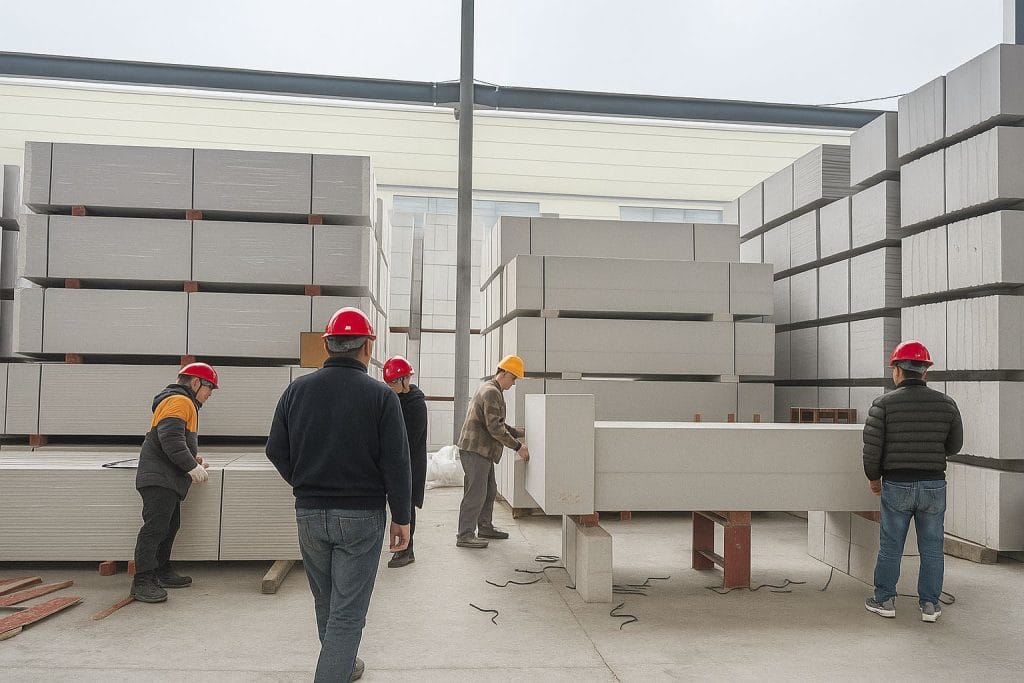
An ALC wall panel is a factory-made, precast partition or external wall, built from autoclaved lightweight concrete for optimal strength, insulation, and install speed.
Definition & Process:
These panels are manufactured by mixing cement, fillers (sand, limestone), Pozzolanic materials (slag, fly ash) water, and a filler (foaming agent or lightweight aggregate), which is then poured into steel molds with built-in wire mesh. The panels are cut to size (typically 600mm wide) and finished with tongue-and-groove edges (if required).
Differences vs. Other Walls:
Unlike AAC blocks (smaller, laid like bricks), ALC panels are large and reinforced, allowing for rapid, seamless wall construction. Traditional masonry wall (bricks, cast-in-situ concrete walls, CMU-Concrete-masonry-unit, hollow core panel) are heavier, slower to build, and require more wet works and skilled labor.
Example:
A Johor industrial warehouse project replaced all internal block walls with ALC panels, completing wall installation 60% faster than the previous phase.
What are the key technical specifications and performance benefits of ALC wall panels?
ALC wall panels offer superior performance: lighter, stronger, and more insulating than conventional wall systems, with industry-leading specs for 2025.
Technical Specs (MY/SG 2025):
- Panel thickness: 50mm, 75mm, 100mm, 125mm, 150mm, 200mm
- Width: 600mm (industry standard)
- Density: 450–550 kg/m³ (about 1/3 traditional concrete)
- Thermal conductivity: 0.1375 W/(m·K) (excellent insulation)
- Fire rating: Up to 4 hours (depending on thickness)
- Finish: Factory-smooth, ready for skim coat, paint, or direct tiling
Benefits:
- Installation speed: Large panel size means fewer joints, up to 70% faster install than brick/block.
- Labour savings: Smaller crew, less wet work.
- Sustainability: Lower material use, factory offcuts recycled, strong Green Mark / Green Label Scoring.
- Performance: High thermal insulation, moisture resistant.
Example:
A Singapore data centre used 100mm ALC panels for partitioning, achieving both BCA Green Mark points and a 35% reduction in construction time.

Where and why are ALC wall panels used in Singapore & Malaysia projects?
ALC wall panels are now the go-to solution for projects demanding fast, reliable, and compliant construction—especially where performance matters.
Typical Applications:
- Data Centres: Fire safety, insulation, and speed (critical for tech sector timelines)
- Food Factories: Moisture resistance and thermal insulation
- Industrial & Warehouses: Impact-resistant, long panel spans
- High-Rise Residential & Commercial: Lighter structure reduces total dead load; installation on tight schedules
- Schools & Institutions: Acoustic comfort and durability
Why Specifiers Choose ALC:
- Code compliance
- Proven to reduce project timelines and costs
- Consistent quality from factory-controlled manufacturing
Example:
A Klang Valley school expansion specified ALC panels for both external and internal partitions, meeting acoustic and fire-rating requirements for MOE compliance.
How do ALC wall panels comply with Singapore/Malaysia regulations and certifications?
Using ALC wall panels simplifies your regulatory process—when sourced from certified suppliers, approval is straightforward and submission-ready.
Compliance Checklist:
- Masonry wall/ Partition Wall need to comply to British Standard BS5234 (Robustness Test)/ Singapore Standard SS 492:2001
- Fire Rating need to comply to BS 476 Part 22:1987 (Fire tests on building materials and structures -Non-load-bearing elements of construction)
- Acquire COC (Certificate of Conformity)
- STC value (Sound Transmission Class)
- Green Mark/ Green Label certification
- Thermal conductivity value in w/mK and U-value calculation upon request.
- Water Absorption test report
- Professional engineer endorsement on installation detail
Others Checklist:
- Include installation manual
- Past project references
- General shopdrawing
- (Malaysia) Bomba Approval
- (Malaysia) CIDB’s IBS (Industrialised Building System) Approval List
Example:
A Penang hospital project required fire-rated walls for the Ministry of Health; the supplier’s IBS and Bomba certifications enabled approval in a single round.
What are the expert tips and FAQs for specifiers considering ALC wall panels?
Practical insights and answers to your top ALC questions—straight from MY/SG industry experts.
Specifier Tips:
- Always request updated test data: Especially for fire/thermal/acoustic performance
- Proper joint mortar selection, to ensure good water tightness overtime and less drying shrinkage.
- Proper panel to panel installation, ensuring proper connection between panel jointing, thus reducing hairline crack risk.
- Insist on site training: Most suppliers offer guidance for first installation (trade demo)
Common FAQs:
- Q: Can ALC panels be used externally?
A: Yes, with proper weatherproofing and thickness spec. - Q: Are ALC panels load-bearing?
A: No—use for partition/infill, not main structure. - Q: What mistakes should I avoid?
A: Skipping anchor details at base/top, poor panel alignment, jointing not fully filled with mortar. - Q: How fast can I install?
A: Up to 8x faster than brick or block—plan crane/mini-hoist for maximum speed.
Example:
A contractor in Johor avoided costly rework by requesting site training from the ALC supplier—avoiding common mistakes with mechanical fixings and joint details.
Conclusion
ALC wall panels aren’t just the future—they’re the smart, proven solution for today’s MY/SG construction projects.
Faster, greener, and compliant with strict regional standards, ALC panels are transforming the way walls are built across sectors.
Ready to specify ALC for your next project?
Ready to explore ALC wall panels for your next project? Contact Vodapruf today for expert guidance, tailored solutions and let our specialists support your next project.
Frequently Asked Questions
Can ALC wall panels be installed in existing buildings, or only new construction?
ALC wall panels are suitable for both new construction and renovation of existing buildings. For retrofits, panels can be cut and installed with minimal disruption, reducing downtime and mess compared to wet trades. Structural checks are needed for integration with existing floors/walls, but most commercial and institutional buildings are eligible.
Are ALC panels suitable for Singapore’s humid and rainy climate?
Yes. For external use, ensure panels are properly sealed and finished with recommended waterproofing and weatherproof coatings for long-term durability.
How do I choose the right thickness of ALC wall panel for my project?
Panel thickness depends on your performance needs: 100mm for most internal partitions; 150mm for external or higher fire/acoustic ratings. 200mm for best thermal insulation without the use of insulation wood (double wall system). Always consult your project’s engineer or architect, and request technical data from your supplier to match your code and spec requirements.
How does the cost of ALC panels compare to other wall systems in Singapore & Malaysia?
ALC wall panels are generally more cost-effective over the entire project compared to brickwork or precast concrete. While initial material cost may be higher than basic blockwork, ALC panels cut down labor, installation time, and finishing costs. This makes them especially attractive for fast-track, large-scale, or labor-scarce projects.
What if my project needs custom panel sizes or shapes?
Most ALC panel suppliers can manufacture custom lengths, heights, or even special shapes for your project. Early coordination and accurate shop drawings are key—discuss custom requirements upfront to minimize lead time and wastage.
What are the most common site problems during ALC panel installation and how can I prevent them?
Common issues include improper panel alignment, lack of proper anchoring at slab, jointing cracks between panel. Prevent these by providing clear shop drawings, ensuring onsite supervision, and requesting supplier training for your installation team.
Will ALC wall panels become the industry standard in Singapore & Malaysia for the next decade?
All signs point to yes—demand is growing fast, and regional regulations increasingly favor green, efficient wall systems. Developers are prioritizing solutions like ALC panels that deliver on speed, performance, and sustainability. Expect adoption to accelerate as more case studies and compliance data emerge.
Why is there so much confusion about the names for ALC, AAC, autoclaved aerated concrete, autoclaved lightweight concrete, wall, panel, and block—and what do they actually mean?
The construction industry uses a variety of overlapping names for these products, which confuses buyers, and specifiers. Even with this article earlier explanation on the difference between ” ALC” (Autoclaved Lightweight Concrete) and “AAC” (Autoclaved Aerated Concrete), some markets use “ALC” and “AAC” interchangeably, and all these terms (ALC, AAC, autoclaved aerated concrete, autoclaved lightweight concrete, wall, panel, block) belong to the same product family. “Panel” usually refers to large, factory-made reinforced slabs used for walls, while “block” refers to smaller, brick-sized units laid by hand. To avoid confusion in your project, or when searching online , always specify both the material (ALC/AAC) and the product type (panel or block), and confirm with technical data and project requirements.
What do CIDB (Malaysia), SIRIM (Malaysia), SGBC (Singapore), Green Mark (Singapore), SEC (Singapore Environment Council), and Green Label (Singapore) mean?
CIDB (Malaysia):
Construction Industry Development Board. It is a statutory body established under the Construction Industry Development Act 1994 (Act 520) to regulate, develop, and promote the Malaysian construction industry.
SIRIM (Malaysia):
Standards and Industrial Research Institute of Malaysia (now known as SIRIM Berhad). It is a wholly-owned government organization under the Minister of Finance Incorporated, serving as Malaysia’s premier body for industrial research, technology development, standardization, testing, inspection, and certification.
SGBC (Singapore):
Administered by a non-profit organization established in 2009, focuses on advocacy and certification for sustainable building products, and runs the Singapore Green Building Product (SGBP) scheme to ensure eco-friendly materials in designs.
Green Mark (Singapore):
Administered by the Building and Construction Authority (BCA), focuses on evaluating whole-building environmental performance, and runs a rating system launched in 2005 with levels like Certified, Gold, and Platinum for energy efficiency and sustainability.
SEC (Singapore Environment Council):
Administered as a non-profit government-linked body established in 1992, focuses on broader environmental education and policy advocacy, and runs the SGLS while promoting public awareness and global eco labelling networks.
Green Label (Singapore), or the Singapore Green Labelling Scheme (SGLS):
Administered by the Singapore Environment Council (SEC), focuses on certifying eco-friendly consumer and industrial products, and awards a Type I ecolabel to over 3,800 items meeting standards on energy and recyclability.