
 English
 Arabic
Key Takeaways
AAC Blocks Offer Superior Insulation:
Autoclaved Aerated Concrete (AAC) has the lowest thermal conductivity, so it blocks more heat and keeps buildings cooler than red brick or concrete blocks.
Lower U-Value Means Lower Electricity Bills:
AAC’s U-value is much lower than traditional materials, directly leading to big savings on air-conditioning—about $300/year per 100m² of wall.
AAC Combines Strength, Fire Resistance, and Practical Savings:
AAC blocks are strong enough for most buildings, fire-rated for up to 4 hours, and reduce both construction and long-term energy costs.
Proper Installation and Moisture Protection are Essential:
Using thin-bed adhesive and water-resistant plaster ensures AAC walls deliver maximum insulation and stay durable, even in humid climates.
Introduction
In the construction of the building envelope, the choice of wall material is often dictated by structural integrity and cost. However, with rising energy costs and increasing ambient temperatures, the thermal performance of the wall is now a critical third pillar of decision-making.
This technical breakdown analyzes three common walling materials: Fired Clay (Red Brick), Concrete Masonry Units (CMU/Hollow Block), and Autoclaved Aerated Concrete (AAC). We will derive their U-values from first principles and calculate the theoretical electricity savings for air conditioning.
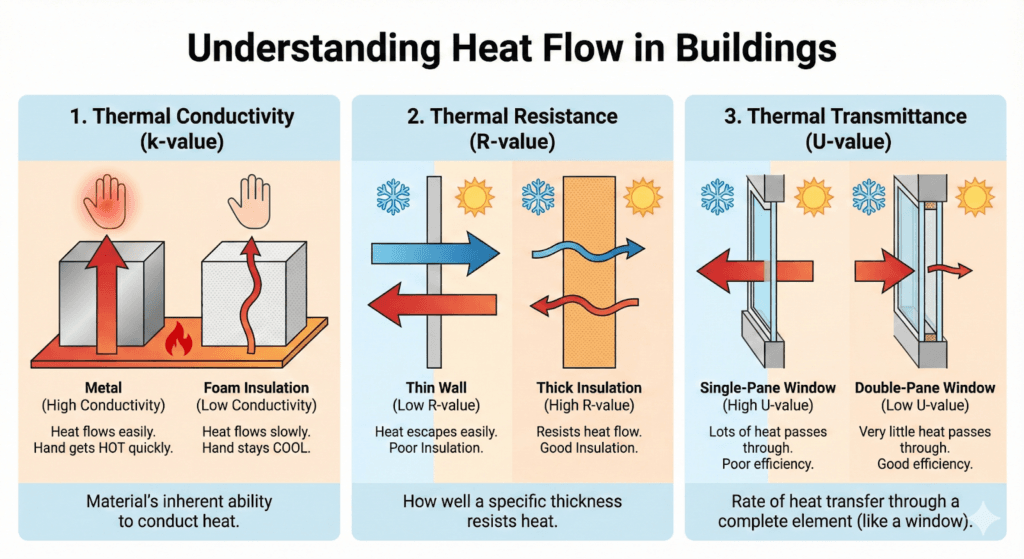
What are the Core Metrics of Heat Transfer in Buildings?
Thermal transmittance (U-value) is the rate of heat transfer through a structure, where a lower value indicates better insulation and higher energy efficiency.
To compare these materials fairly, we must understand the three governing metrics of heat transfer in building physics:
- Thermal Conductivity (k or λ):
- Definition: The rate at which heat passes through a specific material.
- Unit: Watts per meter-Kelvin (W/m·K).
- Rule: Lower is better for insulation. It means the material fights heat flow.
- Thermal Resistance (R-value):
- Definition: The measure of how well a specific thickness of a material resists heat flow.
- Formula: R = d/k (where d is thickness in meters).
- Unit: Square meter-Kelvin per Watt (/m·K/W).
- Rule: Higher is better.
- Thermal Transmittance (U-value):
- Definition: The rate of heat transfer through a structure (including surface air films), divided by the difference in temperature across that structure.
- Formula: U = 1 / ΣR = 1 / (Rsi + Rwall + Rse)
- Rsi = Internal surface resistance (typically 0.13)
- Rse = External surface resistance (typically 0.04)
- Unit: Watts per square meter-Kelvin (W/m²·K).
- Rule: Lower is better.
How Do Material Properties Compare Across a Standard 200mm Wall?
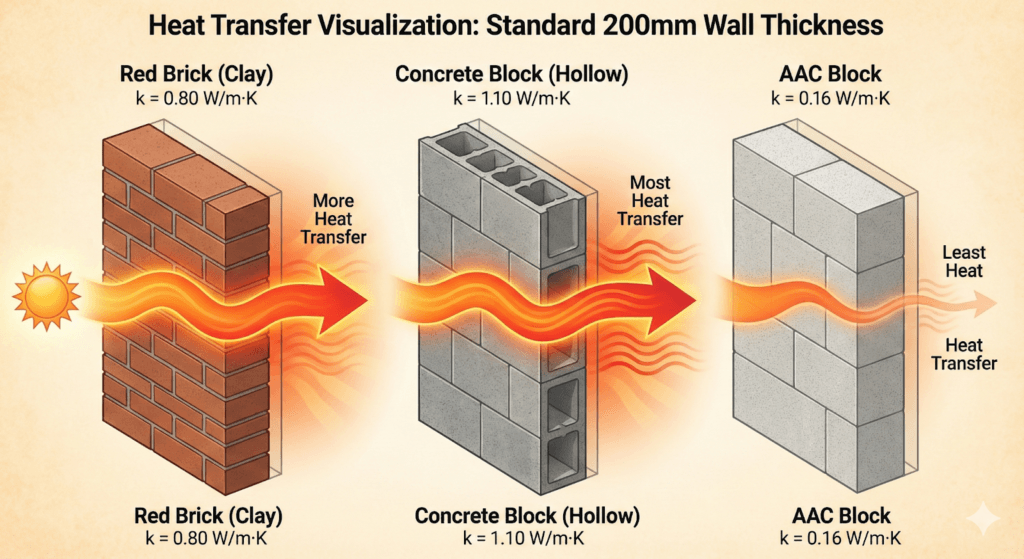
For an “apples-to-apples” comparison, we assume a standard wall thickness of 200mm (0.2m) for all contenders.
AAC Block features a closed-cell porous structure with a thermal conductivity (k) of 0.16 W/m·K, offering superior insulation compared to high-density red brick and concrete.
| Material | Density (kg/m³) | Est. Thermal Conductivity (k) | Characteristics |
| Red Brick (Clay) | 1600 – 1900 | 0.80 W/m·K | High thermal mass, poor insulator. |
| Concrete Block (Hollow) | 1200 – 1400 | 1.10 W/m·K* | Thermal bridges via webs; aggregate is conductive. |
| AAC Block | 450 – 650 | 0.16 W/m·K | Closed-cell porous structure; superior insulation. |
*Note: Solid concrete has a k of ~1.6+. Hollow blocks are effectively ~1.1 depending on aggregate.
The Calculation: Which Material Has the Best U-Value?
The Winner: Autoclaved Aerated Concrete (AAC) reduces thermal transmittance by approximately 70% compared to Red Brick and 75% compared to Concrete Blocks.
Let us calculate the U-value for a 200mm uninsulated single-skin wall for each material.
- Formula: R_total = Rsi + (d / k) + Rse
- Surface Resistance (Combined): 0.13 + 0.04 = 0.17 m²·K/W
A. Red Brick Wall
- R-value (material): 0.2m / 0.8 = 0.25 m²·K/W
- Total Resistance: 0.25 + 0.17 = 0.42
- U-value: 1 / 0.42
- Result: U_brick ≈ 2.38 W/m²·K
B. Concrete Block Wall
- R-value (material): 0.2m / 1.1 = 0.18 m²·K/W
- Total Resistance: 0.18 + 0.17 = 0.35
- U-value: 1 / 0.35
- Result: U_concrete ≈ 2.85 W/m²·K
C. AAC Wall
- R-value (material): 0.2m / 0.16 = 1.25 m²·K/W
- Total Resistance: 1.25 + 0.17 = 1.42
- U-value: 1 / 1.42
- Result: U_AAC ≈ 0.70 W/m²·K
Economic Impact: How Much Electricity Can You Save with AAC?
Switching from Red Brick to AAC can save approximately $302.40 per year in electricity costs for a 100m² wall area under standard cooling conditions.
To translate these abstract U-values into financial metrics, we simulate a typical scenario:
- Wall Area: 100m².
- Temp Diff (ΔT): 10°C
- Cooling: 10~hrs/day
- AC Efficiency (COP): 3.0
- Tariff: $0.15/kWh
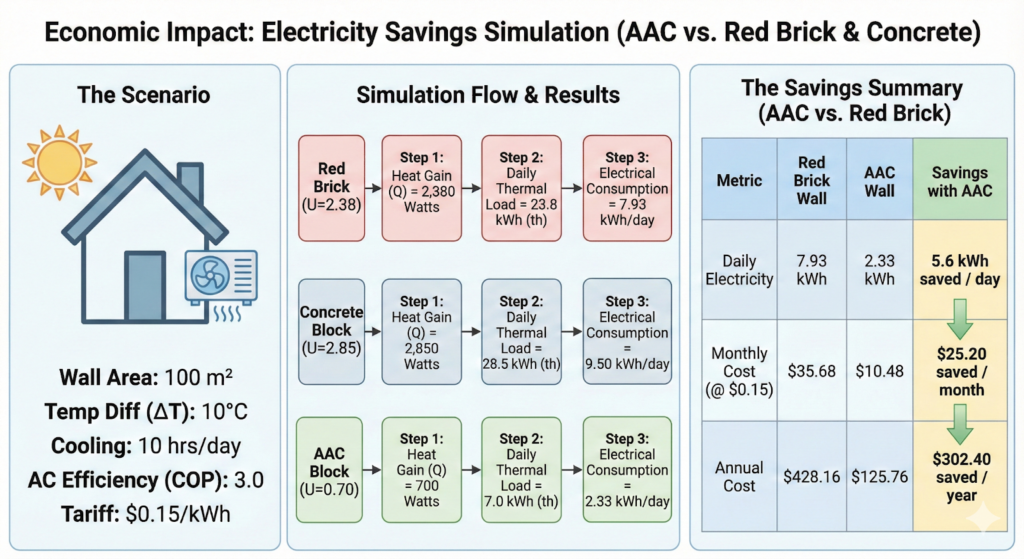
Savings Summary: AAC vs. Red Brick
| Metric | Red Brick Wall ($U=2.38$) | AAC Wall ($U=0.70$) | Savings with AAC |
| Heat Gain (Q) | 2,380 Watts | 700 Watts | 1,680 Watts saved |
| Daily Thermal Load | 23.8 kWh (th) | 7.0 kWh (th) | 16.8 kWh (th) saved |
| Daily Electricity Consumption | 7.93 kWh/day | 2.33 kWh/day | 5.6 kWh saved/day |
| Monthly Cost (@$0.15) | $35.68 | $10.48 | $25.20 saved/month |
| Annual Cost | $428.16 | $125.76 | $302.40 saved/year |
Conclusion
The data confirms that while red brick and concrete blocks remain industry standards for structural mass, they are poor thermal performers. AAC Block stands out as the superior choice for modern, energy-efficient building envelopes.
By achieving a U-value of ~0.70 W/m²·K, AAC effectively reduces heat transmittance by over 70% compared to traditional materials. For developers and homeowners, this translates directly into significant long-term operational savings, reducing cooling costs and enhancing indoor thermal comfort in an era of rising global temperatures.
Frequently Asked Questions (FAQ)
Is AAC strong enough to replace Red Brick for load-bearing structures?
Yes, AAC is available in various strength classes (typically 3.5 to 7.5 MPa), making it suitable for load-bearing walls in low-rise buildings. For high-rise structures, it is primarily used as an infill wall within a reinforced concrete frame, significantly reducing the dead load on the foundation.
How does the “Thermal Mass” of red brick compare to the “Insulation” of AAC?
Red brick has high thermal mass, meaning it stores heat during the day and releases it at night, which can lead to high indoor temperatures in the evening.1 AAC focuses on high thermal resistance (insulation), preventing the heat from entering the building in the first place, which is more efficient for 24/7 air-conditioned spaces.
Does high humidity in regions like Malaysia or Singapore affect AAC’s insulation properties?
While AAC is porous, its closed-cell structure limits capillary action; however, excessive moisture can slightly increase its thermal conductivity. Applying a high-quality water-resistant plaster or “skim coat” is essential to maintain the quoted k-value of $0.16~W/m·K in tropical environments.
Do I need special mortar to install AAC blocks to keep the U-value low?
Yes, AAC should be installed using “thin-bed adhesive” (2-3mm joints) rather than traditional thick cement-sand mortar (10-12mm).3 Thin joints minimize “thermal bridging,” ensuring the wall maintains its superior insulation performance across the entire surface area.
What is the fire resistance of an AAC wall compared to Concrete Blocks?
AAC offers exceptional fire safety, with a 200mm wall typically achieving a Fire Resistance Rating (FRR) of up to 4 hours. Because it is inorganic and non-combustible, it does not emit toxic fumes and performs better under extreme heat than hollow concrete blocks, which can crack or explode due to moisture trapped in the cavities.
Is AAC more expensive than Red Brick when considering the total project cost?
While the unit price per block may be higher, AAC reduces total costs by lowering labor hours due to its large size and lightweight nature. Additionally, the reduction in required structural steel (due to lower weight) and long-term electricity savings usually result in a lower “total cost of ownership.
Will adding a layer of plaster significantly change the U-values calculated?
Standard 15mm plastering on both sides adds a small amount of thermal resistance (R), typically improving the U-value by about 3-5%. While the core material (AAC vs. Brick) remains the dominant factor, quality plastering acts as an important secondary barrier against air infiltration.