
 English
 Arabic
Key Takeaways
AAC Alone Does Not Meet Party Wall Acoustic Standards:
Bare AAC blocks—even when plastered—rarely achieve the STC 50+ rating required for privacy in multi-unit buildings. Their low mass allows mid- and low-frequency sounds (like voices or TV bass) to pass through more easily than dense materials.
Mass-Spring-Mass Systems Are Essential for High STC Ratings:
To achieve proper sound isolation with AAC, you need to add layers—like plasterboard, air gaps, and mineral wool insulation—creating a decoupled wall system. These upgrades can boost STC ratings to 50–65+, suitable for modern apartments, hotels, or luxury spaces.
AAC Excels in Sound Absorption but Needs Help for Isolation:
The cellular structure of AAC dampens echoes and absorbs high-frequency sounds but does not provide enough “blocking” of airborne noise on its own. True privacy requires a combination of AAC’s damping with added mass and separation.
Correct Detailing and Installation Prevent Acoustic Weakness:
Even the best wall assembly can fail if there are leaks (like back-to-back outlets) or poor sealing. Always use acoustic-rated sealants, avoid direct penetrations, and consider acoustic breaks at wall junctions to prevent sound flanking around the wall.
Introduction
In modern multi-residential construction, the “party wall”—the shared wall between two distinct units—is the primary line of defense against noise intrusion. As developers increasingly favor Autoclaved Aerated Concrete (AAC) for its thermal efficiency and speed of installation, a critical question arises for architects and acoustic engineers: Can a lightweight, porous material like AAC actually meet the stringent Sound Transmission Class (STC) requirements for privacy?
The short answer is: Not on its own. While AAC has unique acoustic properties, relying on a bare AAC block to stop sound transmission is a misunderstanding of physics.
To understand why, we must distinguish between sound absorption and sound isolation, and look at how the cellular structure of AAC interacts with acoustic energy.
The Physics of AAC: Why Porosity and Mass Matter?
Relying on a bare AAC block to stop sound transmission is a misunderstanding of physics because, while it has unique acoustic properties, it is a lightweight material that naturally struggles to block low-frequency energy.
To evaluate AAC, we first need to understand the metric. Sound Transmission Class (STC) is a single-number rating used to categorize how well a building partition attenuates airborne sound.
- STC 35: Loud speech is audible and understandable.
- STC 50: Loud speech is not audible (Target for luxury/compliant party walls).
The “Mass Law” Problem
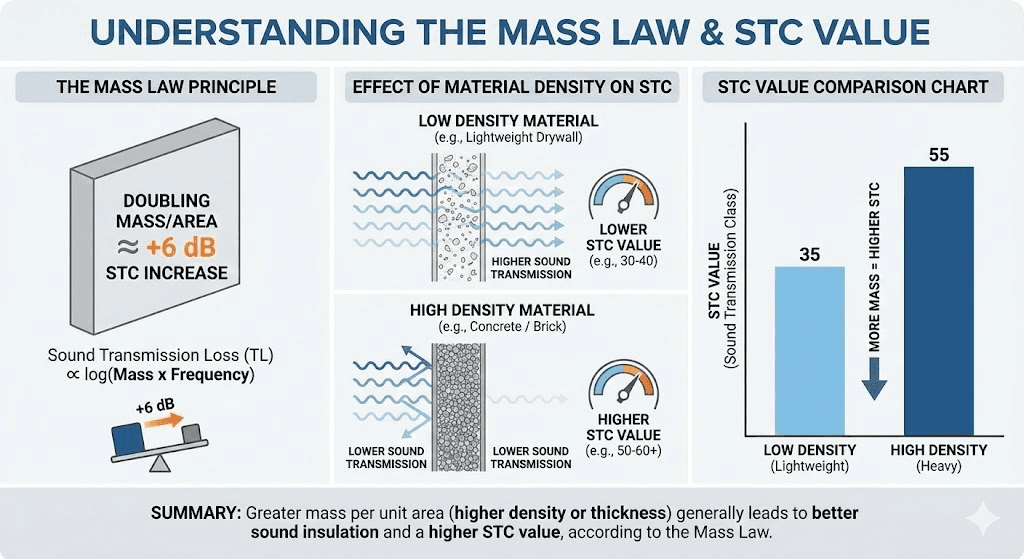
Standard acoustic theory relies heavily on the Mass Law, which states that for every doubling of a wall’s mass per unit area, the sound insulation increases by approximately 6 dB.
AAC is approximately 20% to 25% the weight of standard concrete. Because it is lightweight, it naturally struggles to compete with dense materials (like reinforced concrete or heavy brick) in blocking low-frequency energy. If you purely calculate based on mass, AAC performs poorly.
| Mass/Area Change | STC Increase |
| Doubling Mass/Area | ≈ +6 dB |
Summary: Greater mass per unit area (higher density or thickness) generally leads to better sound insulation and a higher STC value, according to the Mass Law.
How Does the “Damping” Advantage of AAC Work?
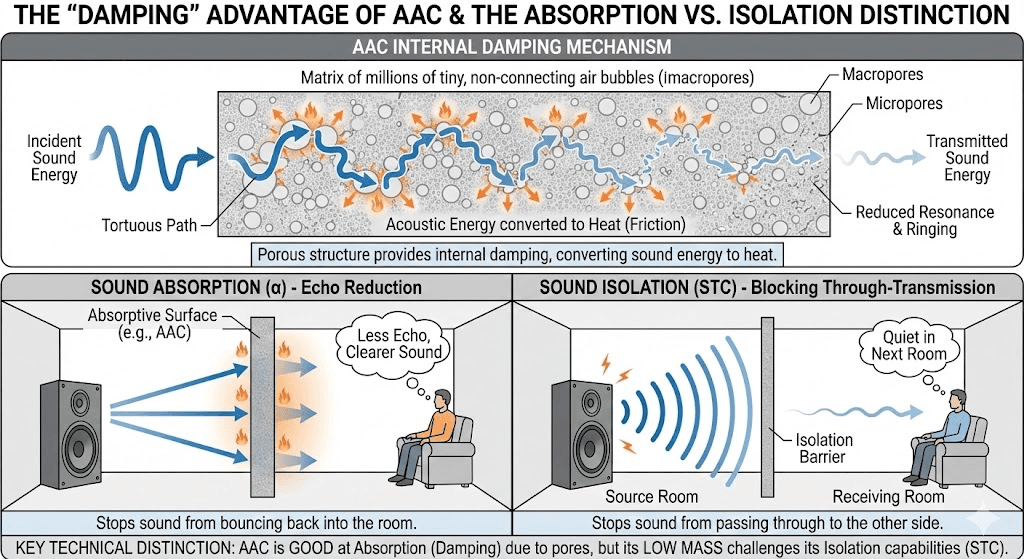
AAC constitutes a matrix of millions of tiny, non-connecting air bubbles (macropores) and micropores that provide internal damping, converting sound energy into heat through friction.
However, AAC is not just “light concrete.” This porous structure means AAC has significantly better Sound Absorption (α) than standard concrete. It reduces internal resonance and “ringing,” but absorption does not equal isolation.
Key Technical Distinction:
- Absorption: Stops sound from bouncing back into the room (Echo reduction).
- Isolation (STC): Stops sound from passing through to the other side.
AAC is good at absorption due to its pores, but its low mass challenges its isolation capabilities (STC).
The Verdict: Is a Single Leaf AAC Wall Enough?
A single layer of AAC, even when rendered, rarely achieves the comfortable STC 50+ threshold required for party walls because the lack of mass allows mid-to-low frequencies to transmit.
For a standard residential party wall, building codes typically mandate a minimum of STC 45, with STC 50+ being the preferred standard for occupant comfort. Let’s look at the numbers for a single leaf (one layer) of AAC:
| Wall Assembly | Approx. STC Rating | Suitability |
| 100mm Bare AAC Block | STC ≈ 36-38 | Fail. Speech clearly audible. |
| 100mm AAC + 10mm Plaster (Both sides) | STC ≈ 40-42 | Marginal. Acceptable for internal partitions, not party walls. |
| 150mm AAC + 10mm Plaster (Both sides) | STC ≈ 44-46 | Borderline. May meet minimum code, but complaints likely. |
Conclusion: The porous nature absorbs some high frequencies, but the lack of mass allows mid-to-low frequencies (like TV bass or male voices) to transmit.
When Should You Add Acoustic Insulation Layers?
To utilize AAC in a party wall, you must move away from a “mass barrier” approach and adopt a “Mass-Spring-Mass” principle to decouple the sides of the wall and trap sound in the middle.
Here are the scenarios where you must treat the AAC core with additional insulation or lining:
Scenario A: The Direct Stick (Laminate) Method
- Target: STC 50-55
- Method: Instead of wet plaster, adhere 10mm or 13mm plasterboard directly to the AAC using daabs of adhesive.
- Physics: The small air gap created by the adhesive daabs acts as a miniature spring, and the plasterboard adds a distinct vibrating layer different from the AAC resonance.
- Use Case: Budget-conscious projects needing to just cross the compliance threshold.
Scenario B: The Disconnected Liner (The Gold Standard)
- Target: STC 60+
- Method: Construct a 100mm AAC wall, but install a separate stud frame spaced 20mm off the face of the block. Fill the stud cavity with fibrous acoustic insulation (glass wool or rock mineral wool).
- Why Insulation Matters: The AAC block prevents direct sound transmission. The fibrous insulation in the cavity absorbs the cavity resonance that would otherwise amplify noise.
- Physics: This creates a massive decoupling. The sound must pass through:
- Plasterboard (Mass 1)
- Insulation/Air Gap (Spring/Absorber)
- AAC Block (Mass 2/Damping)
Scenario C: The Double Wall
- Target: STC 65+ (Cinema rooms, luxury separation)
- Method: Two leaves of 100mm AAC separated by a 50mm air gap containing acoustic batting.
- Physics: This eliminates mechanical bridging entirely. The porous AAC prevents standing waves inside the cavity better than dense concrete would, making this highly effective.
Conclusion
While AAC offers superior thermal performance and speed, it requires a strategic, multi-layered approach to meet modern acoustic standards. By applying the Mass-Spring-Mass principle through direct sticking or disconnected liners, developers can leverage the damping benefits of AAC while achieving the STC 50+ ratings necessary for high-quality party walls.
Frequently Asked Questions (FAQ)
How do service penetrations like electrical outlets affect the STC rating of an AAC wall?
Service penetrations are “acoustic leaks” that can drop an STC 50 wall down to STC 30 if not treated. You must use acoustic-rated backing boxes or fire-rated sealants and avoid placing outlets back-to-back in the same wall cavity to prevent a direct path for sound.
Does the type of plaster or render used change the acoustic performance?
Yes, a dense cement-based render adds more mass than a lightweight gypsum plaster, slightly improving isolation. However, the most significant gain comes from the sealing effect; because AAC is porous, a continuous coat of plaster seals the surface pores, preventing air (and sound) from leaking through.
What is the difference between “airborne noise” and “impact noise” in AAC?
STC measures airborne noise like voices or TV, while IIC (Impact Insulation Class) measures structure-borne noise like footsteps or dropped objects. While AAC is excellent at damping airborne sound, its rigid structure can still transmit impact vibrations, often requiring resilient mounts or underlays in flooring applications.
How does AAC handle low-frequency noise (subwoofers) compared to high-frequency?
AAC’s cellular structure is very effective at “trapping” high-frequency sounds, but its low mass makes it susceptible to low-frequency vibrations. For rooms with home theaters or heavy machinery, a decoupled “Mass-Spring-Mass” system is mandatory to stop those long, powerful sound waves from vibrating the entire wall.
Can I use spray foam instead of mineral wool in the “Mass-Spring-Mass” cavity?
Generally, no. Closed-cell spray foam is often too rigid and can create a “mechanical bridge” that transmits vibrations between the two layers. Open-fibrous materials like mineral wool or glass wool are preferred because they allow sound waves to pass through and dissipate as heat energy within the fibers.
What is “flanking transmission” and how do I prevent it in AAC builds?
Flanking is sound that travels around a wall through shared floor joists, ceilings, or side walls. In AAC construction, you prevent this by using acoustic breaks (resilient expansion joints) where the party wall meets the external leaf or floor slab to ensure the vibration doesn’t bypass your high-STC wall.
Does increasing AAC thickness alone eventually meet STC 50?
While increasing thickness helps, the law of diminishing returns applies; you would need a prohibitively thick and expensive single-leaf wall to hit STC 50. It is much more cost-effective and space-efficient to use a thinner 100mm AAC block combined with a decoupled plasterboard liner to achieve the same result.