
 English
 Arabic
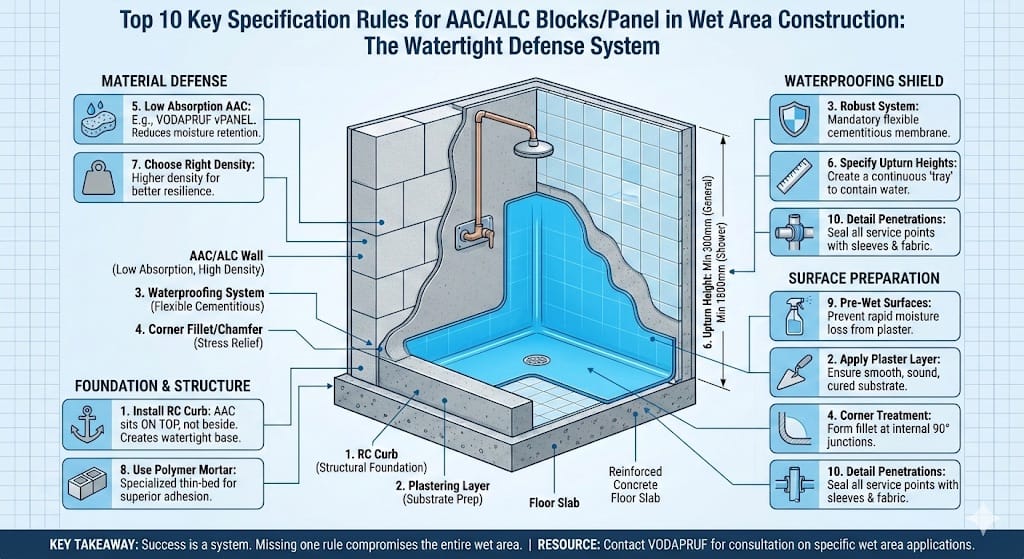
Key Takeaways
Structural foundation is critical: RC curbs must be installed before AAC walls to create a watertight barrier and prevent water tracking beneath walls.
Waterproofing is non-negotiable: High-quality cementitious waterproofing membranes with proper upturn heights (minimum 300mm general, 1800mm for showers) are essential for wet area protection.
Material quality matters significantly: Choosing low water absorption AAC/ALC products like VODAPRUF vPANEL can dramatically reduce moisture retention and prevent long-term damage.
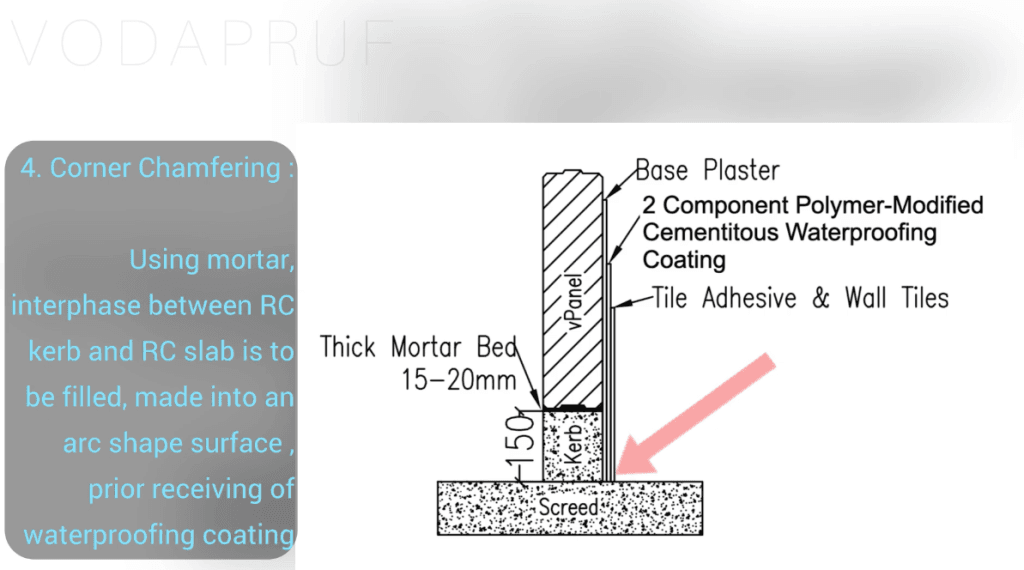
Proper substrate preparation prevents failure: Plastering layers and corner treatments (chamfers/fillets) ensure waterproofing membranes adhere correctly without tearing at stress points.
Penetration points are vulnerability zones: Service penetrations require specialized sealing with sleeves, non-shrinking sealants, and reinforcing fabric to maintain watertight integrity.
Introduction
Autoclaved Aerated Concrete (AAC) blocks and Aerated Lightweight Concrete (ALC) panels have revolutionized modern construction with their exceptional insulation properties, fire resistance, and lightweight characteristics. However, when these materials are used in consistently wet or high-moisture environments—such as bathrooms, kitchens, laundries, and exterior walls exposed to rain—the risk of moisture-related failures increases dramatically without proper specification and installation protocols.
The construction industry has witnessed numerous wet area failures caused by inadequate moisture management, leading to costly repairs, structural damage, and compromised building integrity. Whether you’re a contractor, architect, or building owner in Malaysia or Singapore, understanding these critical specification rules can mean the difference between a durable, watertight installation and a moisture-prone failure.
This comprehensive guide presents the top 10 specification rules that construction professionals must follow to ensure watertight design when using AAC/ALC blocks and panels in wet areas. These proven practices address everything from structural requirements and material selection to waterproofing application and service penetration detailing.
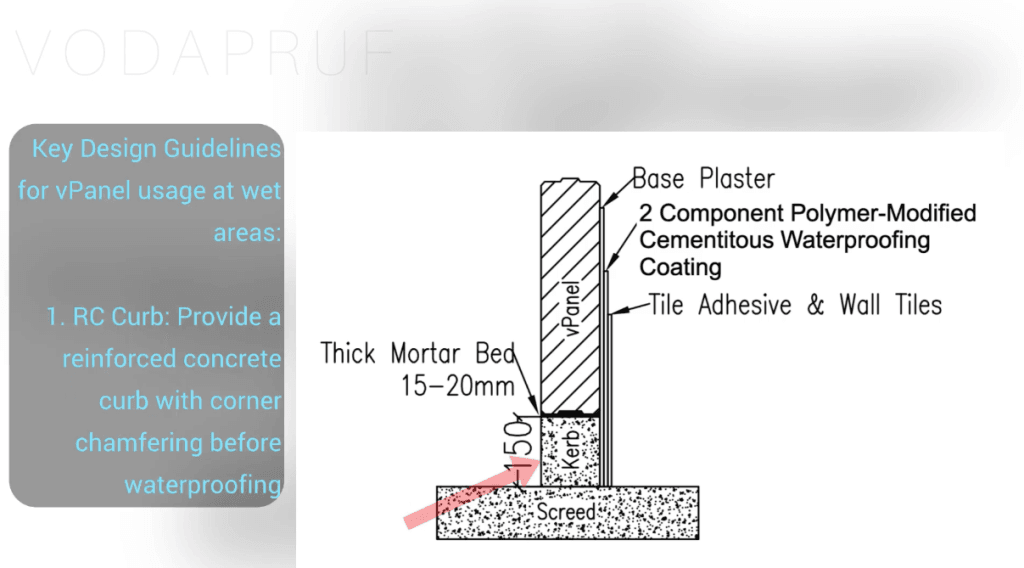
1. Structural Requirement: Installation of RC Curb
- Detail: The integrity of a wet area relies on a physical barrier to contain water at the floor perimeter.
- Action: A Reinforced Concrete (RC) curb must be cast and properly cured before the installation of any non-structural walling materials, such as AAC panels or blocks, is commenced. The AAC wall should sit on top of the RC curb, not beside it.
Purpose: The RC curb serves as a robust, non-absorbent, and structurally sound base for the waterproofing system to terminate against. It prevents water from tracking beneath the AAC wall and into adjacent dry areas, providing a foundational barrier for the entire wet area containment system.
2. Substrate Preparation: Plastering Layer over AAC
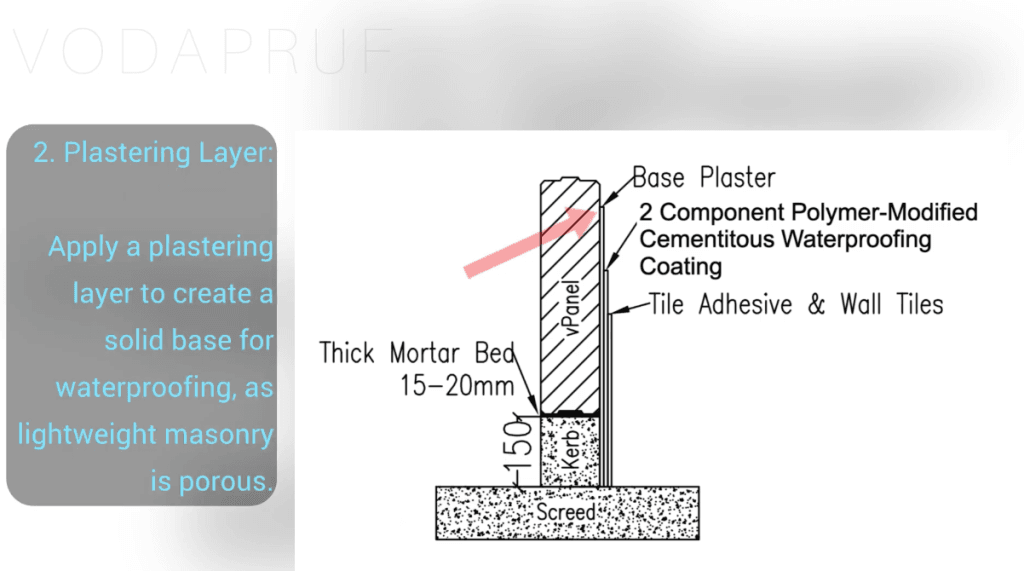
- Detail: AAC blocks/panels, after installation, often present an uneven, slightly dusty, and highly absorbent surface that is unsuitable for direct application of most liquid-applied waterproofing membranes.
- Action: A layer of cementitious plastering must be applied over the AAC substrate. This layer should be cured and dry before the waterproofing application.
- Purpose: The plaster provides a solid and sound substrate. It ensures the surface is smooth, clean, free of voids (pinholes), and has sufficient tensile strength for the waterproofing to adhere correctly and function without being compromised by movement or substrate imperfections.
3. Implement a Robust Waterproofing System (Mandatory)
AAC blocks are porous and not inherently waterproof. A comprehensive waterproofing system is non-negotiable for all wet areas:
- Application: Apply a high-quality, flexible cementitious waterproofing membrane across the entire surface of the AAC wall, especially in showers, around plumbing fixtures, and floor-to-wall junctions. Avoid using alternative waterproofing categories, such as Polyurethane or Acrylic-based products, as they may not achieve adequate adhesion to masonry substrates, or the subsequent tile finishing may encounter difficulties adhering to the surface.
- Coverage: Ensure the membrane extends sufficiently high (e.g., up to shower head level or at least 1800mm) and overlaps onto the floor membrane.
- Curing: Allow the membrane to cure fully as per the manufacturer’s instructions before tiling or cladding.
5. Material: Choose AAC/ALC that has low water absorption rate
- Detail: The success of the waterproofing system is highly dependent on the properties of the substrate material, especially when using Autoclaved Aerated Concrete (AAC) blocks or panels.
- Action: Specify and use an AAC/ALC product that is manufactured to have a low water absorption rate.
- Purpose: AAC/ALC is naturally porous. Using a low-absorbent type minimizes the amount of moisture the substrate will wick up. This reduces the risk of water retention in the walls, which can lead to blistering or premature failure of the external waterproofing layer, as well as interior dampness and efflorescence.
6. Waterproofing Upturn Height Specification
- Detail: The waterproofing membrane must not be terminated at floor level; it must be brought up the vertical surfaces (walls/curbs) to a specified height.
- Action:
- For general wet areas (e.g., toilets, kitchens): The waterproofing upturn must be a minimum of 300 mm from the finished floor level, conforming to standard building authority (e.g., BCA in Singapore) specifications.
- For dedicated shower areas: The waterproofing should extend up to a minimum of 1800 mm from the finished floor level (i.e., full height or near full height) to protect against splash and overspray.
- Purpose: The upturn acts as a continuous ‘tray’ to contain any water that penetrates the floor finish, preventing lateral seepage into adjoining dry areas or structural elements.
7. Choose the Right Density and Grade
AAC blocks are available in different densities. For wet areas, it is vital to:
- Specify a higher density grade: Denser AAC blocks generally exhibit lower water absorption and better compressive strength, making them more resilient to prolonged moisture exposure. Consult the manufacturer’s technical data for specific recommendations on minimum density for wet area applications.
- Ensure compliance: Verify that the blocks meet the relevant national or international standards for masonry units in wet applications.
8. Use Polymer Modified Thin-Bed Mortar
Standard sand-cement mortar is highly susceptible to water ingress and can weaken the bond with AAC.
- Adhesion: Use only specially formulated AAC thin-bed polymer-modified mortar. These mortars offer superior adhesion and are designed to work with the block’s inherent properties.
- Consistency: Ensure consistent application thickness (typically 3-10mm) to maintain structural integrity and minimize pathways for water penetration.
9. To Wet Block Surfaces Before Application
To prevent the plastering layer from losing moisture too quickly
- pre-wet AAC surfaces with water before applying tiles or render.
- Some users may even soak the AAC blocks in water before use.
10. Proper Detailing for Service Penetrations
Points where pipes or fixtures penetrate the wall are common failure points for moisture.
Sealing: Use non-shrinking, water-resistant sealants (e.g., polyurethane or silicone) and reinforcing fabric (bond breakers) around all penetrations underneath the main waterproofing layer to create a durable, watertight seal.
Sleeves: Install appropriate sleeves or boxes for all pipe and fixture penetrations before waterproofing.
Conclusion
Successful AAC and ALC block application in wet areas is not a matter of chance—it requires systematic attention to each of these ten critical specification rules. From the foundational structural requirement of RC curbs to the final detailing of service penetrations, every step builds upon the previous to create a comprehensive moisture management system.
The construction industry’s evolution toward lightweight, sustainable materials like AAC and ALC panels offers tremendous advantages in terms of energy efficiency, construction speed, and overall building performance. However, these benefits can only be realized when proper wet area specifications are implemented and rigorously followed.
For contractors, architects, and building owners throughout Malaysia and Singapore, the message is clear: invest in proper specification and execution of wet area AAC construction from the beginning. The modest additional cost of higher-grade materials like VODAPRUF vPANEL, quality waterproofing systems, and proper installation procedures is insignificant compared to the expense and disruption of wet area failures.
Contact VODAPRUF for comprehensive consultation on wet area AAC/ALC application specifications. Our team of technical specialists can provide project-specific guidance, product selection support, and installation best practices to ensure your wet area construction delivers lasting performance and watertight reliability.
This comprehensive guide reflects current industry best practices and building authority requirements for AAC/ALC wet area construction in Southeast Asia. Specifications should always be verified against local building codes and project-specific engineering requirements.