
 English
 Arabic
KEY TAKEAWAYS
- Material cost is only 40-50% of the story: When you factor in labor, timeline, and financing costs, ALC panels often deliver better total value for projects above 1,500m² despite 40-85% higher material prices.
- Installation speed creates 60-75% timeline savings: ALC panels complete 100m² walls in 2 days versus 5-7 days for AAC blocks, compressing project schedules by 2-4 months on typical industrial projects.
- Break-even happens at different project scales: For projects where delay costs exceed RM 3,000/day, ALC panels justify their premium above 1,000m² wall area; below this, AAC blocks remain more economical. Per truck load of 40ft lorry are able to carry 520 m2 of ALC Panel.
INTRODUCTION
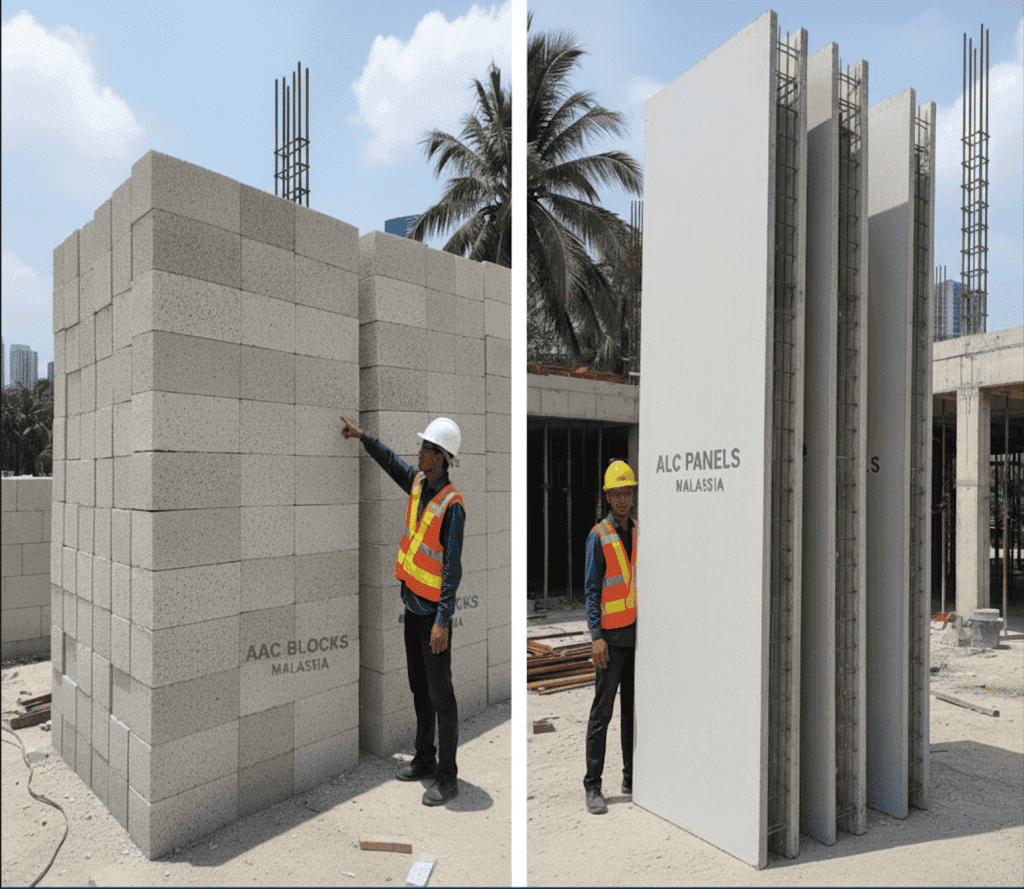
When a logistics company in Shah Alam completed their 3,500m² warehouse walls in just 35 days using ALC panels—saving 85 working days and avoiding RM 1.2 million in delay penalties—the project manager’s only regret was not knowing this option existed earlier.
Meanwhile, a factory developer in Senai successfully used AAC blocks for their 1,200m² project, staying within budget and meeting all deadlines with a 52-day installation timeline that fit their flexible schedule perfectly.
Both made the right choice. But how do you know which is right for your Malaysian construction project in 2025?
This guide provides the complete financial analysis, regional supplier information, and decision frameworks you need to choose between AAC blocks and ALC panels based on your project’s specific requirements—not generic advice, but real Malaysian market data from Johor Bahru to Kuala Lumpur to Penang.
HOW MUCH TIME DOES IT TAKE TO INSTALL 100M² WITH AAC BLOCKS VS ALC PANELS?
DIRECT ANSWER: Experienced crews install 100m² of AAC block walls in 5-7 working days with 6-8 workers, while the same area with ALC panels takes 1.5-2 working days with 4-5 workers—a 60-75% reduction in installation time.
AAC Block Installation Timeline (100m² Wall)
| TOTAL DURATION: 5-7 working days | Crew Requirements: | Critical Factors Affecting Speed: |
| Days 1-2: Foundation preparation, first courses, alignment (15-20m² daily) | 6-8 workers (2 skilled masons, 4-6 laborers) | Mortar curing time between courses |
| Days 3-5: Main wall construction with experienced crew (18-22m² daily) | Daily productivity: 15-20m² per day average | Block cutting and adjustment for openings |
| Days 6-7: Final courses, openings, quality checks (remaining area) | Weather-dependent: Rain delays common in Malaysian climate | Scaffolding repositioning & Weather interruptions |
ALC Panel Installation Timeline (100m² Wall)
| TOTAL DURATION: 1.5-2 working days | Crew Requirements: | Speed Advantages: |
| Day 1 Morning: Site prep, first panel row (40-50m²) | 4-5 workers (crane operator, 3-4 installers) | Large panel sizes cover the area quickly |
| Day 1 Afternoon: Second panel row (30-40m²) | Daily productivity: 50-60m² per day | No curing time delays |
| Day 2 Morning: Final row and connections (20-30m²) | Weather impact: Minimal if crane work is safe | Reduced scaffolding needs |
| Day 2 Afternoon: Quality verification and finishing touches | Precise factory dimensions |
Real Project Comparison: 1,500m² Industrial Wall
| AAC BLOCK PROJECT | ALC PANEL PROJECT | |
| Installation duration | 52 working days | 18 working days |
| Crew size | 8 workers | 5 workers |
| Total labor hours | 3,328 hours | 720 hours |
| Weather delays | 6 days lost to rain | 1 day (crane safety) |
| Budget | RM 78,000 total | RM 127,500 total |
TIME SAVINGS: 34 working days (65% reduction).
This 34-day difference translated to RM 850,000 in additional value: earlier occupancy, faster revenue generation, reduced financing costs, and avoided delay penalties.
Supplier Selection Checklist
When evaluating suppliers, verify:
- CIDB IBS certification for IBS scoring eligibility
- SIRIM testing certificates (MS 2514 compliance)
- Fire resistance certification (2-4 hour rating)
- Delivery reliability and lead time guarantees
- Technical support availability for installation questions
- Batch testing documentation for quality assurance
- Return/replacement policy for damaged materials
Real Decision Examples
Example 1: 900m² Factory Extension, Senai
- Design Status: 95% final
- Timeline: Flexible (90-day window)
- Delay Cost: RM 1,200/day
- DECISION: AAC Blocks
- Reasoning: Project scale below break-even, timeline value insufficient to justify panel premium
Example 2: 3,200m² Warehouse, Shah Alam
- Design Status: 100% final
- Timeline: Critical (penalty RM 5,000/day after 120 days)
- Delay Cost: RM 4,500/day
- DECISION: ALC Panels
- Reasoning: Large scale + high delay cost + design certainty = clear panel advantage; timeline compression worth RM 127,500 vs RM 78,000 material difference
EXAMPLE 3: 1,300m² Office Building, Penang
- Design Status: 85% final (tenant fit-out pending)
- Timeline: Moderate pressure
- Delay Cost: RM 2,200/day
- DECISION: AAC Blocks
- Reasoning: Design uncertainty + moderate scale + panel logistics challenges in Penang = blocks preferred despite moderate timeline value
CONCLUSION
Choosing between AAC blocks and ALC panels for your Malaysian construction project isn’t about which material is universally “better”—it’s about which aligns with your specific project’s priorities, scale, and constraints.
The fundamental insight: Material cost represents only 40-50% of the true economic picture. When you account for financing costs, site overhead, labor market dynamics, delay risks, and revenue timing, ALC panels often deliver 2-5x better total value despite their 35-55% material premium—but only for projects above 1,500m² where timeline value exceeds RM 3,000 per day of savings.
For projects under 1,000m² walls, AAC blocks remain economically optimal unless specialized requirements (precision equipment, extreme timeline pressure, critical sound isolation) specifically demand panel performance. The material cost savings, design flexibility, and contractor familiarity make blocks the rational choice for small-scale construction.
For projects above 2,000m² walls, ALC panels typically deliver superior economics when timeline matters. The 60-75% installation time reduction cascades through entire project schedules, compressing timelines by 3-4 months and eliminating delay risks worth RM 200,000-800,000 on typical commercial and industrial projects.
FOR ALC PANEL PROJECTS REQUIRING EXPERT SUPPORT:
Contact Vodapruf at vodapruf.com for:
- Project-specific cost and timeline analysis
- Installation training for your crews
- Engineering consultation for connection design
- Complete CIDB/IBS documentation support
- Delivery coordination across Johor, KL, Penang, and Singapore
Vodapruf’s comprehensive technical support ensures successful implementation, particularly valuable for contractors new to panel systems or projects requiring precise execution.
The right material choice, informed by complete economic analysis and regional supplier realities, sets the foundation for project success. Make your decision based on total value, not just upfront costs—your project timeline, budget, and stakeholders will thank you.
FREQUENTLY ASKED QUESTIONS
Can I mix AAC blocks and ALC panels in the same project?
Yes, hybrid approaches work well when strategically planned: use ALC panels for main structural walls requiring speed and precision (exterior walls, long spans, load-bearing elements), while using AAC blocks for partition walls, small sections, and areas requiring design flexibility. This optimizes both cost and timeline. However, mixing requires careful coordination: ensure compatible connection details between systems, plan material deliveries to match installation sequence, coordinate different crew types and skills, and maintain consistent finishing standards. Many Malaysian industrial projects successfully use panels for perimeter walls (fast enclosure, weather protection) and blocks for interior partitions (flexibility, cost savings). Vodapruf’s technical team can help design hybrid systems, particularly valuable for phased projects or complex facilities.
What special equipment is needed to install ALC panels compared to AAC blocks?
ALC panel installation requires lifting equipment (crane, forklift, or hoist) for positioning panels, but most other tools are standard construction equipment. You’ll need a crane or forklift rated for panel weight (typically 150-300 kg per panel depending on size), temporary bracing systems for stabilization during installation, standard power drills for connection work, grouting equipment for joints, and safety equipment for working at height. Most contractors already own or can easily rent these tools—the main investment is crew training, which Vodapruf provides as part of their technical support package, typically requiring 1-2 days for experienced construction workers to become proficient.
How do I calculate the exact number of AAC blocks needed for my project?
Calculate AAC block quantity using this formula: (Wall area in m² × 8.3 blocks per m²) + 5-10% wastage allowance for cutting and breakage. For example, a 100m² wall requires approximately 830-915 blocks (100 × 8.3 = 830, plus 5-10% = 872-915 blocks). This formula assumes standard 600×200×150mm blocks, which is the most common size in Malaysia—if using different dimensions, recalculate based on block area (0.12m² per standard block = 8.3 blocks per m²). For complex walls with many openings (doors, windows), first subtract opening areas from total wall area, then apply the formula.
Will ALC panels become cheaper in Malaysia as adoption increases over the next 3-5 years?
ALC panel prices will likely decrease moderately (10-20%) over the next 3-5 years as Malaysian adoption increases, but they will remain premium-priced compared to AAC blocks due to fundamental manufacturing economics. Factors supporting price reduction include increased local production capacity, manufacturing scale economies, improved distribution networks, and competitive pressure as more suppliers enter. However, panels will maintain a premium because they require more sophisticated manufacturing equipment, and their value proposition (speed, precision) supports premium pricing. The more significant trend is that total cost of ownership advantages will strengthen as Malaysian labor costs continue rising 8-12% annually, making panels’ reduced labor requirements increasingly valuable even if material prices only decline modestly.